Why SMEs adopt AI tools: the real drivers in 2026


AI adoption among small and mid-sized businesses has moved far beyond early experimentation. 76% of small business owners were already using AI by 2026, with regular use rising from 40% in 2024 to 69% in early 2026. Yet the question of why SMEs adopt AI tools is rarely answered with the specificity business owners actually need. This article cuts through the noise: what is genuinely motivating adoption, what benefits are materialising, what barriers still exist, and how you can apply AI tools in a way that produces measurable returns rather than wasted spend.
Table of Contents
- Key takeaways
- Why SMEs adopt AI tools: the core motivations
- Tangible benefits SMEs report from AI adoption
- Barriers and AI adoption challenges for SMEs
- Practical approaches to AI integration for SMEs
- My perspective on what SME AI adoption actually requires
- How Meethayat helps SMEs integrate AI with confidence
- FAQ
Key takeaways
| Point | Details |
|---|---|
| Adoption is accelerating fast | Regular AI use among small businesses nearly doubled between 2024 and early 2026. |
| Cost and efficiency lead the motivation | Inventory, customer service, and marketing automation deliver the clearest early returns for SMEs. |
| The literacy gap is the real barrier | Most SME owners struggle not with cost but with knowing which AI applications are worth pursuing. |
| Workflow redesign matters as much as tooling | Layering AI onto broken processes delivers poor results; document workflows first, then automate. |
| Start small, measure everything | Pilot projects with clear metrics build internal confidence and sustain momentum for broader adoption. |
Why SMEs adopt AI tools: the core motivations
The motivations behind AI adoption in small and mid-sized businesses are not abstract. They are grounded in specific operational pressures that owners face every day.
Operational efficiency and cost reduction sit at the top of the list for most SMEs. Repetitive tasks, inventory management errors, and manual data entry consume disproportionate time in smaller operations where every hour has a direct cost. AI tools applied to these areas produce fast, quantifiable results. Machine learning forecasting reduces inventory costs by 20 to 50% and cuts stockouts by 65%, outcomes that matter acutely to product-based SMEs managing tight margins.
Customer experience and responsiveness represent the second major driver. Customers now expect responses within minutes, not hours. AI-powered customer service tools handle first contact around the clock without requiring additional headcount. For a 15-person business competing against much larger firms, that parity is strategically valuable.
Competitive positioning is increasingly cited as a motivation, particularly in sectors where larger players have already adopted AI tools. SME owners recognise that standing still is itself a decision with consequences.
Key motivations reported by SME owners include:
- Reducing staff time spent on routine administrative tasks
- Improving speed and consistency of customer communications
- Generating and scheduling marketing content at lower cost
- Automating financial reconciliation and cash flow monitoring
- Gaining data-driven insight into sales trends without a dedicated analyst
Pro Tip: Before evaluating any AI tool, write down the three tasks in your business that consume the most time relative to their value. That list is your AI adoption roadmap.
Tangible benefits SMEs report from AI adoption
The case for why small businesses use AI becomes clearest when you examine the data on outcomes already being reported.
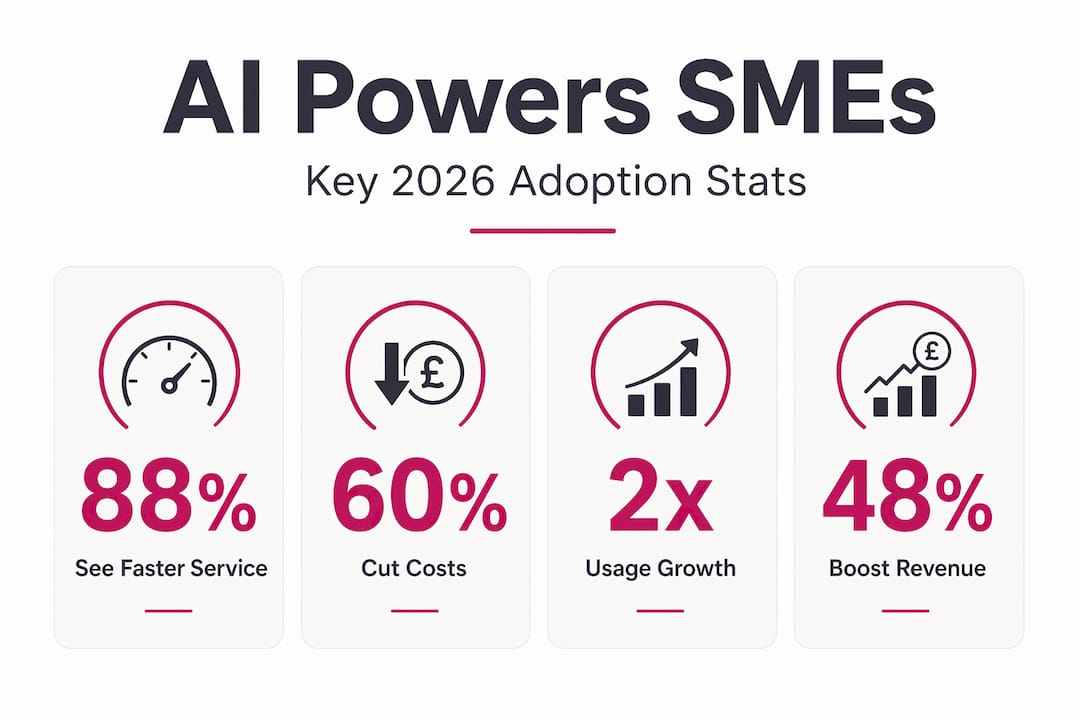
AI customer service agents cut first-response times by 80 to 90% and deflect 40 to 60% of routine enquiries entirely. For a small e-commerce or professional services firm, that deflection rate translates directly into reduced support costs and faster resolution for customers with complex needs. The human team concentrates on high-value interactions rather than answering the same ten questions repeatedly. You can read more about this dynamic in this practical guide on automating customer support.

| AI application | Reported benefit | Relevant SME function |
|---|---|---|
| Inventory forecasting (ML-based) | 20, 50% cost reduction, 65% fewer stockouts | Retail, wholesale, manufacturing |
| AI customer service agents | 80, 90% faster first response, 40, 60% query deflection | E-commerce, hospitality, professional services |
| Marketing automation | 30, 40% time reduction in content production | Marketing, sales |
| Accounting AI (e.g. Xero, QuickBooks AI) | Faster reconciliation, reduced human error | Finance, administration |
| AI scheduling and calendar tools | Reduced no-shows, optimised appointment density | Health, consulting, trades |
Beyond time and cost metrics, SME owners report revenue-correlated benefits. Businesses that use AI for personalised marketing see higher conversion rates due to more targeted outreach. Those that apply AI to financial forecasting gain earlier visibility into cash flow stress, allowing corrective action before a problem becomes a crisis.
Pro Tip: Track one metric per AI tool you deploy: response time, cost per enquiry, or hours saved per week. Without a baseline, you cannot build the internal business case to expand adoption.
SMEs adopting AI through tools already embedded in software they use, such as Microsoft Copilot, Google Workspace AI, or Intuit’s AI features, report smoother adoption because staff do not need to learn an entirely new system. Familiarity reduces resistance and accelerates time to value.
Barriers and AI adoption challenges for SMEs
Despite the clear benefits, only 14% of small businesses have fully integrated AI into their core operations. While 92% plan to use AI, fewer than half have a formal AI policy in place. The gap between intention and execution is real, and understanding it is the first step to closing it.
The barriers SME owners most frequently encounter are:
- AI competence gap. The literacy gap is a larger obstacle than tool cost. Many owners cannot confidently evaluate which AI use cases will deliver value in their specific context, which leads to paralysis or poorly targeted spending.
- Data privacy and security concerns. SMEs handling client data, commercially sensitive information, or personal records worry about where their data goes when using third-party AI platforms. This is a legitimate concern, not a perception problem.
- Absence of formal AI strategy. Without a defined approach, AI adoption becomes reactive, one tool bought here, a subscription added there, with no coherent measurement or governance.
- Integration complexity. Connecting a new AI tool to existing systems (CRMs, ERPs, accounting platforms) requires technical work that many SMEs do not have in-house.
- Employee anxiety. Staff concern about job security when AI is introduced can create quiet resistance that undermines even well-designed implementations.
“The main barrier to AI adoption in small businesses has shifted from cost to competence. Monthly AI spending has declined as tools become more affordable, but knowing how to identify and implement valuable AI use cases remains the central challenge.”, JPMorgan Chase Institute
On the privacy question specifically, using enterprise-grade private AI instances protects proprietary data and reduces exposure risk considerably. This approach is now accessible even at SME budget levels. Pairing that with a written AI policy (even a one-page document covering acceptable use, data handling, and output review requirements) addresses both the legal and cultural dimensions of the concern.
Starting small with simple, high-impact AI applications and supporting staff with targeted training can double weekly AI use rates and meaningfully reduce job anxiety. The evidence is clear: inclusion in the adoption process, rather than top-down imposition, changes the outcome.
Practical approaches to AI integration for SMEs
Knowing the motivations and barriers is only useful if it leads to action. The following structured approach reflects what actually works for SMEs integrating AI into operations.
- Map your existing workflows before selecting tools. Documenting current manual workflows to identify bottlenecks is more effective than blanket AI application. Tools such as Scribe allow you to record processes step-by-step, which then reveals where automation produces the highest return.
- Prioritise by pain point severity. Score each process by time consumed, error frequency, and cost impact. Begin AI adoption where the intersection of these three is highest.
- Leverage AI already inside your current software. Before adding new subscriptions, activate the AI features within platforms you already pay for. Microsoft 365 Copilot, Google Gemini integration, and Xero’s AI reporting tools are already included in many SME software plans.
- Run a focused pilot. Select one process, one team, and one measurable outcome. Run the pilot for 30 to 60 days with a defined success criterion before expanding.
- Train for the specific use case, not AI in general. Generic AI training rarely changes behaviour. Showing a customer service team exactly how to use an AI tool to draft responses, review them, and send faster produces immediate competence gains.
- Measure, report, and iterate. Set a monthly review cadence. Share the results with your team. Visibility of progress sustains motivation and builds organisational confidence in the technology.
The comparison below illustrates the difference between reactive and strategic AI adoption:
| Approach | Reactive AI adoption | Strategic AI adoption |
|---|---|---|
| Tool selection | Based on peer recommendation or advertising | Based on mapped workflow pain points |
| Integration | Standalone, disconnected from existing stack | Connected to CRM, accounting, or ops systems |
| Staff involvement | Announced after decision | Involved in pilot design |
| Success measurement | Subjective (“feels faster”) | Defined metrics tracked monthly |
| Outcome | Low utilisation, abandoned tools | Sustained use, measurable ROI |
AI success in SMEs depends on dynamic organisational capabilities and redesigned workflows, not just technology acquisition. Buying a tool is not adoption. Changing how work gets done is.
Pro Tip: If an AI tool does not have a measurable effect within 60 days of active use, it is either solving the wrong problem or has not been integrated into the actual workflow. Revisit the process design, not just the tool settings.
For context on what different types of AI support look like in practice, the comparison between an AI agent operator and consultant is worth reading before you decide what kind of help your business actually needs.
My perspective on what SME AI adoption actually requires
In my experience working with SMEs as both a CFO and an AI agent operator, the businesses that achieve durable results from AI are not the ones with the largest budgets or the most technically sophisticated founders. They are the ones that treat organisational readiness as seriously as tool selection.
I have seen owners spend months evaluating AI platforms and then deploy them into workflows that were already broken. The AI does not fix the broken process. It accelerates it, and usually makes the dysfunction more visible and more costly. The discipline of documenting and cleaning up a workflow before automating it is unglamorous work, but it is where the real return lives.
The cultural dimension is equally underestimated. Staff who understand why AI is being introduced, and who had some voice in how it is implemented, adopt it consistently. Staff who had AI dropped on them from above use it occasionally, reluctantly, and often incorrectly. The difference in outcomes between those two groups is stark.
What I would tell any SME owner right now: do not wait for a perfect strategy before starting. Pick one high-cost, high-repetition task. Build a small pilot. Measure it honestly. The confidence that comes from a single documented win changes the internal conversation about AI far more than any external case study ever could.
, Hayat
How Meethayat helps SMEs integrate AI with confidence
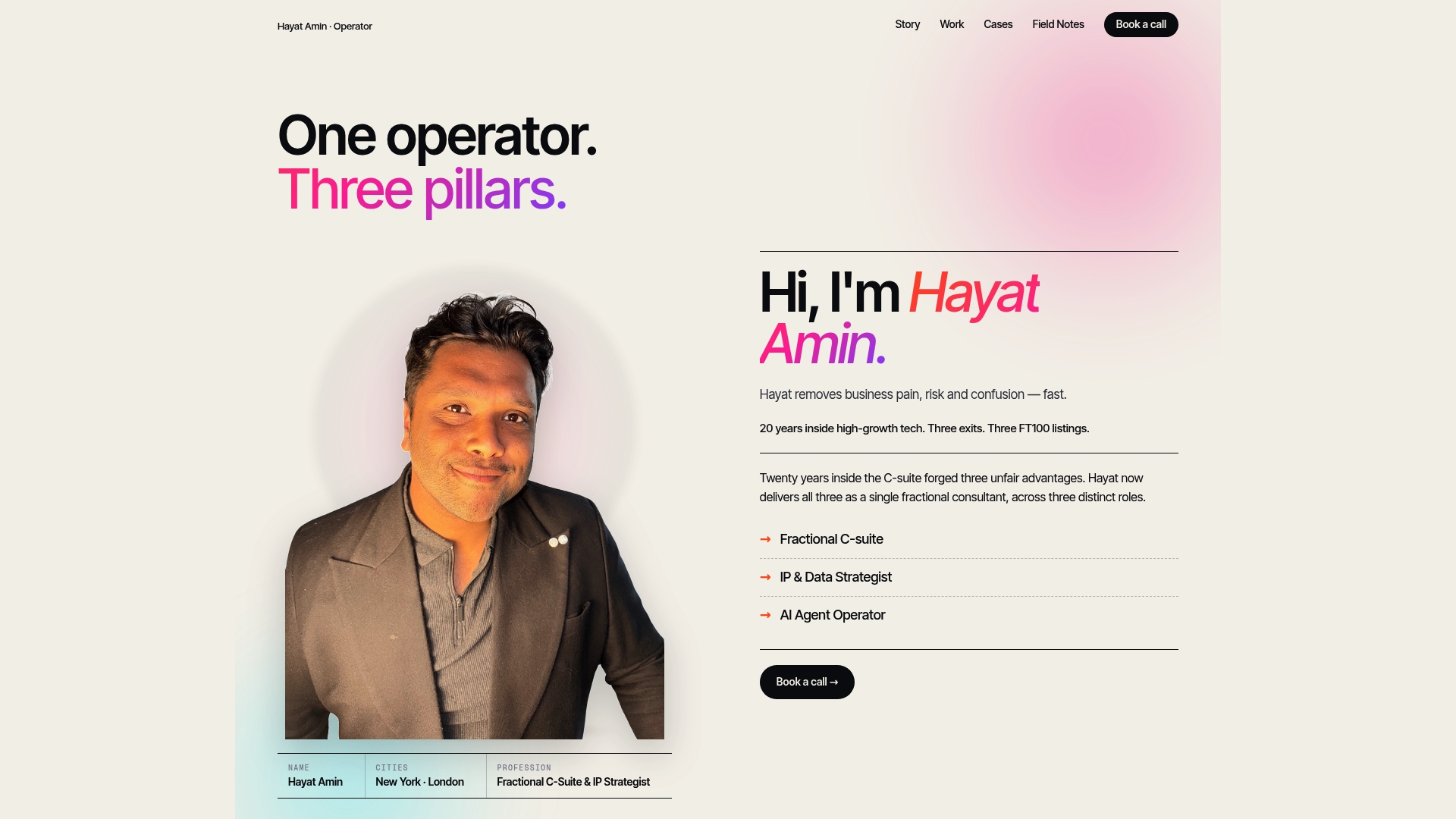
If the practical steps above reflect challenges you recognise in your own business, Meethayat offers direct support for SMEs at exactly this stage of the adoption process. As an AI agent operator with a background as a three-times exited CFO, Hayat Amin builds and operates agentic systems tailored to SME workflows in finance, legal, and go-to-market functions.
The work is specific: identifying the right AI applications for your operational context, designing the agentic stack, integrating it with your existing systems, and measuring outcomes against defined targets. No generic software recommendations. No disconnected tooling. Explore the AI agent operator services to understand what a fully operated AI implementation looks like in practice, or read the 2026 founder playbook on hiring an AI agent operator to clarify what role you actually need before you start.
FAQ
Why do SMEs adopt AI tools more now than before?
The cost of capable AI tools has declined significantly, and the tools themselves are now embedded in software SMEs already use. Regular AI use rose from 40% to 69% among small businesses between 2024 and early 2026, driven primarily by the accessibility and measurable operational returns of modern AI applications.
What is the biggest challenge SMEs face when adopting AI?
The primary challenge is not cost. It is competence in identifying which AI use cases will generate real value and knowing how to implement them effectively within existing operations.
How should SMEs start with AI to avoid wasted spend?
Start with workflow documentation to identify the highest-cost, most repetitive processes, then select one AI application to pilot against a defined metric. Documenting workflows first before automating produces significantly better outcomes than selecting a tool and retrofitting it to existing processes.
Are AI tools safe for SMEs handling sensitive client data?
Yes, provided the right configuration is used. Enterprise-grade private AI instances prevent data from being used to train third-party models and significantly reduce exposure risk. Pairing these with a written AI policy gives SMEs both technical and governance protection.
Do SME staff need extensive AI training to see results?
No. Training focused on a specific tool and a specific task produces faster and more lasting results than broad AI literacy programmes. Targeted training on high-impact use cases can double weekly AI use rates and reduce employee anxiety about the technology significantly.