What is tool-calling in AI: a 2026 guide


Tool calling in AI is defined as the mechanism by which a language model generates structured requests to invoke external functions, APIs, or systems rather than producing plain text alone. The formal industry term is “function calling,” though “tool calling” has become the dominant phrase across most platforms and documentation. Understanding tool-calling in artificial intelligence matters because it is the capability that transforms a passive text generator into an active agent. The model does not execute code itself. It produces a structured intent, and a separate runtime handles the actual execution. This distinction is foundational to every serious AI tool integration built today.
What is tool-calling in AI and how does it work?
Tool calling functions as a parse-execute loop where the AI model generates structured JSON and the runtime validates and executes it. The model never touches external systems directly. It produces a description of what it wants done, and the surrounding infrastructure does the work.
The process follows four clear steps:
- Intent generation. The model reads the user’s request and decides which tool to call. It outputs a JSON object containing the function name and the required arguments.
- Validation. The runtime receives the JSON and checks it against the tool’s schema before any execution begins.
- Execution. The runtime calls the actual function, whether that is a weather API, a database query, or a command sent to an external application.
- Result return. The output is passed back to the model, which incorporates it into its next response or triggers another tool call.
Developers treat the AI model as a stateless dispatcher issuing remote procedure calls within a safe runtime. This mental model matters because it clarifies where responsibility lies. The model picks the function and fills the arguments. The runtime deserialises, executes, and returns results. Confusing these two roles is the most common source of security errors in early-stage agentic builds.
Pro Tip: Treat every tool call as an untrusted network request. The model’s JSON output is user-supplied data from the runtime’s perspective. Validate it before execution, every time.

How does tool calling differ from structured output and function calling?
These three terms cause genuine confusion, even among experienced developers. The distinctions are real and operationally significant.
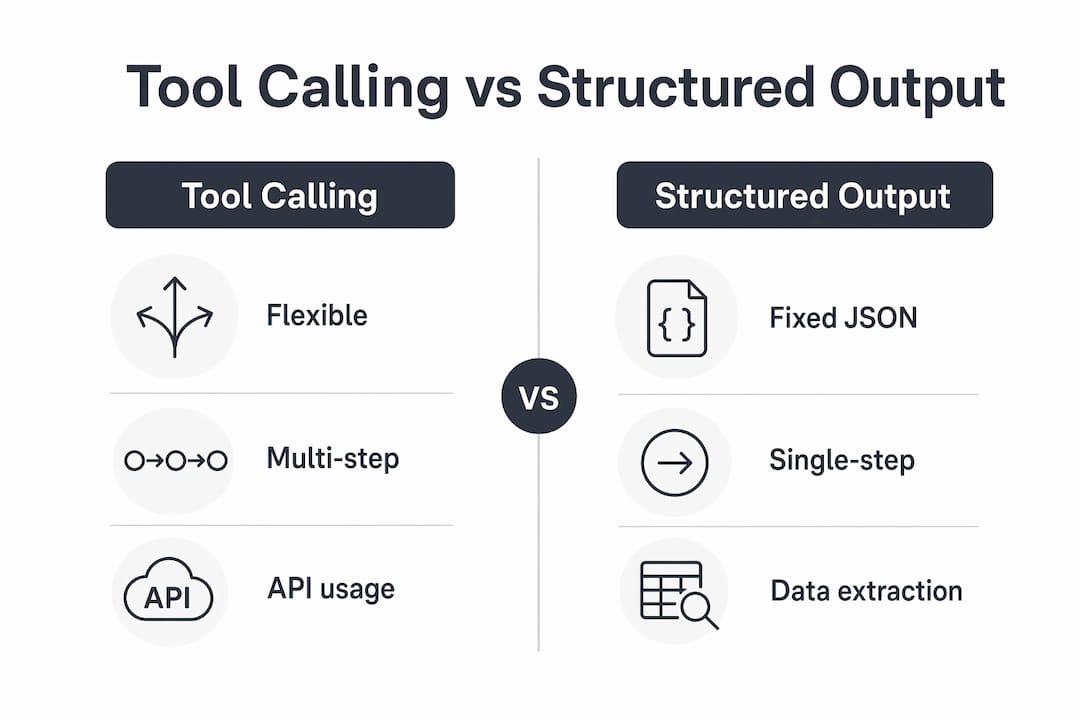
Tool calling differs from structured output in a fundamental way. Structured output enforces a fixed JSON shape on the model’s response. It is a one-shot constraint. Tool calling, by contrast, supports a request and response loop, allowing the model to call multiple functions across multiple steps to solve a complex problem.
| Concept | Behaviour | Primary use case | Flexibility |
|---|---|---|---|
| Structured output | Returns a fixed JSON schema in one response | Data extraction, form filling | Low |
| Function calling | Model requests a named function with arguments | Single-step external actions | Medium |
| Tool calling | Multi-step, interactive function request loop | Agentic workflows, automation | High |
Function calling is best understood as a subset or synonym of tool calling. The terminology evolved as platforms expanded beyond single-function invocations to multi-tool orchestration. Most major model providers now use “tool calling” as the preferred term, though the underlying mechanism is the same core principle.
Pro Tip: If your pipeline needs a single, deterministic JSON extraction, use structured output. If the model needs to decide which action to take and may need several steps, use tool calling.
What are the practical applications of tool calling in AI?
Tool calling is the key technology that turns text-based AI into functional, action-capable agents enabling automation well beyond chat. The practical range is wide, and the most compelling examples involve multi-step reasoning.
Common tool-calling examples in production environments include:
- Live data retrieval. The model calls a weather API, a stock price feed, or a news aggregator to answer questions that require current information.
- Database operations. The model queries or updates a CRM, an ERP, or a financial ledger based on user instructions.
- Email and calendar management. An AI scheduling assistant uses tool calls to read availability, create events, and send confirmations without human intervention.
- Workflow automation. Multi-step pipelines trigger sequences of tool calls across different systems, such as pulling invoice data, reconciling it against a ledger, and flagging discrepancies.
- Sales and client interactions. AI agents in B2B sales use tool calls to look up prospect data, personalise outreach, and log activity to a CRM in real time.
The most sophisticated pattern is the ReAct loop (Reasoning and Acting), where the model alternates between reasoning about a problem and calling tools to gather information. A single user request can trigger five or more sequential tool calls before a final answer is produced. This is how AI-driven revenue operations platforms handle complex, multi-system workflows without a human in the loop.
Only 18% of enterprise users interact with AI assistants weekly, with the top 5% of power users generating 12 times more conversations than the bottom 50%. This concentration shows that tool calling’s full value is currently captured by a small group of technically fluent users. Organisations that invest in training and tooling will close that gap quickly.
Security, validation, and best practices for tool calling
Security is the area where most early implementations fail. The model’s output is not trustworthy at the execution boundary. It must be treated as untrusted input.
Rigorous validation and sandboxing around tool calls prevent injection attacks and failures caused by hallucinated or malformed AI outputs. The model can generate plausible-looking but entirely incorrect arguments. Without validation, those arguments reach your database or API.
Core best practices:
- Validate with Pydantic. Use Pydantic (Python) or an equivalent schema validation library to enforce argument types and ranges before any tool executes. This catches hallucinated values before they cause damage.
- Sandbox execution. Run tool calls in isolated environments. The sandbox prevents a malformed call from affecting adjacent systems or leaking data.
- Sanitise database inputs. Never allow the model’s output to reach a database query without prior sanitisation. SQL injection via AI-generated arguments is a real attack vector.
- Use Tool RAG for large inventories. Tool RAG dynamically selects relevant tools from large libraries, preventing the model from being overwhelmed by irrelevant tool descriptions. Accuracy improves when the model only sees the tools it needs.
- Apply forced tool invocation for deterministic pipelines. Forced tool invocation enables deterministic pipelines with consistent output formats regardless of input variability. Use it in structured data extraction to guarantee results consistency in production.
Pro Tip: Log every tool call with its input arguments and the returned result. This audit trail is your first line of defence when debugging unexpected agent behaviour or investigating a security incident.
The RPC (Remote Procedure Call) paradigm is the correct mental model for this layer. The model is a client. The tool is a server. Every interaction should be governed by the same discipline you would apply to any external API call in a production system.
What are the challenges and future directions for tool calling?
Tool calling is powerful, but the current state of the technology carries real limitations that practitioners need to understand.
Key challenges include:
- Hallucinated arguments. The model can generate syntactically valid JSON with semantically wrong values. A date field might contain a plausible but incorrect date. Validation catches this, but it adds engineering overhead.
- Tool inventory management. As the number of available tools grows, the model’s ability to select the correct one degrades. Tool RAG addresses this, but it adds architectural complexity.
- Security surface area. Each tool call is a potential attack vector. Prompt injection attacks can manipulate the model into calling unintended tools or passing malicious arguments.
- Enterprise adoption gaps. The concentration of usage among power users means most organisations are not yet extracting value from tool calling at scale. Governance frameworks and monitoring are underdeveloped in most enterprise deployments.
- Orchestration complexity. Multi-step ReAct loops are difficult to debug. When a five-step tool chain fails, identifying which step introduced the error requires structured logging and observability tooling.
The trajectory is clear. AI workflow automation platforms are building more sophisticated orchestration layers that abstract away much of this complexity. Model providers are improving native tool selection accuracy. The role of AI in software development will increasingly depend on reliable, auditable tool calling as agentic systems move into production environments.
Key takeaways
Tool calling is the foundational mechanism that converts language models from text generators into active agents capable of executing real-world tasks through structured, validated, and sandboxed function calls.
| Point | Details |
|---|---|
| Core definition | Tool calling is a parse-execute loop where the AI generates JSON intent and the runtime executes it. |
| Structured output vs tool calling | Structured output produces a fixed one-shot JSON; tool calling supports multi-step interactive function loops. |
| Security is non-negotiable | Validate all AI-generated arguments with Pydantic and sandbox every execution before it reaches a live system. |
| Power user concentration | The top 5% of enterprise AI users generate 12 times more interactions, showing tool calling’s value is unevenly distributed. |
| Tool RAG for scale | Dynamically selecting relevant tool descriptions prevents model overload and improves accuracy in large tool inventories. |
Why tool calling is the most consequential AI capability right now
I have built and operated AI agents across finance, legal, and GTM functions for SMEs. The single capability that separates a genuinely useful agent from an expensive chatbot is tool calling. Without it, the model can only describe what should happen. With it, the model can make it happen.
What I find underappreciated is how much the security layer matters for enterprise trust. Organisations that deploy tool-calling agents without proper validation and sandboxing are not just taking a technical risk. They are taking a reputational one. A hallucinated argument that corrupts a financial record or sends an unintended communication is a governance failure, not just a bug.
The mental model shift is also harder than most technical documentation acknowledges. Treating the AI as a stateless dispatcher, rather than an intelligent actor, requires developers to rethink where trust lives in the system. That shift takes time and deliberate practice.
The upside is substantial. Tool calling enables AI to break out of the chat window and interact with real-world software and APIs, driving next-generation automation systems. For any organisation serious about AI adoption, understanding this capability is not optional. It is the foundation everything else is built on.
, Hayat
Meethayat’s AI agent operator services
Meethayat builds and operates AI agents for SMEs that use tool calling to automate real workflows across finance, legal, and commercial functions. These are not proof-of-concept deployments. They are production systems with validation layers, audit trails, and governance built in from day one.

If you are evaluating whether to hire an AI agent operator or consultant, Meethayat’s guide covers the distinction in detail and helps you identify which engagement model fits your organisation’s maturity and objectives. For organisations ready to deploy, the AI agent operator services page outlines how Meethayat designs and runs agentic stacks tailored to your specific operational context.
FAQ
What is tool calling in AI in simple terms?
Tool calling is when an AI model generates a structured request to use an external function or API, rather than answering in plain text. The model describes what it wants done, and a separate runtime executes it.
Is function calling the same as tool calling?
Function calling and tool calling refer to the same core mechanism. “Tool calling” is the more current term, reflecting the expansion from single-function invocations to multi-step, multi-tool agentic workflows.
How does tool calling differ from structured output?
Structured output enforces a fixed JSON shape on a single response. Tool calling supports a multi-step request and response loop, allowing the model to call several functions sequentially to complete a complex task.
What are the main security risks in tool calling?
The primary risks are hallucinated arguments reaching live systems, prompt injection attacks, and unsanitised inputs hitting databases. Validation with libraries like Pydantic and sandboxed execution are the standard mitigations.
Why do only a small number of enterprise users use tool calling heavily?
Only 18% of enterprise users interact with AI assistants weekly, and tool calling requires technical fluency to implement and govern. Most organisations lack the tooling, training, and governance frameworks to deploy it at scale.