What is explainable AI? A guide for decision-makers


Explainable AI (XAI) is defined as a set of methods and techniques that make the decisions of artificial intelligence systems understandable to human users, enabling transparency, accountability, and trust. The global XAI market was valued at USD 12.7 billion in 2026 and is projected to reach USD 62.7 billion by 2035, growing at a CAGR of 17.3%. That trajectory reflects genuine organisational demand, not speculative enthusiasm. For technology and business leaders, understanding explainable AI is no longer optional. Regulatory frameworks, audit requirements, and ethical obligations are converging to make XAI a core operational discipline.
What is explainable AI and why does it matter?
Explainable AI refers to the practice of designing or augmenting AI systems so that their outputs and reasoning can be interpreted, audited, and challenged by humans. The industry standard term is XAI, used across research institutions, regulators, and vendors including IBM, Red Hat, and the European Commission. Where a conventional machine learning model produces a prediction with no accompanying rationale, an XAI-enabled system answers key questions: why did the model make this decision, when might it fail, and how can errors be corrected.
The distinction matters because AI is now embedded in decisions that carry legal, financial, and reputational consequences. A credit scoring model that denies a loan, a diagnostic algorithm that flags a patient for further investigation, or a fraud detection system that blocks a transaction: each of these requires a defensible explanation. Without XAI, organisations are exposed to regulatory censure, litigation, and the erosion of stakeholder trust. The importance of explainable AI is therefore structural, not cosmetic.

What methods and techniques are used in explainable AI?
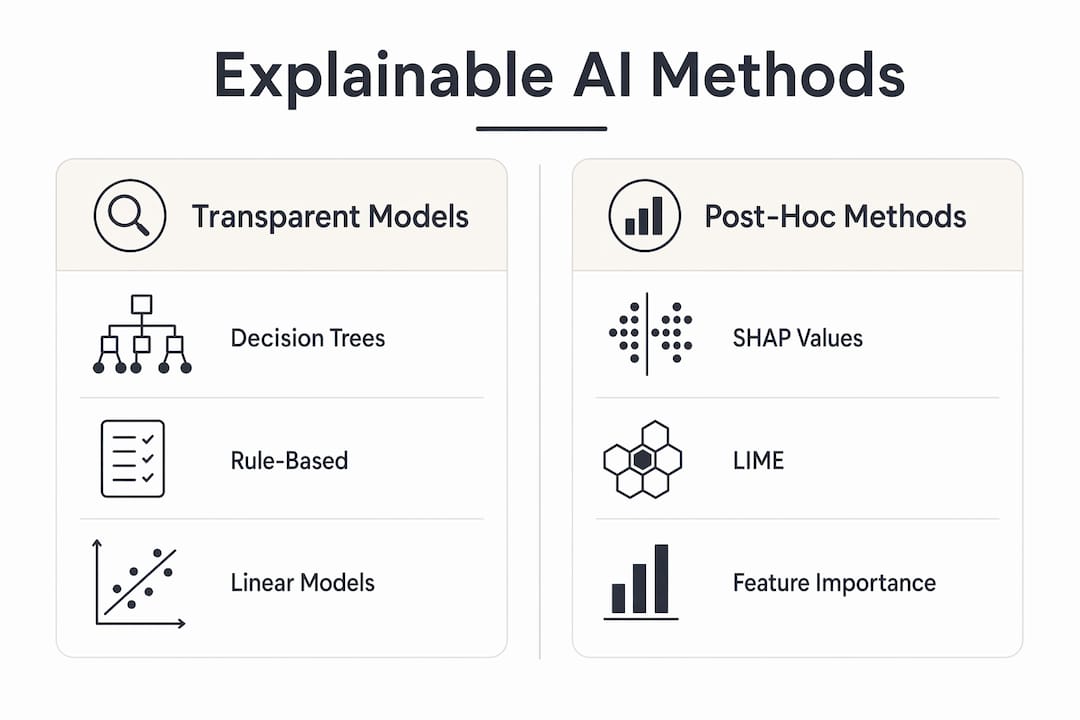
XAI techniques divide into two broad categories: transparent models and post-hoc methods. The choice between them depends on the model architecture and the explainability requirement.
Transparent models are inherently interpretable. Decision trees, linear regression, and rule-based systems expose their logic directly. A decision tree, for instance, produces a visible branching structure that any analyst can trace. These models are well-suited to regulated environments where auditability is mandatory, though they often sacrifice predictive performance on complex data.
Post-hoc methods are applied after a model has been trained, to explain outputs without altering the underlying architecture. The two most widely deployed are:
- LIME (Local Interpretable Model-agnostic Explanations): Approximates the behaviour of a complex model around a specific prediction by fitting a simpler, interpretable model locally. Useful for explaining individual decisions in neural networks or gradient boosting models.
- SHAP (SHapley Additive exPlanations): Assigns each input feature a contribution value based on game theory principles. SHAP values are consistent and comparable across predictions, making them the preferred tool for feature attribution in finance and healthcare audits.
- Visualisation methods: Techniques such as saliency maps and attention visualisation highlight which parts of an input (pixels in an image, words in a document) most influenced a model’s output.
XAI techniques must be tailored to the AI model type: transparent models benefit from direct visualisation, while complex neural networks require post-hoc methods such as LIME or SHAP. This means there is no universal explainability solution. The right technique depends on the model, the stakeholder, and the decision context.
Pro Tip: When selecting an XAI method, start with the stakeholder requirement, not the model architecture. A risk committee needs a narrative explanation; a data scientist needs feature attribution scores. Matching the output format to the audience is as important as the technical method itself.
Why is explainable AI essential for compliance and ethics?
Regulatory pressure is the single most powerful driver of XAI adoption in high-stakes industries. Three frameworks are shaping organisational obligations in 2026.
| Regulatory framework | Jurisdiction | Key XAI requirement |
|---|---|---|
| EU AI Act | European Union | High-risk AI systems must provide human-interpretable explanations and maintain audit logs |
| OCC SR 11-7 | United States | Model risk management requires documentation of model logic and validation of outputs |
| GDPR Article 22 | European Union | Individuals have the right to an explanation for automated decisions affecting them |
In finance, explainable AI is mandatory to meet audit and regulatory standards like the EU AI Act, with specific focus on exception explainability and traceability of source data. For a CFO or Chief Risk Officer, this is not an abstract compliance exercise. It means that every AI-assisted decision in credit, fraud, or financial planning must be traceable to its inputs and defensible to an auditor.
Beyond regulation, ethical AI requires fairness, accountability, transparency, and social impact considerations alongside predictive performance. A model that is accurate but opaque can still embed and amplify historical bias. XAI provides the mechanism to detect and correct that bias before it causes harm.
“Researchers highlight a gap between applied AI and responsible machine learning, urging a shift from accuracy focus to ethical explainability.”, Ethical AI and the Path to Responsible ML
In healthcare, explainability supports clinical governance by allowing physicians to interrogate diagnostic recommendations. In government, it enables public accountability for automated benefit or enforcement decisions. The XAI requirements in financial audits and legal compliance are particularly demanding, requiring both source data traceability and exception documentation at the transaction level.
What challenges and misconceptions surround explainable AI?
Understanding the limits of XAI is as important as understanding its capabilities. Three challenges consistently undermine effective adoption.
-
The black box problem. The black box problem describes the operational complexity of modern AI that makes it difficult to explain internal decision processes, creating opaque and potentially untrustworthy outputs in sensitive domains. Large language models and deep neural networks may have billions of parameters. No post-hoc method fully reconstructs the causal chain from input to output. What SHAP or LIME provide is an approximation, not a complete account.
-
The illusion of understanding. AI-generated explanations often create an illusion of understanding by making users overconfident without improving actual accuracy in interpretation. Philosopher Shannon Vallor describes this as a metacognitive risk: users confuse the feeling of comprehension with genuine comprehension. A plausible-sounding explanation can be technically correct at the feature level while being causally misleading at the system level. For professionals making consequential decisions, this is a material risk.
-
Approximation versus causation. Traditional XAI approaches like SHAP and LIME often miss underlying causal structures. Modern practice is moving toward causal inference methods for reproducibility in critical sectors, but these are computationally demanding and require specialist expertise. Most organisations are not yet equipped to deploy them at scale.
Pro Tip: Treat XAI outputs as hypotheses, not verdicts. When a SHAP explanation attributes a credit decision to three features, verify that attribution against domain knowledge and historical data before acting on it. The explanation is a starting point for investigation, not a substitute for it.
The distinction between genuine AI understanding and superficial explanation summaries is one that professionals must actively maintain. Organisations that treat XAI as a compliance checkbox rather than a critical evaluation discipline are the most exposed to the risks it is designed to mitigate.
How can organisations effectively implement explainable AI?
Effective XAI implementation requires a lifecycle approach, not a one-time technical intervention. The following framework applies across sectors.
Design phase
- Define explainability requirements before selecting a model. Identify which stakeholders need explanations, in what format, and to what standard of auditability.
- Classify the decision type. High-stakes, regulated decisions (credit, clinical, enforcement) require stronger explainability guarantees than low-stakes recommendations.
- Select the model architecture with explainability in mind. Where a transparent model is viable, prefer it over a complex model with post-hoc explanation.
Development phase
- Apply SHAP or LIME during model validation, not just at deployment. Feature attribution should be reviewed alongside accuracy metrics throughout training.
- Transition from algorithm-first development to a requirement-driven process that validates AI outputs against ground truth, not just feature attribution. This means defining what a correct explanation looks like before building the model.
- Document model logic, training data provenance, and known failure modes in a model card or equivalent governance artefact.
Monitoring phase
- Track explanation drift alongside model drift. If SHAP values for key features shift materially over time, the model’s behaviour has changed and requires review.
- Establish a process for challenging and overriding AI decisions. Explainability is only operationally useful if there is a human in the loop with the authority and information to act on it.
| Approach | Best suited to | Explainability output |
|---|---|---|
| Decision tree | Regulated, low-complexity decisions | Direct rule trace |
| SHAP on gradient boosting | Tabular data, finance, risk scoring | Feature contribution scores |
| LIME on neural network | NLP, image classification | Local approximation |
| Causal inference model | High-stakes, reproducibility-critical | Causal attribution |
The lifecycle approach to explainable AI adoption in sectors such as finance and healthcare requires integrating explainability at every stage, not retrofitting it after deployment. Organisations that build explainability into the design phase consistently achieve better audit outcomes and faster regulatory approval.
Key takeaways
Explainable AI is a technical and governance discipline that requires formal requirements, tailored methods, and continuous validation to deliver genuine accountability rather than the appearance of it.
| Point | Details |
|---|---|
| XAI is a defined discipline | XAI covers methods like SHAP, LIME, and decision trees that make AI decisions auditable and interpretable. |
| Regulation is the primary driver | The EU AI Act, GDPR Article 22, and OCC SR 11-7 mandate explainability in high-risk AI deployments. |
| Illusion of understanding is a real risk | AI explanations can create false confidence; treat SHAP and LIME outputs as hypotheses requiring validation. |
| Lifecycle integration is required | Explainability must be designed in from the start, not added after deployment. |
| Method selection depends on context | Match the XAI technique to the model architecture, the decision type, and the stakeholder audience. |
The uncomfortable truth about XAI adoption I keep seeing
Most organisations I encounter treat explainable AI as a documentation exercise. They deploy a model, run SHAP values over the outputs, attach the feature attribution chart to the model governance file, and consider the obligation met. That is not XAI. That is the appearance of XAI.
The gap between a SHAP chart and a genuine causal account of a model’s decision is significant. I have seen finance teams approve AI-assisted credit models on the basis of SHAP outputs that looked authoritative but were, on closer inspection, approximating a non-linear interaction that the underlying model had learned in a way the SHAP values did not fully capture. The explanation was technically generated. It was not technically accurate.
The metacognitive risk that Shannon Vallor identifies is real and professionally consequential. When a well-formatted explanation lands in front of a senior decision-maker, the instinct is to accept it. The discipline required to interrogate it, to ask whether the feature attribution reflects actual causation or a local approximation, is not natural. It has to be built into governance processes deliberately.
My practical advice: appoint someone in your organisation whose explicit responsibility is to challenge AI explanations, not just receive them. That person does not need to be a data scientist. They need to understand the decision domain well enough to know when an explanation is implausible, and they need the authority to escalate. The difference between an AI agent operator and an AI consultant is precisely this: an operator builds the governance layer into the agentic stack from the outset, rather than advising on it after the fact.
XAI will grow in importance as AI systems take on more consequential roles. The organisations that treat it as a genuine discipline now will be better positioned for the regulatory environment that is already forming.
, Hayat
Deploy AI agents with built-in explainability

Meethayat builds and operates AI agents for finance, legal, and go-to-market teams where auditability is not optional. Every agent in the agentic stack is designed with explainability requirements defined at the outset: source data traceability, exception documentation, and output validation against ground truth. If your organisation is deploying AI in regulated workflows and needs the governance layer to match, the AI agent operator service covers the full lifecycle from design through monitoring. Book a consultation to discuss your specific explainability and compliance requirements.
FAQ
What is explainable AI in simple terms?
Explainable AI (XAI) is a set of methods that make AI decisions understandable to humans, answering why a model produced a specific output, when it might fail, and how errors can be corrected.
What are the main explainable AI techniques?
The most widely used techniques are SHAP (SHapley Additive exPlanations), LIME (Local Interpretable Model-agnostic Explanations), decision trees, and visualisation methods such as saliency maps. Each is suited to different model types and stakeholder needs.
Why is explainable AI important for regulated industries?
Regulatory frameworks including the EU AI Act, GDPR Article 22, and OCC SR 11-7 require organisations to provide interpretable explanations for AI-assisted decisions in high-risk domains such as credit, healthcare, and public services.
What is the black box problem in AI?
The black box problem refers to the inability to explain the internal decision process of complex AI models such as deep neural networks. XAI methods address this by providing post-hoc approximations of model behaviour, though these are not complete causal accounts.
Can AI explanations be misleading?
Yes. Research shows that AI explanations create an illusion of understanding, making users overconfident without improving actual interpretive accuracy. Professionals should treat XAI outputs as hypotheses requiring domain validation, not as definitive accounts of model reasoning.