What is an AI orchestration layer? A 2026 guide


An AI orchestration layer is defined as the middleware architecture that coordinates AI models, agents, data pipelines, and business applications into a single governed system. Without it, enterprise AI deployments fragment into isolated tools that cannot share context, recover from errors, or enforce policy. The orchestration layer acts as the conductor synchronising these components, and 74% of enterprise CIOs surveyed report regretting recent AI platform choices precisely because they lacked this coordination capability. That statistic reflects a structural problem, not a vendor problem. IT leaders and business executives who understand what an AI orchestration layer does, and how it differs from automation or traditional integration, are far better placed to build AI systems that actually deliver.
What is an AI orchestration layer and how is it structured?
An AI orchestration layer is not a single product. It is a composite system combining model inference services, agent frameworks, workflow engines, and observability tools to manage, debug, and audit AI behaviour at scale. Each component handles a distinct responsibility, and together they form a coherent architecture.
The four core components are:
- Integration layer, APIs and connectors that link AI models to business applications, databases, and external services.
- Workflow and logic layer, the engine that sequences tasks, manages retries, handles fallbacks, and routes decisions between agents.
- Data pipeline layer, the infrastructure that moves, transforms, and contextualises data so each AI component receives the right inputs.
- Management and governance layer, the control plane that enforces policy, tracks assets, logs decisions, and surfaces observability data.
These components interlink to produce what practitioners describe as a decision-aware system. When one agent fails, the workflow layer triggers a retry or escalates to a human approver. When a data source changes, the pipeline layer adapts without breaking downstream models. This is qualitatively different from a simple API gateway or an ETL pipeline.
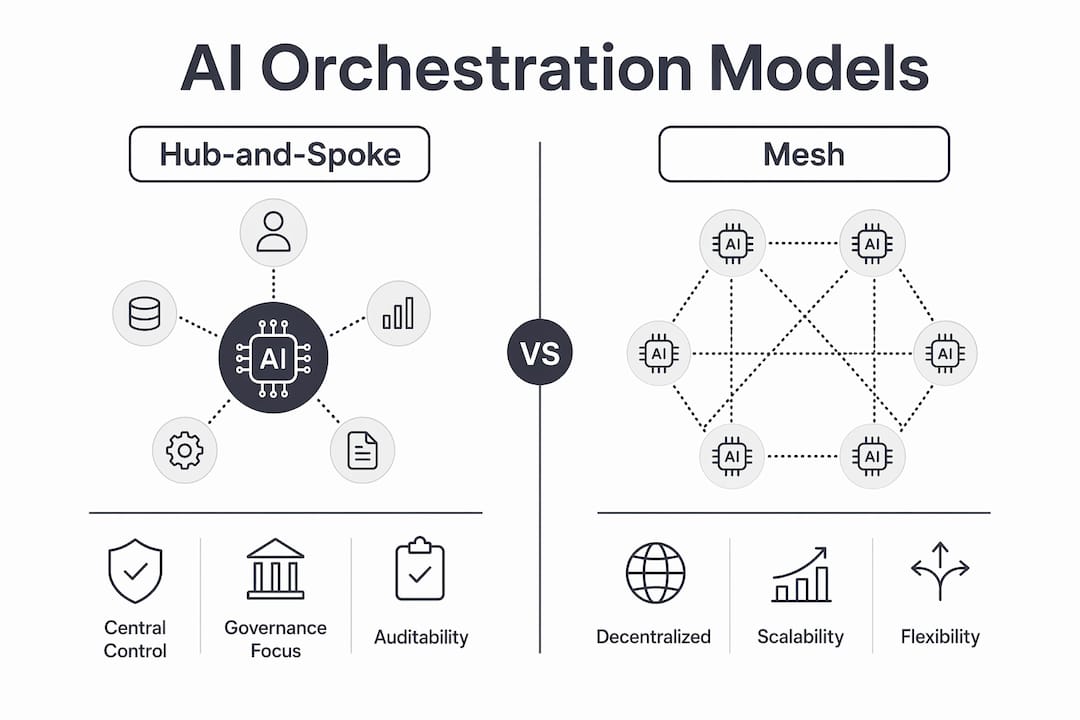
| Architecture model | How it works | Best suited for |
|---|---|---|
| Hub-and-spoke | Central orchestrator routes all agent calls | Centralised governance, lower complexity |
| Mesh | Agents communicate peer-to-peer | High-throughput, distributed workloads |
| Layered | Orchestration separated by task, process, and strategy tiers | Large enterprises with distinct operational layers |
| Event-driven | Workflows trigger on data events or state changes | Real-time processing and reactive systems |

Pro Tip: Start with a hub-and-spoke model when governance and auditability are your primary constraints. Migrate to mesh or event-driven architectures only once your observability tooling is mature enough to trace peer-to-peer agent decisions.
How does AI orchestration differ from automation and traditional integration?
Automation executes fixed rules. AI orchestration manages multi-step, probabilistic workflows where outputs are variable and context-dependent. That distinction matters enormously in practice.
Traditional integration platforms focus on data transfer: moving a record from system A to system B. Orchestration goes further. It enables dynamic, decision-aware flows that handle context, exceptions, and human intervention within the same workflow. A rule-based automation either succeeds or fails. An orchestrated AI workflow can pause, request clarification, reroute to a different model, or escalate to a human approver, all within a single process run.
Consider a customer support scenario. A rule-based system routes tickets by keyword. An orchestrated AI system reads the ticket, checks the customer’s account history, queries a knowledge base, drafts a response, and flags the case for human review if confidence falls below a threshold. Each step involves a different AI component, and the orchestration layer manages the sequencing, state, and error handling across all of them.
Key distinctions at a glance:
- Automation, deterministic, rule-based, no context retention between steps.
- Traditional integration, data movement and transformation, no decision logic.
- AI orchestration, probabilistic, context-aware, stateful, with built-in error recovery and human-in-the-loop support.
Pro Tip: If your current workflow breaks whenever an AI model returns an unexpected output, you have an automation problem, not an AI problem. Orchestration solves this by treating unexpected outputs as a normal condition to route, not a failure to halt on.
What are the key benefits of adopting an AI orchestration layer?
The primary benefit is reliability. Orchestration transforms static automation into workflows that handle exceptions, maintain state, and recover from errors without manual intervention. That reliability compounds across every AI system the organisation runs.
The business case extends well beyond uptime. Governance is the second major benefit. Orchestration embeds policy enforcement directly into workflows, so compliance rules apply automatically rather than being bolted on after deployment. Auditability follows naturally: every agent decision, data access event, and workflow transition is logged and traceable.
Top benefits for IT professionals and business leaders:
- Governance at scale, policy enforcement and data access controls applied consistently across all AI agents and models.
- Auditability, full decision trails enabling regulatory review and internal debugging.
- Reliability, retries, fallbacks, and error handling built into the workflow layer.
- Faster outcomes, parallel agent execution and pre-built connectors reduce time to production.
- Reduced vendor lock-in, open orchestration frameworks allow model and tool substitution without rebuilding workflows.
The 74% CIO regret rate cited earlier is a direct consequence of skipping this layer. Organisations that deploy AI models without orchestration find themselves unable to audit decisions, enforce policy, or scale without rewriting bespoke logic for every new use case.
How does an AI orchestration layer address governance and compliance?
Only 18% of enterprises maintain a comprehensive AI asset inventory. That gap means most organisations cannot answer basic questions about which models are running, what data they access, or which jurisdictions they operate in. The orchestration layer closes this gap by tracking every AI asset and enforcing governance rules programmatically.
The compliance case is equally pressing. 93% of enterprise executives explicitly include data sovereignty in their AI strategy. Orchestration layers automate compliance with regional data residency rules, national security requirements, and sector-specific regulations by embedding these constraints directly into workflow logic.
A practical governance framework built on orchestration includes four numbered controls:
- Asset registry, every model, agent, and data pipeline catalogued with metadata on jurisdiction, data classification, and ownership.
- Policy automation, compliance rules encoded as workflow conditions, triggering blocks or escalations when a boundary is crossed.
- Human-in-the-loop approvals, high-risk decisions routed to named approvers before execution, with full audit trails.
- Data access controls, role-based and context-based permissions enforced at the pipeline layer, not at the application layer.
For teams building out these controls, Meethayat’s guide on compliance monitoring with AI agents covers the technical implementation in detail. The AI governance frameworks guide addresses the policy layer for technology companies specifically.
How is an AI orchestration layer applied in real enterprise workflows?
Most enterprise AI failures stem from treating AI models as standalone tools rather than integrated workflow components. Orchestration is the missing layer that provides persistent state, error handling, and cross-system coordination.
A practical example: a B2B sales workflow. An orchestration layer coordinates a lead-scoring agent, a CRM integration, a proposal-drafting model, and a compliance check, all within a single process. The workflow engine sequences these steps, passes context between them, and routes the output to a human sales manager for final approval. Without orchestration, each of these components would require a separate integration, separate error handling, and no shared state.
Orchestration operates at three levels in enterprise environments:
- Task level, individual model calls, tool invocations, and data retrievals.
- Process level, multi-step workflows spanning several agents and systems.
- Strategic level, cross-functional orchestration aligning AI outputs with business objectives and governance policies.
Building bespoke orchestration logic is risky. Custom builds tend to produce brittle, siloed systems that break when models are updated or new tools are added. Adopting open protocols such as Model Context Protocol promotes interoperability and reduces the cost of future changes. For teams evaluating workflow automation platforms, the choice of underlying protocol matters as much as the feature set.
Pro Tip: When selecting an orchestration framework, verify it supports open protocols before committing. A framework that locks agent communication to proprietary APIs will cost you significantly more to replace than one built on open standards.
Key takeaways
An AI orchestration layer is the governance and coordination infrastructure that separates reliable, auditable enterprise AI from a collection of disconnected models.
| Point | Details |
|---|---|
| Core definition | An orchestration layer coordinates models, agents, pipelines, and apps into one governed system. |
| Governance gap | Only 18% of enterprises hold a full AI asset inventory, making orchestration a compliance necessity. |
| Not automation | Orchestration handles probabilistic, multi-step workflows; automation only executes fixed rules. |
| Sovereignty pressure | 93% of executives include data sovereignty in AI strategy, requiring programmable compliance controls. |
| Build vs. adopt | Custom orchestration builds create brittle silos; open protocols like Model Context Protocol prevent lock-in. |
Why I think most enterprises are solving AI orchestration backwards
The pattern I see repeatedly is this: an organisation deploys several AI tools, hits reliability or compliance problems, and then looks for an orchestration layer to fix what is already broken. That is the wrong sequence.
Orchestration is not a remediation tool. It is a design decision that should precede model selection, not follow it. When I build agentic stacks for SMEs, the first question is always about workflow boundaries and governance requirements, not which model to use. The model choice is almost secondary once you have a clear orchestration architecture.
The second mistake is treating observability as optional. You cannot govern what you cannot see. Every orchestration architecture I have built includes logging and tracing from day one, not as an afterthought. The best AI agent operators for enterprise work the same way: governance and observability are structural, not cosmetic.
The shift from siloed AI tools to unified orchestration is a genuine competitive advantage, but only for organisations that treat it as infrastructure rather than a feature. IT leaders who prioritise orchestration in their AI roadmaps now will spend far less time firefighting fragmented deployments later.
, Hayat
Working with Meethayat on AI orchestration

Meethayat builds and operates AI agent systems for SMEs, with orchestration architecture at the centre of every engagement. The work covers integration design, governance layer configuration, and ongoing agent operations, so clients get a system that is auditable and maintainable from the start, not just at launch.
If you are deciding between hiring an in-house specialist and engaging an external operator, the AI agent operator hiring guide sets out exactly what to look for, what to pay, and when each model makes sense. For teams still clarifying the difference between an operator and a consultant, the operator vs consultant comparison covers the practical distinctions in full.
FAQ
What is an AI orchestration layer in simple terms?
An AI orchestration layer is the middleware that coordinates multiple AI models, agents, and data pipelines into a single, governed workflow. It handles sequencing, error recovery, and policy enforcement so that AI systems behave reliably at scale.
How does AI orchestration differ from RPA or workflow automation?
RPA and workflow automation execute fixed, deterministic rules. AI orchestration manages probabilistic, multi-step processes where outputs vary and context must be maintained across steps, including human-in-the-loop approvals and dynamic rerouting.
Why do enterprises need an AI orchestration layer?
74% of enterprise CIOs regret AI platform choices made without orchestration and governance capabilities. Without an orchestration layer, AI deployments lack auditability, consistent policy enforcement, and the ability to scale across systems.
What governance problems does AI orchestration solve?
Orchestration embeds compliance rules, data access controls, and asset tracking directly into workflows. This addresses the fact that only 18% of enterprises currently maintain a comprehensive AI asset inventory.
What is the best architecture for enterprise AI orchestration?
Hub-and-spoke is the most practical starting point for enterprises prioritising governance and auditability. Mesh and event-driven architectures offer higher throughput but require mature observability tooling to manage effectively.