What is AI token economics: a guide for entrepreneurs


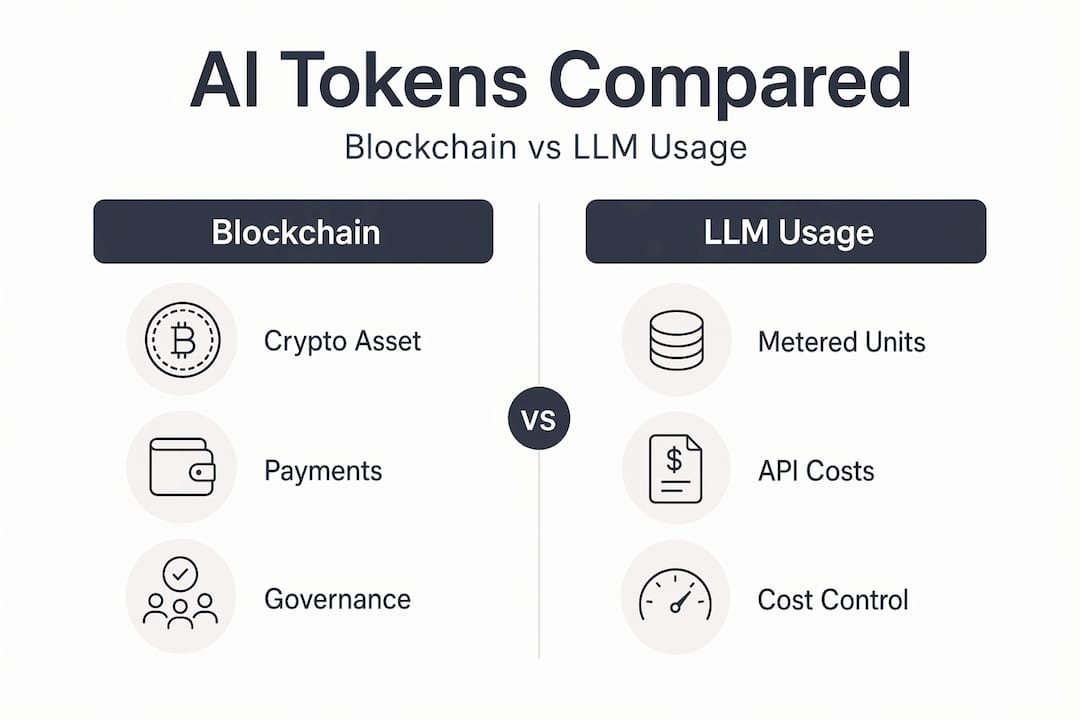
If you’ve encountered the phrase “what is AI token economics” and walked away more confused than when you started, you’re not alone. The term collides two distinct worlds: blockchain-based crypto token design and the metered billing mechanics of large language model (LLM) APIs. For SME decision-makers building AI-driven business models, that confusion is expensive. Misapplying the governance logic of one to the other produces wrong KPIs, blown budgets, and failed product strategies. This guide separates the two cleanly and gives you the frameworks to act on both.
Table of Contents
- Understanding AI tokens: two distinct meanings
- Core concepts of AI token economics in blockchain and LLM usage
- Challenges and cost control in AI token economics for enterprises
- Use cases and real-world AI crypto token models
- Practical steps for SMEs to leverage AI token economics
- Rethinking AI token economics: why clarity beats hype
- Explore expert AI agent operator services to harness token economics
- Frequently asked questions
Key Takeaways
| Point | Details |
|---|---|
| Two meanings of AI tokens | AI tokens refer either to blockchain crypto assets in AI protocols or to LLM API usage tokens for metering AI services. |
| Disambiguate token type | Clarifying the AI token type is critical to choosing the right economic model and KPIs for your business. |
| Tokenomics vs usage costs | AI crypto tokenomics involves supply and incentives, while LLM token economics controls pay-per-use charges for AI outputs. |
| Cost governance essential | Enterprise AI budgets often exceed forecasts without detailed workflow-level token tracking and governance. |
| Practical SME steps | SMEs should classify token models, track usage carefully, and optimize AI model routing to improve efficiency and control costs. |
Understanding AI tokens: two distinct meanings
The word “token” does real work in two completely separate technical contexts, and conflating them is the single most common mistake entrepreneurs make when entering the AI space.
The first meaning: crypto AI tokens are blockchain-based digital assets issued by decentralized AI projects. They function as payment instruments, governance votes, staking collateral, or incentive mechanisms within their ecosystems. Projects like Fetch.ai (FET), Bittensor (TAO), and Render Network (RNDR) each issue tokens that users need to access services, participate in governance, or earn rewards for contributing compute resources.
The second meaning: LLM usage tokens are the metered units that AI API providers (such as OpenAI or Anthropic) use to measure and bill for inference. Every word, punctuation mark, and whitespace you send to or receive from an LLM is counted in tokens. Your monthly API bill is a direct function of how many tokens your applications consume.
As crypto AI tokens are blockchain assets entirely distinct from LLM tokenization and payment-by-token economics, treating them as the same thing produces strategy errors at every level.
Here is how the two token types differ at a foundational level:
- Crypto AI tokens: exist on a blockchain ledger, have market prices, can be traded on exchanges, and are subject to tokenomics design (supply schedules, vesting, inflation).
- LLM usage tokens: exist only as billing units within an API provider’s metering system, have no market price, cannot be traded, and are consumed in real time during inference.
- Governance implications: crypto tokens may carry voting rights; LLM tokens carry none.
- Cost predictability: crypto token costs fluctuate with market prices; LLM token costs fluctuate with usage volume and model selection.
- Strategic relevance: crypto tokens matter for product design in decentralized AI ecosystems; LLM tokens matter for cost governance in AI-powered applications.
If you are building AI agent workflows for your SME, clarifying which token type your strategy involves is the first decision you need to make, not an afterthought.
Core concepts of AI token economics in blockchain and LLM usage
With definitions established, the economic mechanics behind each token type diverge sharply.
Tokenomics (the portmanteau of “token” and “economics”) refers specifically to the economic design rules governing a crypto token. Tokenomics covers supply, issuance, distribution, and vesting as crypto-specific economic design, not LLM metering. It answers questions like: How many tokens will ever exist? At what rate are new tokens issued? Who receives them, and under what lock-up conditions?

LLM token economics, by contrast, is a cost-management discipline. It answers: How many input and output tokens does each workflow consume? What is the cost per 1,000 tokens for each model tier? How does context window size affect per-request cost?
The table below captures the core structural differences:
| Dimension | Blockchain AI tokenomics | LLM usage token economics |
|---|---|---|
| Unit of account | Crypto token (e.g., FET, TAO) | Inference token (input/output) |
| Price mechanism | Market-driven, exchange-listed | Fixed rate card per model tier |
| Supply design | Capped, inflationary, or deflationary | Unlimited (consumed per use) |
| Governance role | Voting, staking, protocol control | None |
| Key metric | Market cap, TVL, token velocity | Cost per inference, tokens per workflow |
| Vesting/lockups | Yes, often multi-year schedules | Not applicable |
| Risk type | Speculative, regulatory, liquidity | Budget overrun, context creep |
Understanding token economics at this level requires you to apply the right analytical lens to each type. Applying market cap analysis to LLM billing is meaningless. Applying cost-per-inference logic to a crypto token project misses the entire incentive design picture.
The numbered steps below outline how to think about each type during strategy design:
- Identify the token type first. Is this a blockchain asset or an API billing unit? Every subsequent decision depends on this.
- For crypto tokens: analyze supply schedule, vesting cliffs, inflation rate, and real fee revenue.
- For LLM tokens: analyze input/output token ratios, model tier pricing, and context window costs per workflow.
- Match KPIs to token type. Market cap and token velocity for crypto; cost-per-inference and tokens-per-session for LLMs.
- Design governance accordingly. Crypto tokens need on-chain governance rules; LLM tokens need internal spend controls and model routing policies.
Pro Tip: If your team is debating IP and data strategy around an AI product, pin down the token type in the first meeting. Teams that skip this step routinely spend weeks building the wrong financial model. The difference between an AI agent operator and an AI consultant often comes down to exactly this kind of operational precision.
Challenges and cost control in AI token economics for enterprises
The impact of AI on tokens at the enterprise level is most viscerally felt in the finance function. Traditional software licensing is predictable: you pay a flat fee per seat or per year. Token-based AI billing is fundamentally different. You pay for every unit of computation consumed, and that consumption scales non-linearly with usage patterns.
73% of enterprise GenAI deployments exceed budget, largely because finance teams apply licensing-era forecasting models to token-based billing. The mismatch is structural, not a forecasting error.
The primary cost drivers in LLM token economics include:
- Input token volume: every character of context, system prompt, and user message counts.
- Output token volume: typically priced 2 to 4 times higher than input tokens on most model tiers.
- Context window creep: multi-turn conversations accumulate prior messages in the context window, compounding costs with each exchange.
- Agentic workflow loops: autonomous AI agents that call tools, evaluate results, and re-plan can generate 10 to 50 times more tokens per task than a single-turn query.
- Model tier selection: using a frontier model (GPT-4o, Claude 3.5 Sonnet) for tasks that a smaller model handles adequately wastes significant budget.
“Agentic AI workflows represent the highest-risk cost category in enterprise AI deployments. A single autonomous task loop can consume more tokens than hundreds of standard queries, making per-workflow cost attribution essential for any serious governance framework.”
Governance steps that actually work in practice:
- Run pilot tests to establish baseline token ratios per workflow before full deployment.
- Implement usage tracking at the workflow level, not just the application or team level.
- Build contingency buffers of 30 to 50% into AI budget lines during the first two quarters of deployment.
- Require vendors to provide granular token consumption data, not just aggregate billing.
- Review model tier assignments quarterly as new, cheaper models enter the market.
Pro Tip: Measure token spend by individual business workflows (invoice ingestion, contract review, customer support triage) rather than by application. This is the only way to identify which processes are cost-efficient and which need AI implementation redesign.
Use cases and real-world AI crypto token models
How does token economics work in practice for decentralized AI projects? The answer depends heavily on which infrastructure layer the token serves.
Render Network offers decentralized GPU compute with token-based payments at prices undercutting major cloud providers by 50 to 70%, processing real customer invoices. This is a fundamental use-case token: demand for GPU compute is real, the token is the payment rail, and revenue is fee-based rather than speculative.
| Project | Token | Primary function | Revenue model | Key risk |
|---|---|---|---|---|
| Fetch.ai | FET | Agent coordination, DeFi automation | Transaction fees, staking rewards | Ecosystem adoption pace |
| Bittensor | TAO | Decentralized AI model training | Miner rewards, subnet fees | Model quality validation |
| Render Network | RNDR | Decentralized GPU compute | Per-render job fees | GPU supply/demand volatility |
| Ocean Protocol | OCEAN | Data marketplace access | Data transaction fees | Data quality and licensing |
Evaluating AI crypto token projects for strategic investment or integration requires looking past price action and examining fundamentals:
- Real usage data: daily active addresses, transaction volume, and fee revenue are more reliable signals than token price.
- Vesting and inflation schedules: heavy token unlocks create sell pressure that can undermine even strong projects.
- Utility clarity: does the token need to exist for the protocol to function, or is it grafted on for fundraising?
- Infrastructure demand: projects addressing genuine AI compute or data scarcity have structural tailwinds.
- Speculative vs. fundamental tokens: tokens without a clear fee mechanism rely entirely on sentiment for price support, which is not a durable business model.
The decentralized compute segment (Render, Akash) currently has the strongest fundamental case because demand for GPU resources is growing faster than centralized cloud providers can supply it.
Practical steps for SMEs to leverage AI token economics
Understanding token economics conceptually is only useful if it translates into operational decisions. Here is how SMEs can apply these principles directly:
- Clarify token type before strategy design. Whether you are building a product on a decentralized AI network or deploying LLM-powered workflows internally, the token type determines every downstream decision on KPIs and financial controls.
- Implement workflow-level tracking. Deploy token usage attribution at the process level from day one. Retrofitting this later is painful and expensive.
- Apply the correct KPIs. For crypto tokens: market cap, token velocity, fee revenue, and staking ratio. For LLM tokens: cost-per-inference, tokens-per-session, and output-to-input token ratio.
- Incorporate token costs into product pricing. If your product is AI-powered, LLM token costs are a direct cost of goods sold. Model them as such in your unit economics.
- Allocate internal AI costs by workflow. This enables accurate ROI measurement and identifies which AI deployments are generating value versus consuming budget without return.
- Review and rebalance quarterly. The AI model market moves fast. A model that was the best cost-quality option six months ago may have been superseded.
Pro Tip: Use tiered AI model routing in your agentic stack. Route simple classification or extraction tasks to smaller, cheaper models, and reserve frontier models for complex reasoning tasks. This single architectural decision can reduce LLM token spend by 40 to 60% without degrading output quality. If you need help designing this, hiring an AI agent operator with hands-on agentic stack experience is faster than building the expertise internally.
Rethinking AI token economics: why clarity beats hype
The prevailing narrative in tech circles treats “AI tokens” as a unified category, something you either understand or you don’t. That framing is the problem. Crypto AI tokenomics and LLM usage token economics are not variations of the same concept. They are different disciplines requiring different skills, different metrics, and different governance frameworks.
The practical cost of conflating them is not theoretical. A team that applies crypto tokenomics thinking (market cap, token velocity, governance voting) to an LLM deployment will build a financial model that bears no relationship to actual costs. A team that applies LLM cost-governance thinking (cost-per-inference, context window management) to a blockchain AI token project will miss the incentive design entirely and build a product with no token utility.
“Confusing crypto AI tokens with LLM token economics leads to wrong KPIs and misaligned controls, hurting business outcomes.”
From the perspective of a CFO who has exited three businesses and now operates AI agents for SMEs, the most dangerous moment in any AI project is when the team thinks they understand the economics but has not yet asked which type of token they are actually dealing with. That ambiguity costs real money.
The entrepreneurs who navigate this well share one habit: they define terms precisely before they design systems. They do not let vendor marketing or crypto hype set the vocabulary. They ask whether their token is a blockchain asset or an API billing unit, and they build their governance model from that answer outward.
Ongoing measurement matters too. The AI token landscape is evolving rapidly, both in terms of new crypto projects reaching real utility and in terms of LLM pricing dropping as competition intensifies. Static governance frameworks become outdated within quarters. Build measurement into your operating rhythm, not just your launch checklist. Explore how AI agent operator services can support that ongoing governance function.
Explore expert AI agent operator services to harness token economics
Navigating AI token economics requires more than conceptual clarity. It requires someone who can design the agentic stack, attribute token costs to business workflows, and adjust governance as the market evolves. For SMEs, that expertise is rarely available in-house.

Hayat Amin’s AI agent operator services are built specifically for SMEs that want to deploy AI agents effectively, control token costs, and build governance frameworks that hold up under real operational pressure. Whether you are evaluating decentralized AI token projects or managing LLM API spend across your business, the work starts with precise definitions and ends with measurable outcomes. For larger organizations, AI agent operator services for enterprises address the additional complexity of multi-team deployments and cross-functional cost attribution. If you are ready to move from understanding to implementation, the first step is engaging an AI agent operator with direct experience in both the financial and technical dimensions of AI deployment.
Frequently asked questions
What is the main difference between AI crypto tokens and LLM usage tokens?
AI crypto tokens are blockchain assets used for payments, governance, or incentives in decentralized AI ecosystems, while LLM usage tokens meter the consumption of AI services, billing based on input and output tokens processed. The two types require entirely different governance frameworks and financial models.
Why do enterprises often exceed their AI token budget forecasts?
73% of enterprise GenAI deployments go over budget because finance teams apply flat-fee licensing logic to token-based billing, which scales with usage volume. Output token costs, context window growth, and agentic workflow loops routinely push actual spend two to three times above initial forecasts.
How can SMEs apply AI token economics to improve operational efficiency?
SMEs should clarify token type first, implement workflow-level usage tracking, select correct KPIs for either crypto or LLM contexts, and use tiered model routing to balance cost and output quality across their AI deployments.
What makes a good AI crypto token project?
A good AI crypto token project has real usage metrics, ongoing fee-based revenue from genuine users, transparent tokenomics with controlled supply and vesting schedules, and addresses a concrete AI infrastructure or compute need rather than relying on speculative price support.