What is AI-powered invoicing? A 2026 SME guide


AI-powered invoicing is an automated billing process that uses machine learning, natural language processing (NLP), and optical character recognition (OCR) to capture, validate, and process invoices with minimal manual effort. The industry term for this category is intelligent invoice automation, though AI-powered invoicing is now the widely used shorthand. Platforms such as HighRadius and tools built on SAP and Oracle integrations sit at the mature end of this market. The business case is direct: processing costs drop by up to 80% and small finance teams reclaim 15, 25 hours of bookkeeping time every month. For any business owner or finance manager still running invoices through spreadsheets or rigid rules-based systems, those numbers represent a material shift in how the finance function operates.
What is AI-powered invoicing and how does it capture invoice data?
AI-powered invoicing works by replacing manual data entry with a layered set of technologies that read, interpret, and validate invoice information automatically. The process is not a single step. It is a pipeline, and understanding each stage helps you set realistic expectations before you commit to a platform.
- Invoice ingestion. The system receives invoices in any format: PDF, scanned image, XML, or EDI file. OCR converts the document into machine-readable text.
- Data extraction. An NLP or large language model (LLM) layer reads the extracted text and identifies fields such as vendor name, invoice number, line items, tax codes, and payment terms.
- Validation. Machine learning models cross-check extracted data against purchase orders, contracts, and historical records. Anomalies, such as a duplicate invoice number or a mismatched total, are flagged automatically.
- Coding and posting. Validated invoices are coded to the correct general ledger accounts and posted to the connected ERP or accounting system without human input.
- Exception routing. Invoices that fall outside confidence thresholds are sent to an exception queue for human review.
The critical difference between AI and older rules-based automation (RPA) is adaptability. Rules-based systems break when invoice formats change, whereas AI models recognise context. A system trained on thousands of invoices understands that “Inv #” and “Invoice No.” refer to the same field. RPA does not.
Pro Tip: Before selecting a platform, ask vendors for their field-level accuracy rates, not document-level rates. A document with one wrong line item is still an incorrect document in your accounts.

What accuracy and automation rates can SMEs realistically expect?
Accuracy benchmarks matter more than marketing claims. AI achieves 95, 99% header-field accuracy for standard invoice fields such as vendor name, date, and total amount. That figure sounds high, but field-level accuracy is the metric that counts in accounting. A single incorrect tax code on an otherwise perfect invoice creates a compliance problem.
Straight-through processing (STP) rates tell you what percentage of invoices complete the full pipeline without any human touch. Mature deployments achieve STP rates of 60, 80%. That means 20, 40% of invoices still require human intervention, even in well-configured systems. This is not a failure. It is the expected operating model.
AI invoicing vs rules-based automation: key metrics
| Metric | AI invoicing | Rules-based (RPA) |
|---|---|---|
| Header-field accuracy | 95, 99% | 85, 95% (format-dependent) |
| Straight-through processing | 60, 80% | 40, 70% |
| Format adaptability | High (contextual) | Low (breaks on change) |
| Exception handling | Automated routing | Manual reconfiguration |
| Setup complexity | Moderate | Low initially, high over time |
| Ongoing maintenance | Low | High (rule updates required) |
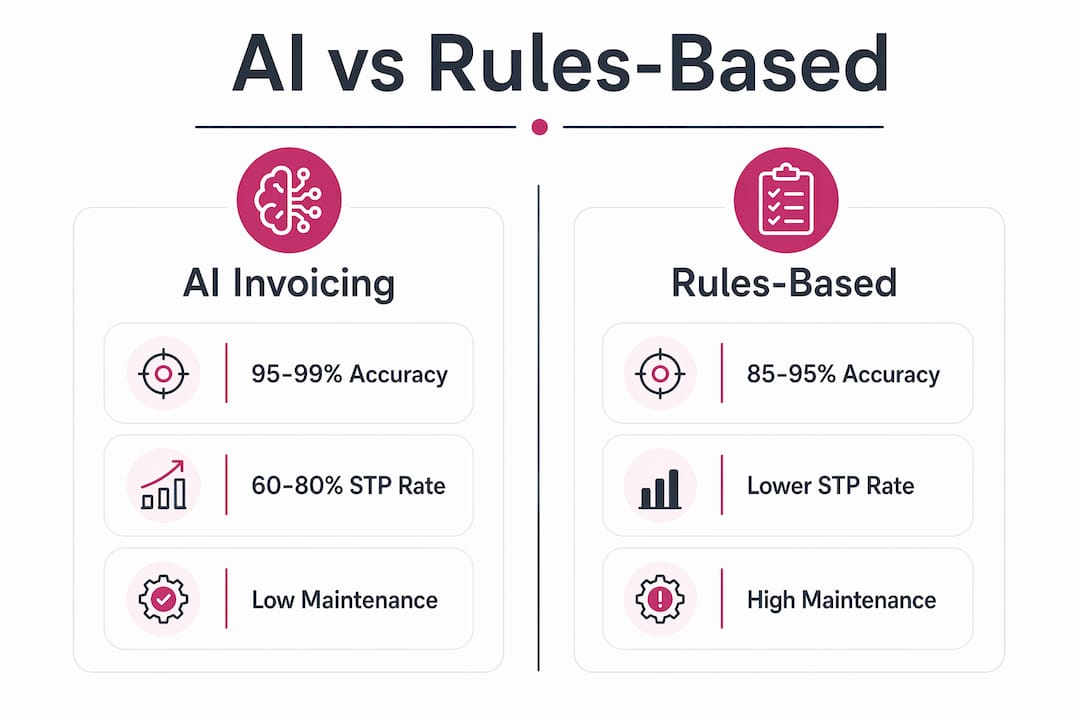
The table above shows why RPA appears cheaper at the start but accumulates hidden maintenance costs. Every time a supplier changes their invoice template, someone must update the rules engine. AI models adapt without manual reconfiguration.
HighRadius Autonomous Receivables reports over 95% straight-through cash application rates on the receivables side. That benchmark illustrates what a mature, purpose-built AI system can achieve when trained on high-volume, consistent data.
What are the key benefits of AI invoicing solutions for SMEs?
The benefits of AI invoicing are concrete and measurable, not theoretical. For SMEs operating with lean finance teams, the gains show up in three areas: cost, time, and cash flow.
- Cost reduction. AI invoice processing cuts costs by up to 80% compared to manual processing. The saving comes from reduced data entry labour, fewer error corrections, and lower audit preparation time.
- Time recovery. Finance managers at small businesses report saving 15, 25 hours of bookkeeping time per month. That time shifts from data entry to analysis and decision-making.
- Faster payments. AI-generated payment reminders reduce payment turnaround by approximately 5 days, which is roughly 45% faster than manual reminders. For a business with 60-day payment terms, collecting five days earlier has a direct impact on working capital.
- Fewer errors. Automated validation catches duplicate invoices, mismatched totals, and incorrect tax codes before they reach the ledger. Human error in manual entry is the leading cause of reconciliation problems at month-end.
- Compliance and audit readiness. AI systems generate immutable audit logs for every invoice processed. This matters for VAT compliance and for businesses subject to external audit.
Pro Tip: Integrate your AI invoicing platform with your existing ERP before going live. AI invoicing connects natively with SAP, Oracle, Microsoft Dynamics, NetSuite, and QuickBooks. A clean integration eliminates duplicate data entry between systems.
The cash flow benefit deserves more attention than it typically receives. Most SME finance managers focus on cost savings when evaluating AI invoicing. The payment acceleration effect, driven by personalised, timed reminders, often delivers more value than the processing cost reduction in the first year of deployment. For a business turning over £2 million with average debtor days of 55, cutting five days off collection time releases meaningful working capital without any change to credit terms.
How does AI invoicing compare to manual and rule-based processing?
Understanding the differences between AI, rules-based automation, and manual processing helps you choose the right approach for your current volume and complexity.
Manual processing relies entirely on human data entry, approval workflows managed by email, and reconciliation done in spreadsheets. It is accurate when volumes are low and staff are experienced, but it does not scale. Error rates increase with volume, and month-end closes become bottlenecks.
Rules-based automation (RPA) removes some manual entry by following fixed instructions. If the invoice matches a defined template, the system processes it. If it does not match, the invoice fails and requires manual intervention. The problem is that supplier invoice formats change regularly. Each change breaks the rule, and someone must fix it. RPA works well in highly controlled environments with a small number of suppliers using standardised formats.
AI models adapt to varied invoice formats because they understand context rather than following rigid rules. This is the defining advantage. An AI system trained on diverse invoice data handles new suppliers and format variations without reconfiguration.
Comparison: AI, rules-based, and manual invoice processing
| Approach | Volume capacity | Error rate | Maintenance burden | Best suited for |
|---|---|---|---|---|
| Manual | Low | High | Low setup, high ongoing | Under 50 invoices/month |
| Rules-based (RPA) | Medium | Medium | High (rule updates) | Standardised, low-variety formats |
| AI-powered | High | Low | Low | Variable formats, growing volume |
AI handles thousands of invoices per hour with minimal human oversight. That capacity is irrelevant for a business processing 30 invoices a month, but it becomes critical when volume grows or when a business acquires another entity with a different supplier base.
The honest limitation of AI invoicing is in exception handling. AI excels at structured tasks like data capture and payment matching but requires human judgement for disputes, complex contract terms, and nuanced business logic. Staff roles shift from data entry to exception review and relationship management. That is a better use of finance talent, but it requires retraining and clear escalation processes.
For AI-driven revenue operations more broadly, the same principle applies: AI handles the repeatable work, and humans handle the judgement calls.
Key takeaways
AI-powered invoicing delivers measurable cost, time, and cash flow benefits for SMEs, but realistic STP rates of 60, 80% mean human oversight remains part of the operating model.
| Point | Details |
|---|---|
| Core technology | AI invoicing uses OCR, NLP, and machine learning to extract and validate invoice data automatically. |
| Accuracy benchmark | Header-field accuracy runs at 95, 99%, but field-level accuracy is the metric that matters for compliance. |
| Automation rate | Expect 60, 80% straight-through processing in mature deployments; the remainder needs human review. |
| Key SME benefit | Cost savings of up to 80% and 15, 25 hours saved monthly are the primary financial gains. |
| AI vs RPA | AI adapts to format changes; rules-based systems break and require manual reconfiguration each time. |
AI invoicing in practice: what three CFO exits taught me
The conversation around AI invoicing in SME circles tends to focus on the technology. The harder problem is the process change that comes with it.
I have seen this pattern across multiple finance transformations. A business deploys an AI invoicing platform, achieves strong STP rates within three months, and then stalls. The reason is almost always the same: the exception queue is not managed as a process. It becomes a backlog. The AI handles 70% of invoices automatically, but the remaining 30% sit unresolved because no one owns the exception workflow.
The fix is straightforward. Before you go live, define who reviews exceptions, what the escalation path is, and what turnaround time is acceptable. Treat the exception queue as a first-class process, not an afterthought.
The second misconception I encounter regularly is that AI invoicing replaces your finance team. It does not. It changes what your team does. Data entry disappears. Supplier relationship management, dispute resolution, and cash flow analysis become the primary activities. That is a better finance function, but it requires deliberate change management.
My view on the market in 2026 is that the gap between AI invoicing and rules-based automation will continue to widen. LLM-based extraction is improving faster than RPA vendors can update their rule libraries. For SMEs evaluating platforms now, the question is not whether to adopt AI invoicing. The question is which integration path fits your current ERP and what your exception handling process will look like on day one.
For finance managers thinking beyond invoicing, the best AI agent operators for finance workflows in 2026 cover a broader set of automation use cases worth reviewing alongside your invoicing decision.
, Hayat
AI agent operator services for finance automation
Finance automation extends well beyond invoice processing. At Meethayat, the work involves designing and operating AI agents that handle the full accounts payable and receivable cycle, not just invoice ingestion.

For SMEs that have outgrown manual processes but are not ready to build an internal AI team, an AI agent operator provides a faster path to automation. The operator designs the agentic stack, connects it to your existing ERP or accounting system, and manages the exception workflows that keep the process running cleanly. If you are weighing up the right type of specialist for your finance function, the AI agent operator vs AI consultant guide covers the practical differences in scope, cost, and output. The right choice depends on whether you need a system built and run, or advice on what to build.
FAQ
What is AI-powered invoicing in simple terms?
AI-powered invoicing is an automated system that reads, validates, and processes invoices using machine learning and OCR, replacing manual data entry. It connects to your accounting or ERP system and posts validated invoices without human input.
How accurate is AI invoice processing?
Header-field accuracy typically runs at 95, 99% in mature deployments. Field-level accuracy is the correct metric to request from vendors, as a single incorrect field makes the entire document incorrect for accounting purposes.
What is the difference between AI invoicing and RPA?
Rules-based RPA follows fixed instructions and breaks when invoice formats change. AI invoicing understands context and adapts to new formats without manual reconfiguration, making it more reliable across diverse supplier bases.
How much can AI invoicing save an SME?
Processing costs can fall by up to 80%, and finance teams typically recover 15, 25 hours of bookkeeping time per month. Payment collection also accelerates by approximately five days through AI-generated reminders.
Does AI invoicing work with existing accounting software?
AI invoicing platforms integrate natively with SAP, Oracle, Microsoft Dynamics, NetSuite, and QuickBooks. A clean integration is the prerequisite for eliminating duplicate data entry between systems.