What is AI model drift: a practitioner's guide


AI model drift is defined as the gradual degradation of a machine learning model’s predictive performance in production, caused by discrepancies between real-world data and the data the model was trained on. The industry term for this phenomenon is model drift, and it sits at the centre of every serious MLOps conversation. Changes in user behaviour, market conditions, and seasonal trends all erode the statistical assumptions a model was built on. Left unmanaged, drift reduces trust in model outputs and destroys the business value those models were deployed to create. Understanding AI model drift is not optional for practitioners running production systems. It is the foundation of reliable, long-term ML operations.
What is AI model drift and why does it matter?
AI model drift occurs when the relationship between input data and expected outputs shifts after a model is deployed. The model itself has not changed. The world around it has. A credit risk model trained on pre-pandemic lending behaviour will produce increasingly unreliable scores as economic conditions evolve. A fraud detection system trained on one quarter’s transaction patterns will miss new attack vectors that emerge the next quarter.

The consequences are not merely technical. Degraded model performance translates directly into poor decisions, financial losses, and regulatory exposure. In regulated industries such as banking and insurance, a model producing outputs outside its validated performance envelope creates compliance risk. The effects of AI model drift include reduced trust from business stakeholders and, ultimately, the withdrawal of model-driven processes from production.
Drift is not a sign that a model was built badly. It is an operational reality of deploying any model in a dynamic environment. The goal is not to prevent drift entirely. The goal is to detect it early and respond appropriately.
What are the different types of AI model drift?
Three primary types of model drift exist: data drift, concept drift, and label drift. Each has a different root cause and demands a different response.
Data drift (also called covariate shift) occurs when the statistical distribution of input features changes. The underlying relationship between inputs and outputs remains valid, but the model now sees data that looks different from its training set. A model trained on customer age distributions from one demographic will drift if the product attracts a new user segment.
Concept drift is more disruptive. Here, the actual relationship between inputs and outputs changes. A model predicting customer churn based on usage patterns will experience concept drift if the product fundamentally changes what “engagement” means. The inputs look similar, but their predictive meaning has shifted.
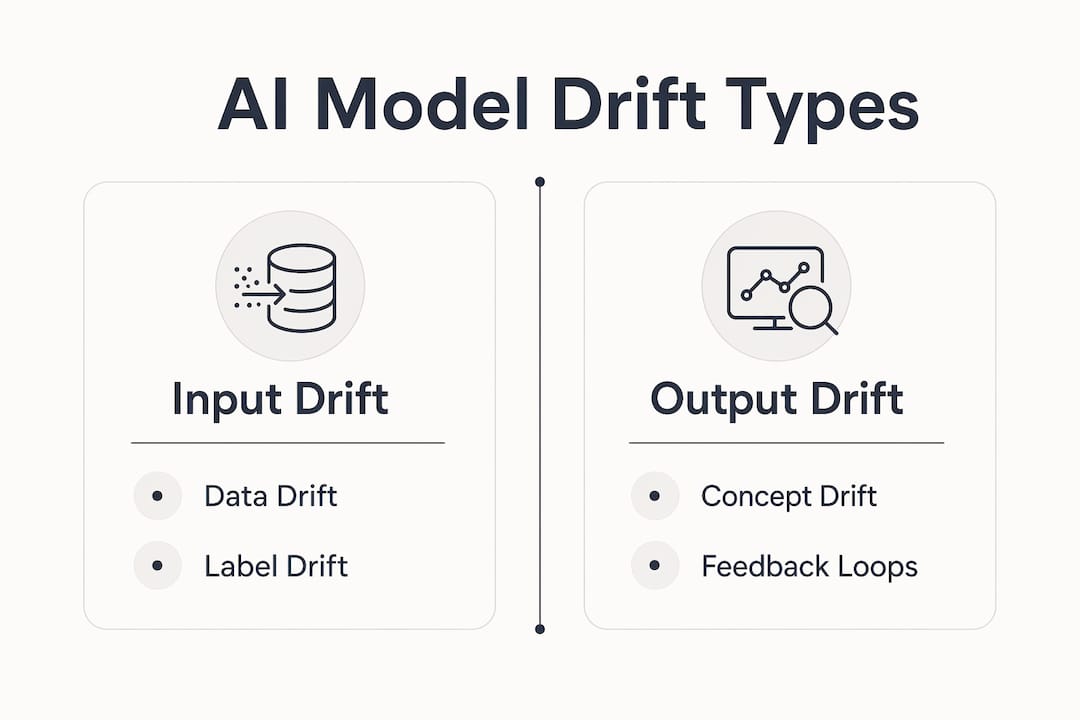
Label drift refers to changes in the proportion of classes in the target variable. If a binary classifier was trained on a balanced dataset but production data becomes heavily skewed toward one class, the model’s calibration degrades even if the input features remain stable.
The distinctions matter because the remediation differs. Data drift often requires retraining on fresher data. Concept drift may require redesigning features or rethinking the modelling approach entirely. Label drift may require recalibrating class weights or thresholds rather than full retraining.
| Drift type | Root cause | Primary response |
|---|---|---|
| Data drift (covariate shift) | Input feature distribution changes | Retrain on recent representative data |
| Concept drift | Input-output relationship changes | Redesign features or modelling approach |
| Label drift | Target class proportion changes | Recalibrate thresholds or class weights |
Separating data drift and concept drift early improves resource allocation and avoids overreacting to minor input fluctuations that carry no real performance consequence.
What causes AI model drift in production environments?
The causes of model drift in production are broader than most practitioners initially assume. The obvious causes are real-world changes. The less obvious causes sit inside your own data pipelines.
Real-world causes include:
- Shifts in user behaviour (new customer segments, changed purchasing patterns)
- Market or economic changes (inflation, regulatory shifts, competitive dynamics)
- Seasonal trends that were underrepresented in training data
- Malicious activity such as adversarial inputs designed to evade detection models
Pipeline and data integrity causes include:
- Schema changes in upstream data sources that alter feature values silently
- Feature engineering errors introduced during a pipeline update
- Missing data or imputation changes that shift input distributions artificially
- Logging failures that cause training and serving data to diverge
The second category is the one practitioners underestimate. Most apparent model drift is actually caused by upstream pipeline issues such as feature processing errors or schema changes, not by genuine shifts in the real world. Retraining a model on corrupted or misaligned data does not fix drift. It entrenches the failure. Verifying data integrity before any retraining decision is not a best practice. It is a prerequisite.
Understanding the role of data in AI systems helps practitioners distinguish between genuine distributional shifts and artefacts of broken pipelines. The two look identical in performance dashboards but require completely different responses.
Pro Tip: Before triggering a retraining pipeline, run a full audit of your data schema, feature engineering steps, and ingestion logs. If the pipeline is the problem, retraining will make things worse, not better.
How can AI model drift be detected effectively?
Detection is where most teams either over-engineer or under-invest. The right approach combines performance monitoring with statistical distribution tests, applied in the correct order.
Performance metrics as the primary signal
Performance metric degradation in accuracy, RMSE, F1 score, or AUC remains the definitive indicator that drift is affecting business outcomes. Input distribution changes alone do not confirm harmful drift. A model can see shifted inputs and still produce accurate outputs. Always anchor your alerting to output-level performance first.
Statistical distribution tests
When ground truth labels are delayed (as they often are in production), statistical tests on input distributions provide an early warning signal. The two most widely used are:
- Population Stability Index (PSI): PSI below 0.1 indicates stable data; PSI above 0.25 signals severe drift requiring urgent action. These thresholds are industry-standard benchmarks in banking and insurance for setting automated monitoring alerts.
- Kolmogorov-Smirnov (KS) test: Measures the maximum difference between two cumulative distribution functions. Useful for continuous features where PSI may be less sensitive.
PSI thresholds give you a heuristic trigger. They do not tell you whether the drift is harmful. That determination requires performance data.
Advanced detection: Margin Density Drift Detection (MD3)
Margin Density Drift Detection (MD3) reduces false alarms by focusing monitoring on low-confidence predictions. The logic is sound: if a model is drifting, it will first become uncertain about the cases it previously classified with high confidence. Tracking the density of predictions near the decision boundary gives an earlier and more targeted signal than broad distribution tests.
| Detection method | What it measures | Best used when |
|---|---|---|
| Accuracy / RMSE monitoring | Output performance vs ground truth | Labels available with low latency |
| PSI | Input feature distribution shift | High-volume tabular data, banking/insurance |
| KS test | Distribution difference for continuous features | Continuous input features |
| MD3 | Low-confidence prediction density | Labels delayed; early warning needed |
Pro Tip: Prioritise output-level monitoring as your primary alert trigger. Use PSI and KS tests as leading indicators, not as grounds for immediate retraining. Treat them as a prompt to investigate, not a mandate to act.
What are practical strategies to manage and mitigate AI model drift?
Managing drift requires a structured response workflow, not a reflexive retrain. The strategy depends on which type of drift you have confirmed.
Matching the response to the drift type
Data drift typically calls for retraining on a more recent data window. Concept drift may require feature redesign, new data sources, or a fundamentally different modelling approach. Label drift calls for threshold recalibration rather than full retraining. Applying the wrong fix wastes engineering time and can introduce new failure modes.
Retraining approaches
Two retraining strategies exist in practice:
- Periodic retraining: Models are retrained on a fixed schedule (weekly, monthly, quarterly). Simple to operationalise but may lag behind rapid drift.
- Triggered retraining: Retraining fires automatically when a monitoring threshold is breached. More responsive but requires well-calibrated thresholds to avoid unnecessary retraining cycles.
Most production teams use a hybrid. Periodic retraining provides a baseline cadence. Triggered retraining handles sudden distributional shifts between scheduled cycles.
Handling feedback loops
Feedback loop effects, where model outputs bias future training data, create a particularly damaging form of drift. Recommendation systems are the canonical example. A model that surfaces only a narrow range of content will generate training data that reinforces that narrowness. Breaking feedback loops requires external ground truth data, diversified sampling strategies, or deliberate exploration policies that expose the model to a broader range of outcomes.
Do’s and don’ts for MLOps teams
Do:
- Audit data pipelines before every retraining decision
- Set PSI and KS thresholds as investigation triggers, not automatic retraining triggers
- Maintain a holdout dataset from the original training distribution for baseline comparison
- Log model confidence scores alongside predictions for MD3-style monitoring
- Document the root cause of each drift incident to build institutional knowledge
Don’t:
- Retrain on data you have not validated for integrity
- Treat all PSI alerts as equivalent. A PSI of 0.12 and a PSI of 0.40 require very different responses
- Ignore label drift in classification systems with imbalanced classes
- Assume that improved input distribution metrics mean improved model performance
Operationalising ML requires accepting that drift is inevitable. The teams that manage it well build automated detection and remediation pipelines rather than treating each drift incident as a crisis.
Key takeaways
Effective management of AI model drift requires distinguishing drift types early, validating data pipelines before retraining, and anchoring all alerting to output-level performance metrics.
| Point | Details |
|---|---|
| Define drift type first | Data, concept, and label drift each require a different remediation response. |
| Pipeline audit before retraining | Most apparent drift originates in upstream data issues, not the model itself. |
| PSI thresholds as investigation triggers | PSI above 0.25 signals severe drift; treat it as a prompt to investigate, not an automatic retrain mandate. |
| Output metrics are the final arbiter | Input distribution shifts alone do not confirm harmful drift; performance degradation does. |
| Feedback loops require active management | Breaking reinforcement bias needs external ground truth or diversified sampling, not just retraining. |
The operational reality practitioners rarely talk about
Drift is framed as a technical problem. In practice, it is an organisational one. The teams I see struggle most with model drift are not the ones with weak detection tooling. They are the ones where the data engineering team and the ML team operate in separate silos, with no shared ownership of the production pipeline.
The most damaging drift incidents I have encountered were not caused by genuine distributional shifts in the real world. They were caused by a silent schema change in an upstream data source that nobody flagged, combined with a retraining pipeline that fired automatically on a PSI alert. The model retrained on corrupted data, performance collapsed, and the root cause took days to identify because the team was looking at model outputs rather than pipeline logs. Rushing to retrain without validating upstream data pipelines produces entrenched failures, not fixes.
My practical advice: treat your first response to any drift alert as a data quality investigation, not a modelling task. Spend the first hour in your pipeline logs, not your training scripts. The majority of alerts will resolve at the data layer. The minority that require genuine model intervention will be far easier to address once you have confirmed the data is clean.
The second thing practitioners underestimate is the value of AI operational insights from adjacent industries. Banking and insurance have been managing model drift under regulatory scrutiny for over a decade. Their PSI thresholds, model validation frameworks, and retraining governance processes are directly applicable to any production ML system. You do not need to reinvent this. You need to adopt it.
Drift is not failure. It is the normal state of any model operating in a dynamic world. The practitioners who accept that and build monitoring infrastructure accordingly will spend far less time firefighting than those who treat each drift incident as an anomaly.
, Hayat
Meethayat’s AI agent operator approach to production model health
Production ML systems in finance, legal, and GTM functions face drift pressures that generic monitoring tools are not built to handle. Domain-specific data pipelines, regulatory constraints, and low-latency decision requirements all create drift patterns that need specialist operational oversight.

Meethayat’s AI Agent Operator service is built for practitioners and SME teams who need automated drift detection, pipeline validation, and retraining governance integrated into their production agentic stack. The service covers alert threshold calibration, feedback loop management, and root cause triage, so your team responds to genuine drift rather than pipeline noise. If you are building or operating AI agents in finance, legal, or GTM contexts, the AI Agent Operator vs AI Consultant guide explains exactly where operational deployment expertise adds value that advisory alone cannot provide.
FAQ
What is AI model drift in simple terms?
AI model drift is when a machine learning model’s predictions become less accurate over time because the real-world data it encounters has changed from the data it was trained on.
What is the difference between data drift and concept drift?
Data drift means the input feature distributions have changed; concept drift means the relationship between inputs and outputs has changed. Concept drift is typically more disruptive and harder to fix.
How do you detect model drift in production?
Monitor output performance metrics (accuracy, RMSE) as the primary signal, and use statistical tests such as PSI and the Kolmogorov-Smirnov test on input features as early warning indicators.
What does a PSI score above 0.25 mean?
A PSI above 0.25 signals severe distributional drift and is the industry-standard threshold for triggering an urgent investigation in banking and insurance model monitoring.
Should you always retrain a model when drift is detected?
No. Most apparent drift originates in upstream pipeline issues rather than genuine distributional shifts. Always audit your data pipeline for schema changes and feature processing errors before initiating any retraining cycle.