What is AI latency? A guide for tech teams


AI latency is defined as the elapsed time between sending a request to an AI system and receiving its output, measured in milliseconds and shaped by two distinct components: Time to First Token (TTFT) and token generation speed. For tech and data teams deploying large language models (LLMs) in production, this metric determines whether an AI-powered product feels responsive or broken. Tools like Redis and SpeedtestHQ have built dedicated resources around measuring and reducing these delays, which signals how central latency has become to production AI operations. Understanding the full picture, from what causes AI latency to how it compounds across your stack, is the starting point for building systems users actually trust.
What is AI latency and how is it defined?
AI latency is the total delay from input submission to completed output delivery in an AI system. It is not a single number. It is the sum of several sequential delays, each with a different cause and a different fix.
The two primary components are TTFT and Time Per Output Token (TPOT). TTFT is the delay until the first output token appears, which is what users perceive as the “thinking” pause before a response begins. TPOT is the speed at which each subsequent token is generated, which governs how quickly the full response streams out. Both matter, but they matter differently depending on your use case.

A practical formula for total LLM latency is: TTFT plus (output tokens multiplied by TPOT). A 500-token response generated at 25 ms per token takes approximately 12.5 seconds to fully stream, regardless of how fast the first token appeared. This means a low TTFT can mask a painfully slow total response if TPOT is not also optimised.
In 2026, typical frontier model TTFT ranges from 500 to 3,000 ms, and TPOT ranges from 10 to 50 ms per token, depending on model size, prompt length, hardware, and provider load. These are not fixed benchmarks. They are the operating range within which most production teams are working today.
What components make up AI latency and how do they affect response times?
Breaking AI response time into its constituent parts is the only way to diagnose and fix performance problems accurately. The components behave differently and require different engineering responses.
TTFT (Time to First Token)
- The delay from request submission to the first output token appearing
- Includes network round-trip time, queue wait time, and the model’s prefill computation
- Longer prompts increase TTFT because the model must process more input tokens before it can begin generating output
- Directly shapes perceived responsiveness in interactive applications such as chat interfaces and copilots
- TTFT is the most user-visible latency metric. A 2,000 ms pause before any output appears will cause users to question whether the system is functioning.
TPOT (Time Per Output Token)
- The interval between each successive output token during streaming
- Governs how quickly the full response appears after the first token
- Affected by model size, hardware throughput, and concurrent load
- More relevant for batch tasks and long-form generation than for short interactive exchanges
Streaming vs batch workloads
The relative importance of TTFT and TPOT shifts depending on the task. In a real-time chat interface, TTFT dominates user perception. In a batch document summarisation pipeline running overnight, TPOT and total throughput matter more than the initial delay. Distinguishing TTFT and TPOT as separate metrics is therefore not academic. It determines which part of your system to fix first.
Pro Tip: When profiling a new AI deployment, measure TTFT and TPOT separately from day one. Teams that track only end-to-end response time often spend weeks optimising the wrong layer.
What causes AI latency? Key factors across the AI system stack
AI latency in production is a system-level issue, not a model-level one. Optimising only model inference will not resolve the end-to-end delays your users experience. The causes stack across multiple layers.
- Model inference compute time. The core computation required to run a forward pass through the model. Larger models with more parameters take longer, and this is often the first place teams look, though rarely the only bottleneck.
- Network round-trip time. The physical distance between the client and the inference endpoint adds latency that no amount of model optimisation can eliminate. A user in London hitting an endpoint hosted in Singapore will experience materially higher TTFT than one hitting a regional endpoint.
- Prefill and prompt processing time. Before the model generates a single output token, it must process the entire input prompt. Long system prompts, extensive context windows, and retrieval-augmented generation (RAG) documents all extend this phase and inflate TTFT.
- Queueing and provider rate limits. Under high concurrent load, requests wait in a queue before inference begins. This wait time is invisible to most monitoring setups unless explicitly instrumented.
- Cold starts and cache misses. Cold starts inflate TTFT significantly due to model load, cache misses, and connection setup. Cold TTFT can be several times higher than warm TTFT, which creates latency spikes on idle sessions or first requests after a period of inactivity.
- Orchestration and tool-calling overhead. Agentic pipelines that call external tools, APIs, or databases introduce additional round-trips. Each tool call adds its own network and compute delay, and these compound across multi-step agent workflows.
- RAG retrieval latency. Retrieving relevant documents from a vector database before inference adds a retrieval step with its own latency profile. Poorly indexed or oversized retrieval sets can add hundreds of milliseconds before the model even begins processing.
The compounding nature of these layers is what makes production AI latency difficult to diagnose without proper observability. A 1,500 ms TTFT might be 300 ms of network, 400 ms of queue wait, and 800 ms of prefill. Each requires a different fix.
How is AI latency measured and monitored in production systems?
Measuring AI latency accurately requires more than recording end-to-end response times. Average latency metrics hide the slower requests that users notice most.
| Metric | What it measures | Why it matters |
|---|---|---|
| TTFT (p50) | Median time to first token | Baseline responsiveness for typical requests |
| TTFT (p95/p99) | Tail latency for 95th/99th percentile requests | Captures worst-case delays that affect real users |
| TPOT | Time per output token during streaming | Governs perceived streaming speed after first token |
| Cold vs warm TTFT | Latency split by cache state | Identifies cold start inflation on idle sessions |
| Latency by prompt length | TTFT segmented by input token count | Reveals prefill bottlenecks from long prompts |
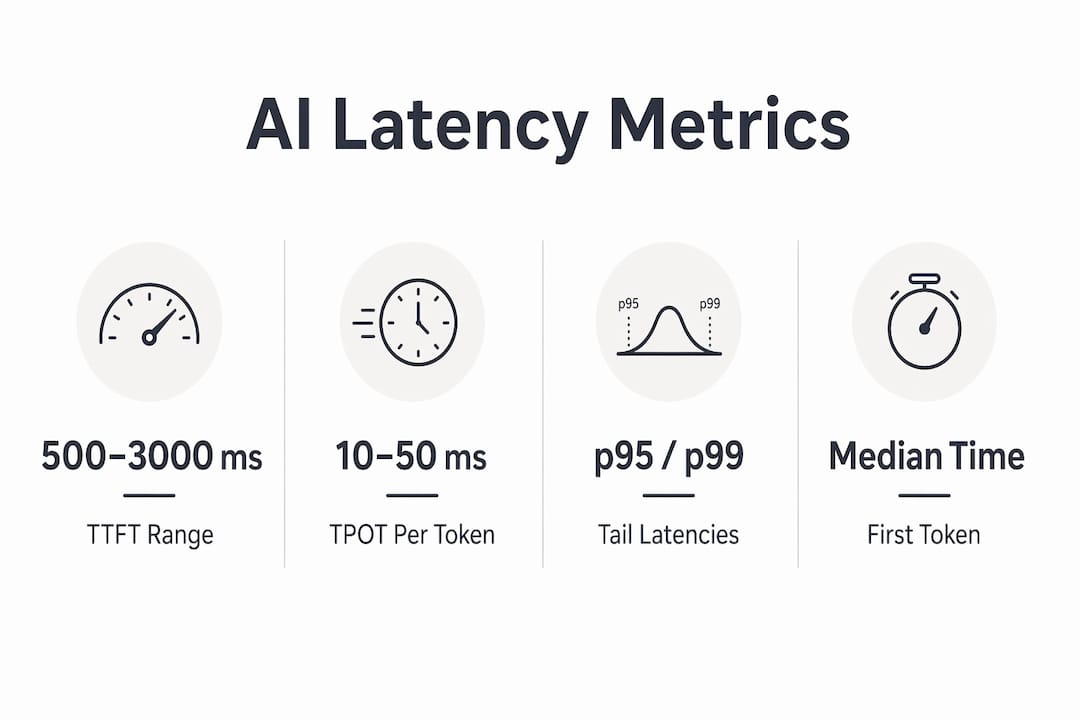
Percentile latency metrics such as p95 and p99 capture the tail delays that averages obscure. If your p99 TTFT is 4,000 ms, one in every hundred users is waiting four seconds before seeing any output. That is not a statistical curiosity. It is a product problem.
LLM instrumentation should separate TTFT into spans reflecting prompt length, route, and cold versus warm cache states. Aggregate end-to-end figures tell you that something is slow. Segmented spans tell you where and why.
Monitoring warm versus cold request latency separately is particularly important for systems with variable traffic. Cold start benchmarking must be included in any realistic performance test, because controlled warm-cache tests will consistently understate the latency spikes real users encounter during peak load or after idle periods.
Pro Tip: Slice your latency dashboards by prompt length quartile. Teams that do this consistently find that their p99 latency is driven almost entirely by requests in the top 25% of prompt length, which points directly to prefill optimisation as the highest-leverage fix.
Practical techniques to reduce AI latency in production
Reducing AI latency is a layered engineering problem. No single technique solves it. The most effective approach targets each bottleneck in sequence, starting with the highest-impact layer for your specific workload.
-
Implement prompt caching and semantic caching. Prompt caching reduces prefill time by reusing previously computed key-value states for repeated prompt prefixes. Semantic caching goes further, returning cached responses for semantically similar queries without re-running inference at all. Both techniques are particularly effective in applications with consistent system prompts or repeated query patterns.
-
Compress and restructure prompts. Shorter prompts reduce prefill time directly. Audit your system prompts for redundant instructions, remove unnecessary context, and use structured formats (such as JSON schemas or concise bullet instructions) rather than verbose natural language. A 30% reduction in prompt token count can translate to a measurable TTFT improvement.
-
Apply chunked prefill and disaggregated serving. Infrastructure techniques like chunked prefill split large prefill operations into smaller chunks processed in parallel or staged sequences, reducing the time before the first token appears. Disaggregated serving separates the prefill and decode phases across different hardware, allowing each to be optimised independently.
-
Right-size your model for the task. Larger models are slower. For tasks that do not require frontier-level reasoning, a smaller, faster model deployed on the same infrastructure will deliver lower latency with acceptable quality. Maintain a model routing layer that directs simple queries to lighter models and complex queries to heavier ones.
-
Optimise network routing and geographic proximity. Deploy inference endpoints in regions close to your primary user base. Use a content delivery network or edge inference layer where latency requirements are strict. The physics of network distance cannot be engineered away, but they can be minimised through thoughtful infrastructure placement.
-
Implement load balancing and queue management. Distribute requests across multiple inference replicas to reduce queue wait time under load. Set concurrency limits and implement request prioritisation so that interactive user-facing requests are not queued behind long-running batch jobs.
-
Instrument before you optimise. None of the above techniques can be applied effectively without knowing which layer is the actual bottleneck. Build observability into your agentic stack before tuning. Teams that skip this step frequently optimise the wrong component and see no meaningful improvement.
Key takeaways
AI latency is a system-wide metric shaped by TTFT, TPOT, network distance, cold starts, and orchestration overhead, and reducing it requires targeted instrumentation before any optimisation work begins.
| Point | Details |
|---|---|
| AI latency definition | The total elapsed time from request submission to completed output, split into TTFT and TPOT. |
| TTFT is the priority metric | TTFT shapes perceived responsiveness most directly; optimise it first for interactive applications. |
| Causes compound across layers | Network, prefill, queueing, cold starts, and orchestration all contribute and require separate fixes. |
| Use percentile metrics | Track p95 and p99 latency, not averages, to capture the tail delays users actually experience. |
| Caching is the highest-leverage fix | Prompt caching and semantic caching reduce prefill time without infrastructure changes. |
Why most teams are measuring AI latency wrong
Having built and operated agentic stacks for SMEs across finance, legal, and GTM functions, the pattern I see most consistently is teams treating AI latency as a model performance problem when it is almost always a system architecture problem.
The instinct is understandable. When a response is slow, the first question is usually “which model are we using?” The more useful question is “where in the request lifecycle is the time being spent?” I have seen deployments where 60% of TTFT was queue wait time, not inference. Switching to a faster model would have done nothing.
The second common error is benchmarking only warm requests. Controlled tests with pre-warmed caches look excellent on paper and mislead product teams into shipping systems that perform poorly for real users hitting cold sessions. Any honest latency assessment must include cold start scenarios.
TTFT is the metric I prioritise in interactive applications above all others. Users tolerate a slow stream. They do not tolerate a blank screen. If your TTFT is above 1,500 ms consistently, that is the first thing to fix, regardless of what your total response time looks like.
Latency optimisation is also not a one-time exercise. As your prompt complexity grows, your user base scales, and your agentic pipelines add tool calls, the bottleneck shifts. The teams that maintain low latency over time are the ones with observability built into their stack from the start, not the ones that ran a benchmark at launch and moved on.
, Hayat
Working with an AI operator to reduce system latency
If your team is deploying AI agents and finding that latency is degrading user experience or operational throughput, the problem is rarely a single configuration change away from resolution.

Meethayat’s AI agent operator services cover the full deployment lifecycle, from agentic stack design and model selection through to instrumentation, caching strategy, and production monitoring. For teams unsure whether they need an operator or a consultant, the operator vs consultant comparison covers the distinction in practical terms. Meethayat also works with finance and data teams on the broader operational and financial implications of AI infrastructure decisions, drawing on three exits as a CFO and direct experience operating agents at scale for SMEs.
FAQ
What is the AI latency definition in simple terms?
AI latency is the total time between sending a request to an AI system and receiving its output. It is typically split into TTFT (the delay before the first token appears) and TPOT (the speed of subsequent token generation).
What causes high AI latency in production?
High AI latency is caused by a combination of model inference time, network round-trip distance, prompt prefill processing, queue wait time under load, cold starts, and orchestration overhead in agentic pipelines. Each layer compounds the total delay.
How do you measure AI latency accurately?
Accurate measurement requires tracking TTFT and TPOT separately, using percentile metrics (p95, p99) rather than averages, and segmenting results by prompt length and cold versus warm cache state to identify the specific bottleneck.
What is a realistic TTFT for a frontier model in 2026?
Typical frontier model TTFT in 2026 ranges from 500 to 3,000 ms depending on model size, prompt length, hardware, and provider load. Values below 800 ms are generally considered acceptable for interactive applications.
What is the fastest way to reduce AI latency?
Prompt caching and semantic caching deliver the fastest latency reductions for most production deployments by eliminating redundant prefill computation. Prompt compression and geographic endpoint optimisation are the next highest-leverage interventions.