What is AI code generation? A developer's 2026 guide


AI code generation is the automated production of source code by artificial intelligence models, primarily large language models (LLMs), responding to natural language prompts or existing code context. Tools like GitHub Copilot, ChatGPT, and Amazon Q Developer now sit inside the daily workflows of millions of developers, generating everything from single-line completions to full function implementations. The shift is not cosmetic. LLMs generate code token-by-token from training on massive code corpora, which means the speed and volume of software production have changed fundamentally. Understanding what drives that change, and where it breaks down, is now a core competency for any serious developer.
What is AI code generation and how does it work technically?
AI code generation is defined as the process by which an LLM receives a prompt, tokenises it, and predicts the most probable sequence of subsequent tokens to produce syntactically valid code. The next-token autoregressive prediction process is the engine underneath every major tool: the model computes a probability distribution over its vocabulary at each step, selects a token, appends it to the context, and repeats until a stopping condition is met. This is fundamentally probabilistic, not deterministic. The same prompt can yield different outputs on different runs, which is the single most important fact developers need to hold in mind.
Tokenisation of code differs from natural language in ways that matter. Code contains dense symbolic syntax, strict indentation, and domain-specific keywords that map to tokens differently than prose. Model families such as GPT-4, CodeLlama, and StarCoder are each trained on different mixes of code corpora, which produces measurable differences in their performance across languages and task types.

The shift from formal program synthesis to LLM-based generation trades mathematical guarantees for broad pattern learning and scalability. Formal synthesis could prove correctness; LLMs cannot. That trade-off is acceptable for boilerplate and scaffolding, but it demands scrutiny for logic-critical paths.
Context window size is a hard constraint. Most models process between 8,000 and 200,000 tokens at once, which is rarely the entire codebase. To compensate, modern AI editors use a retrieval-augmented generation pipeline that semantically indexes the repository, retrieves the most relevant code chunks, and injects them into the model’s context window. This is why Cursor, for example, feels more contextually aware than a plain API call to GPT-4.
- The user writes a prompt or positions the cursor in the editor.
- The IDE or tool semantically indexes the codebase and retrieves relevant chunks.
- The retrieved context plus the prompt are assembled into the model’s input window.
- The LLM generates tokens autoregressively until the output is complete.
- The output is surfaced as a suggestion, diff, or inserted block for developer review.
Pro Tip: When working with large repositories, explicitly reference the file or function name in your prompt. Retrieval pipelines rank by semantic similarity, so specificity in the prompt directly improves the quality of the retrieved context and, therefore, the generated output.
What are the main use cases for AI code generation tools?
A 2026 Springer survey classifies AI code generation tasks into four primary categories: code completion, function synthesis, program generation, and test creation. Each maps to a distinct point in the software development lifecycle, which means the tools you choose should match the stage of work, not just the language.
The practical categories developers encounter daily include:
- Code completion and inline suggestions: GitHub Copilot and Amazon Q Developer complete lines and blocks as you type, reducing keystrokes on boilerplate.
- Function and program synthesis: Describing a function’s purpose in plain English and receiving a full implementation. ChatGPT and Claude are commonly used here.
- Code translation: Converting Python to TypeScript, or migrating legacy COBOL to Java, using models fine-tuned for cross-language tasks.
- Legacy code modernisation: Refactoring outdated patterns, updating deprecated APIs, and adding type annotations to untyped codebases.
- Infrastructure as code (IaC) generation: Producing Terraform, Bicep, or CloudFormation templates from natural language descriptions of infrastructure requirements.
- Automated test generation: Generating unit tests, integration tests, and edge-case scenarios from existing function signatures.
- Code review and documentation: Explaining unfamiliar code, generating docstrings, and flagging potential logic errors.
A separate and fast-growing category is AI app builders. Tools like Lovable, Vercel v0, and Bolt generate entire front-end applications from a single prompt, targeting non-engineers and rapid prototypers. These sit at the far end of the automation spectrum and carry the highest risk of unchecked output entering production.
| Tool category | Primary use case | Representative tools |
|---|---|---|
| Inline completion | Line and block suggestions in IDE | GitHub Copilot, Amazon Q Developer |
| Chat-based synthesis | Function and program generation from prompts | ChatGPT, Claude, Gemini |
| App builders | Full application scaffolding from prompts | Lovable, Vercel v0, Bolt |
| Test generation | Unit and integration test creation | CodiumAI, GitHub Copilot (test mode) |
| IaC generation | Cloud infrastructure template creation | AWS CodeWhisperer, Copilot for Azure |
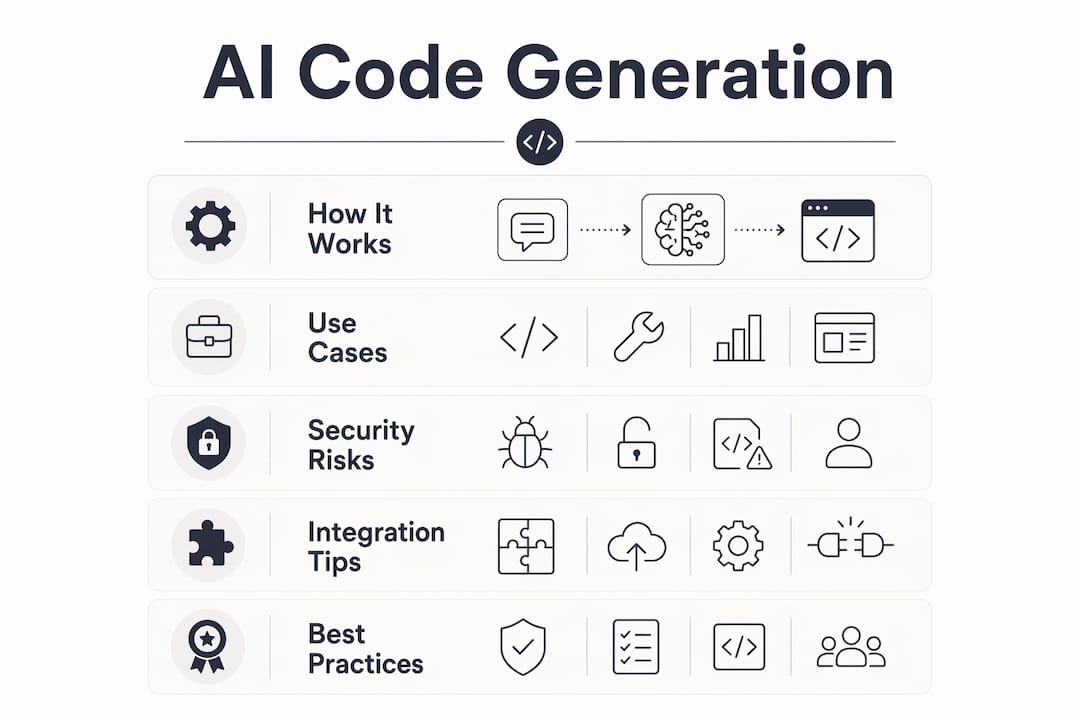
What security risks come with AI-generated code?
Nearly half of AI-generated code commits exhibit known security defects, including SQL injection, cross-site scripting (XSS), and log injection vulnerabilities. This is not a fringe problem. It is a structural consequence of how LLMs work: they optimise for plausible, syntactically correct output, not for secure output. The model has no runtime context, no knowledge of your authentication layer, and no awareness of your data classification policies.
A large-scale empirical study identified 28,931 correctness and security issues across 665 real repositories where AI-generated code had been merged. That figure represents accumulated technical debt that is harder to attribute and remediate precisely because mixed human-AI commits obscure provenance. The debt compounds silently until a security audit or production incident surfaces it.
The specific risks developers need to account for include:
- Hallucinated package names: LLMs sometimes reference non-existent npm, PyPI, or Maven packages. Attackers register these names with malicious payloads, a supply chain attack vector known as dependency confusion.
- Insecure defaults: AI-generated authentication code frequently omits rate limiting, input sanitisation, and proper session management because these are underrepresented in training data relative to the happy path.
- Context blindness: The model cannot see your secrets manager, your network topology, or your compliance requirements. It generates code that works in isolation, not code that is safe in your environment.
“Embedding security tooling into AI-assisted development workflows is the only reliable way to catch vulnerabilities early and balance velocity with safety.”, Veracode
The mitigation stack should include static application security testing (SAST) tools such as Semgrep or Snyk Code, software composition analysis (SCA) for dependency auditing, dynamic analysis (DAST) for runtime behaviour, and a package firewall to block hallucinated or typosquatted dependencies before they reach the build.
Pro Tip: Treat every AI-generated function as untrusted third-party code on first review. Run it through your SAST pipeline before it enters a pull request, not after. The cost of catching a SQL injection pre-merge is orders of magnitude lower than post-deployment.
How to integrate AI code generation into your development workflow
AI is strongest at bounded tasks where the input and expected output are well-defined. Boilerplate, refactors, and test scaffolding are where the productivity gains are real and measurable. Specification, naming, edge-case handling, and correctness verification remain human responsibilities. Conflating the two is where technical debt accumulates.
A practical integration cycle follows this structure:
- Design the prompt with precision. Specify the function signature, expected inputs and outputs, error handling requirements, and any relevant constraints. Vague prompts produce vague code.
- Generate and immediately review. Do not accept suggestions without reading them. AI outputs frequently cover only the happy path, omitting error handling and edge cases that your production environment will encounter.
- Run automated checks before human review. SAST, linting, and type checking should execute on the generated code before it reaches a colleague’s eyes. Automate this in your CI pipeline.
- Modify, do not accept wholesale. Treat AI output as a first draft. Adjust naming conventions, add missing validations, and verify that the logic matches your specification.
- Test explicitly. Write or generate tests that cover the edge cases the AI omitted. If the AI also generated the tests, verify that they actually test failure modes, not just the success path.
Microsoft’s approach with authoring MCP servers for generate-validate-fix cycles demonstrates a mature pattern: restrict generation to locally verifiable code, run automated validation, and surface only passing outputs for developer approval. This agentic loop reduces the surface area of unchecked AI output entering the codebase. For teams building on this model, the role of AI tools for builders is increasingly one of orchestration rather than simple autocomplete.
Pro Tip: Build a prompt library for your team’s most common tasks: API endpoint scaffolding, database migration scripts, test fixtures. Standardised prompts produce more consistent outputs and make AI-assisted code easier to review because reviewers know what to expect.
Key takeaways
AI code generation delivers real productivity gains only when developers treat outputs as probabilistic drafts requiring validation, security review, and explicit edge-case testing.
| Point | Details |
|---|---|
| Core mechanism | LLMs generate code token-by-token via autoregressive prediction, making outputs probabilistic, not guaranteed. |
| Retrieval pipelines matter | Tools like Cursor use semantic indexing to inject relevant codebase context, improving generation quality significantly. |
| Security is structural, not optional | Nearly half of AI-generated commits contain known vulnerabilities; SAST and SCA must be embedded in the CI pipeline. |
| Technical debt accumulates silently | 28,931 issues were identified across 665 real repos; mixed human-AI commits make attribution and remediation harder. |
| Bounded tasks yield the best returns | AI excels at boilerplate, refactors, and test scaffolding. Correctness, naming, and specification remain human work. |
The uncomfortable truth about AI code generation
The productivity narrative around AI code generation is accurate but incomplete. Since late 2022, the pace of capability improvement has been genuinely remarkable. GitHub Copilot went from a novelty to a tool that meaningfully reduces time on repetitive tasks. CodeLlama and StarCoder brought capable open-source alternatives. App builders like Lovable compressed weeks of front-end scaffolding into minutes.
What the productivity narrative underplays is the quality gradient. I have seen teams adopt AI-assisted coding, ship faster for two quarters, and then spend the third quarter unwinding a codebase full of insecure defaults, missing error handling, and hallucinated dependencies that made it into production. The velocity was real. So was the debt.
The developers who get the most from these tools are not the ones who accept suggestions fastest. They are the ones who have internalised what the model cannot know: your threat model, your data contracts, your operational constraints. They use AI to eliminate the tedious parts of coding and apply their own judgement to everything that matters.
The risk of over-trusting AI outputs is not theoretical. It is already showing up in production repositories at scale. The answer is not to use AI less. It is to build validation into the workflow so that speed and quality are not in opposition. That requires deliberate process design, not just tool adoption. If you are thinking about whether AI will displace developers entirely, the honest answer from an operator’s perspective is more nuanced than the headlines suggest.
, Hayat
Work with an AI agent operator to deploy this responsibly
Knowing how AI code generation works is one thing. Deploying it inside a real software development lifecycle, with security controls, validation loops, and measurable productivity outcomes, is a different discipline entirely.

Meethayat’s AI agent operator service is built for organisations that want to move beyond ad hoc tool adoption and into structured, auditable AI-assisted development. Hayat Amin designs and operates agentic stacks that integrate generation, validation, and security review into your existing workflows, whether you are an SME shipping a product or an enterprise managing a legacy codebase. If you are weighing how to structure that engagement, the operator vs consultant comparison is a practical starting point.
FAQ
What is AI code generation in simple terms?
AI code generation is the process by which an AI model, typically a large language model, produces source code from a natural language prompt or existing code context. Tools like GitHub Copilot and ChatGPT are the most widely used examples.
How does an LLM actually generate code?
The model tokenises the input, then predicts the most probable next token iteratively until the output is complete. This autoregressive process is probabilistic, meaning the same prompt can produce different outputs on different runs.
Is AI-generated code safe to use in production?
Not without review. Nearly half of AI-generated commits contain known security vulnerabilities. SAST tools, dependency auditing, and explicit edge-case testing are required before AI-generated code enters production.
What is the difference between code completion and program synthesis?
Code completion suggests the next line or block based on cursor position. Program synthesis generates an entire function or module from a natural language description of its purpose. Both are classified as distinct AI code generation tasks with different model performance profiles.
What is technical debt from AI-generated code?
Technical debt from AI-generated code refers to correctness and security issues that accumulate when AI outputs are accepted without validation. A 2026 study found 28,931 such issues across 665 repositories, compounded by poor provenance tracking in mixed human-AI codebases.