What is a tech company exit: founder's guide


A tech company exit is defined as the liquidity event through which founders, investors, and employees convert private equity into cash or publicly traded shares. The most common routes are acquisition, initial public offering (IPO), and secondary sale. Understanding what is a tech company exit matters because the structure, timing, and preparation of that event determine how much value each stakeholder actually receives. M&A accounts for over 90% of venture-backed tech exits, making it the dominant path by a wide margin. This guide covers exit methods, preparation timelines, valuation drivers, and the practical decisions founders face when planning their own exit.
What is a tech company exit and why does it matter?
A tech company exit is the formal mechanism by which private equity becomes liquid. Before an exit, founder equity sits on a cap table, paying no dividends and generating no cash flow. That illiquidity is the defining constraint of private company ownership, and planning for secondary sales during a prolonged private lifespan is one way founders manage it before a full exit occurs.
The term “exit” is the informal industry shorthand. The recognised financial term is “liquidity event,” and both are used interchangeably across M&A advisory, venture capital, and corporate finance. The distinction matters because the word “exit” can mislead founders into thinking it is purely about leaving the business. In practice, many founders remain operationally involved for years after a transaction closes.
Exits matter to three distinct groups. Founders realise the financial return on years of risk. Investors, particularly venture capital funds with fixed lifespans, need exits to return capital to their limited partners. Employees with equity compensation receive their payout at the same event. Misaligning the interests of these three groups is one of the most common reasons exit processes stall.
What are the main methods for exiting a tech company?
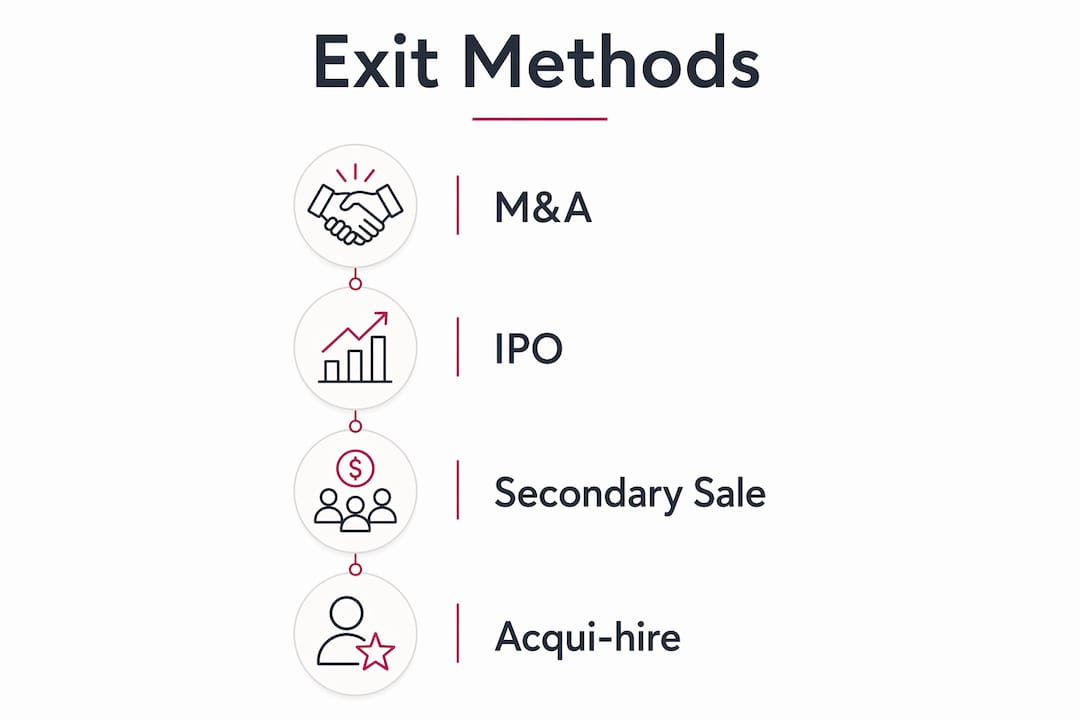
The four primary exit routes are mergers and acquisitions (M&A), IPO, secondary sale, and acqui-hire. Each suits a different company profile, investor base, and founder objective.

Mergers and acquisitions
M&A is the dominant exit path. Over 90% of venture-backed exits are acquisitions, not IPOs. That figure reflects the reality that most tech companies never reach the scale, governance maturity, or public market appetite required for a listing. Acquisitions can be driven by strategic buyers (larger companies seeking technology, talent, or market position) or financial buyers (private equity firms seeking financial returns and operational improvement).
Strategic buyers typically pay more. Strategic buyers pay 1.5, 2x higher valuations than financial buyers because they can generate synergies that a standalone financial model cannot capture. That premium is real, but it comes with integration risk and often a longer negotiation process.
Initial public offerings
IPOs represent fewer than 1% of tech exits. They require significant revenue scale, audited financials under public company standards, a board with independent directors, and the appetite to manage quarterly earnings scrutiny indefinitely. For founders considering this route, IPO readiness is a multi-year preparation process, not a six-month sprint.
Secondary sales and acqui-hires
Secondary sales allow founders and early investors to sell shares to new private investors before a full exit. This provides partial liquidity without triggering a full company sale. An acqui-hire is distinct from a strategic acquisition. Acqui-hires typically result in product sunsetting and modest investor returns. They are team or IP focused, often representing a soft landing for a struggling business rather than a value-maximising outcome.
| Exit method | Typical buyer | Valuation basis | Founder outcome |
|---|---|---|---|
| Strategic acquisition | Corporate buyer | Synergy value | High, with earn-out risk |
| Financial acquisition | Private equity | Financial returns | Moderate, operationally driven |
| IPO | Public markets | Revenue multiples | High, with lock-up period |
| Secondary sale | Private investors | Negotiated | Partial liquidity only |
| Acqui-hire | Corporate buyer | Team or IP value | Low to moderate |
Pro Tip: If you receive interest from both a strategic and a financial buyer simultaneously, run a structured process. Competitive tension between buyer types consistently produces better terms than a bilateral negotiation.
How long does it take to exit a tech company?
The average exit timeline is now 10, 12 years, up from 5, 7 years a decade ago. That shift reflects later-stage private funding rounds, higher IPO thresholds, and more demanding buyer due diligence standards. Founders who build their companies expecting a five-year exit are routinely surprised.
Preparation for the exit itself requires a separate window of 18, 36 months. Founders should begin exit preparation 18, 36 months in advance, focusing on four areas:
- Institutional-grade financial reporting. Buyers and public markets expect audited accounts, clean management accounts, and board-level reporting that matches the standards of a much larger company. Weak board reporting is one of the most common causes of valuation haircuts in due diligence.
- Cap table cleanup. Disorganised option pools, convertible notes with ambiguous terms, and missing shareholder agreements create legal risk that buyers price into their offers. Resolve these before going to market.
- Legal risk resolution. Outstanding IP disputes, employment claims, or regulatory non-compliance issues surface in due diligence and either kill deals or reduce proceeds. Address them early.
- Data room readiness. The bulk of exit preparation is front-loaded into this 18, 36 month window. A well-organised data room signals operational maturity to buyers and accelerates the process.
Pro Tip: Treat your data room as a living document, not a last-minute assembly. Update it quarterly so that when a buyer requests access, you are ready within days rather than weeks.
What factors influence valuation and deal structure?
Valuation in a tech exit is not a single number. It is a starting point for a negotiation that ends with a deal structure. The headline price and the actual cash a founder receives can differ substantially.
Key valuation drivers
Three factors consistently drive valuation outcomes:
- Product-market fit and growth metrics. Buyers pay for predictable, recurring revenue. Annual recurring revenue (ARR) growth rate, net revenue retention, and customer acquisition cost are the metrics that matter most in SaaS and software exits.
- Governance maturity. Operational readiness is as important as growth metrics. A company with strong governance, clean financials, and documented processes commands a higher multiple than a faster-growing company with operational disorder.
- Buyer type. As noted, strategic buyers pay more. Strategic buyers generate synergies that justify premiums a financial buyer cannot match.
Deal structure elements that affect real returns
Deal structure details including liquidation waterfalls, earn-outs, and tax implications are critical and frequently misunderstood. Founders who focus only on headline valuation often receive far less cash than they expected.
- Earn-outs tie a portion of the purchase price to future performance targets. They are common in acquisitions where the buyer and seller disagree on growth projections. They are also frequently missed.
- Liquidation preferences determine the order in which proceeds are distributed. Investors with participating preferred shares may receive their return before founders see any cash.
- Escrow holdbacks place a percentage of proceeds in escrow for 12, 24 months to cover post-close indemnification claims.
- Tax structuring at the deal level can significantly affect net proceeds. Tax implications during M&A are deal-specific and require specialist advice well before signing.
Pro Tip: Ask your adviser to model three scenarios for every deal: headline price, expected cash at close, and worst-case cash after earn-out misses and escrow claims. The gap between scenarios is where founder expectations most often diverge from reality.
What are the practical strategies for founders during an exit?
Execution is where exits succeed or fail. A well-prepared company with a poor process will underperform a moderately prepared company with a disciplined approach.
- Build optionality early. Founders who cultivate relationships with potential acquirers, investment bankers, and secondary buyers years before they need them have more choices when the time comes. Optionality produces better terms.
- Align stakeholders before going to market. Misalignment between founders, investors, and board members surfaces at the worst possible moment during a live process. Resolve disagreements on price expectations, timing, and deal structure before engaging buyers.
- Handle due diligence as a project. Assign a dedicated internal owner for the data room. Buyers lose confidence when responses are slow or inconsistent. M&A financial preparation is a discipline, not an afterthought.
- Do not confuse a term sheet with a closed deal. Many founders equate a high-valuation term sheet with a successful exit, but the deal must survive due diligence, regulatory review, and post-close integration. Term sheets fall apart regularly.
- Recognise when to wait. Market conditions, interest rate environments, and sector sentiment affect exit multiples. A company that is not yet ready to command its target valuation is better served by another 12 months of preparation than a rushed process at a discount.
A successful exit is defined not just by valuation but by deal closure, stakeholder alignment, and the company’s ongoing viability after the transaction. Founders who understand this definition make better decisions throughout the process.
Key takeaways
A tech company exit is a structured liquidity event that requires years of preparation, disciplined governance, and a clear understanding of deal structure to convert equity into actual cash proceeds.
| Point | Details |
|---|---|
| M&A dominates exits | Over 90% of venture-backed tech exits are acquisitions, not IPOs. |
| Prepare 18, 36 months ahead | Cap table cleanup, financial reporting, and legal risk resolution must begin well before going to market. |
| Strategic buyers pay more | Strategic acquirers pay 1.5, 2x more than financial buyers due to synergy value. |
| Headline price is not cash received | Earn-outs, liquidation preferences, and escrow holdbacks reduce actual founder proceeds. |
| Term sheets are not exits | A signed term sheet begins due diligence; deals fail at this stage regularly. |
What three exits taught me about timing and preparation
Having exited three times as a CFO, the single most consistent lesson is this: founders who start exit planning late pay for it in valuation, not just stress. The companies I have seen achieve the strongest outcomes began treating exit readiness as an operational discipline two to three years before any formal process started. They had clean books, resolved IP ownership, and a cap table that a buyer’s lawyer could read in an afternoon.
The second lesson is that founders systematically overestimate the importance of the headline number and underestimate deal structure. I have watched founders celebrate a term sheet at a strong valuation, only to receive materially less cash at close after earn-out mechanics, liquidation preferences, and escrow holdbacks were applied. The number that matters is the one in your bank account after tax.
The third lesson is about buyer type. A strategic acquirer is not always the best outcome. Integration risk is real. If a strategic buyer intends to sunset your product and absorb your team, the earn-out tied to product performance will almost certainly be missed. Understand what the buyer actually wants before you accept a premium that depends on a future you cannot control. Seek expert exit advisory early, not when a buyer is already at the table.
, Hayat
How Meethayat supports founders preparing for a tech exit
Preparing a tech company for exit requires financial, legal, and governance work that most founding teams have not done before.

Meethayat brings three-times exited CFO experience to founders navigating this process. The work covers institutional-grade financial reporting, IP strategy and patent portfolio positioning, governance structuring, and M&A readiness. For founders considering an IPO, Meethayat provides pre-IPO advisory grounded in real transaction experience. For those building towards acquisition, the focus is on the financial and operational disciplines that buyers price into their offers. Meethayat also deploys AI agents into finance and legal operations to accelerate data room preparation and reporting quality. If you are a founder with an exit on the horizon, the right time to engage is now, not when a buyer is already in the room.
FAQ
What is the meaning of a company exit in tech?
A tech company exit is the liquidity event through which founders and investors convert private equity into cash or public shares, most commonly via acquisition or IPO.
How long does a tech startup exit typically take?
The average exit timeline is now 10, 12 years from founding, with a dedicated preparation period of 18, 36 months before going to market.
What is the most common tech company exit route?
M&A is the dominant route, accounting for over 90% of venture-backed tech exits. IPOs represent fewer than 1% of exits.
What is an acqui-hire in a tech exit?
An acqui-hire is an acquisition focused on absorbing a team or IP rather than the product. It typically results in product sunsetting and modest investor returns.
How does deal structure affect founder returns in a tech exit?
Earn-outs, liquidation preferences, escrow holdbacks, and tax structuring can significantly reduce the cash a founder receives relative to the headline acquisition price.