The role of AI in software development: 2026 guide


The role of AI in software development is to act as an autonomous collaborator that handles implementation tasks, testing, and integration while developers focus on guiding and validating outcomes. Tools like GitHub Copilot, Claude Code, and Cursor have moved well beyond autocomplete, operating as agentic coding partners capable of generating multi-file changes, running test suites, and flagging regressions. 84% of developers now use or plan to use AI coding tools, with AI-native teams reporting 20 to 50% productivity improvements. The shift is structural, not cosmetic. Developer roles are migrating from authoring code to orchestrating intelligent agents and specifying intent.
How does AI integrate across the software development lifecycle?
AI’s impact on software development is not confined to a single phase. It spans every stage of the software development lifecycle (SDLC), from design specification through to runtime monitoring, and the SDLC is shifting from sequential, handoff-driven workflows to fluid, concurrent human-AI collaboration.
During the planning and design phase, AI tools analyse requirements documents, surface ambiguities, and generate executable specification artefacts. These artefacts then serve as validation anchors for subsequent AI agents, reducing the interpretive drift that causes rework. In the coding phase, tools like Cursor and Claude Code handle multi-file generation, refactoring, and dependency resolution autonomously. This is qualitatively different from a linter or a snippet library.

Testing has seen some of the most dramatic changes. AI agents generate unit tests, integration tests, and regression suites from code context alone, then execute them in CI/CD pipelines without human intervention. Legacy code modernisation is a particularly strong use case: AI can parse decades-old COBOL or Fortran, map dependencies, and produce annotated migration plans in hours rather than weeks.
Deployment and monitoring are also changing. AI-driven CI/CD automation detects anomalous build patterns, predicts failure probability before a release, and can roll back autonomously under defined conditions. Runtime monitoring agents correlate logs, traces, and metrics to surface root causes faster than any on-call engineer working alone.
- Planning: AI generates specification artefacts and surfaces requirement gaps before a line of code is written.
- Coding: Agentic tools produce multi-file implementations from natural language prompts.
- Testing: Automated test generation and execution reduce manual QA cycles significantly.
- Deployment: AI-driven pipelines predict and prevent release failures.
- Monitoring: Agents correlate telemetry data and recommend or execute remediation.
Pro Tip: Treat your specification documents as first-class infrastructure. AI agents perform significantly better when given structured, unambiguous requirements. Invest time upfront in clean specs and you will recover it tenfold during generation and review cycles.
What changes for developers: new roles, skills, and workflows?
Developer identity is undergoing a fundamental reorientation. The shift is from coding authorship to becoming a designer of intent and an orchestrator of AI agents. This is not a minor adjustment in tooling; it is a change in what constitutes professional value.
Research from Atlassian confirms that developers spend roughly 84% of their time on context assembly, planning, and judgement rather than writing code. AI does not eliminate this work. It amplifies the consequences of doing it well or poorly. A developer who decomposes a task clearly and writes a precise prompt will get a working implementation. One who provides vague instructions will spend hours debugging plausible-looking but subtly broken output.
The new core competencies for AI-native development look like this:
- Task decomposition: Breaking work into discrete, verifiable units that an AI agent can execute and a human can review independently. Vague epics produce vague code.
- Prompt engineering: Writing instructions that constrain the solution space without over-specifying implementation details. This is a learnable skill, not an art form.
- Review and validation: Critically assessing AI-generated code for correctness, security, and architectural fit. Rubber-stamping AI output is the fastest route to technical debt.
- Architectural judgement: Making decisions about system design, data models, and integration patterns that AI agents currently cannot make reliably without human direction.
- Agent orchestration: Configuring, sequencing, and monitoring multiple AI agents working in parallel across a codebase.
The risk of skill degradation is real. Widespread GenAI adoption risks homogenised developer output and the erosion of foundational knowledge when teams stop practising core engineering skills. Junior developers who never write code from scratch may struggle to review it meaningfully. This is not a theoretical concern; it is already visible in teams that adopted AI tools without structured oversight.
Pro Tip: Rotate developers through “no-AI” sprints periodically. This preserves debugging intuition, deepens architectural understanding, and ensures your team can operate if a tool becomes unavailable or produces a systemic failure.
What productivity gains does AI actually deliver?
The productivity case for AI in programming is well-supported, though the numbers require careful interpretation. AI-native teams report 20 to 50% productivity improvements, and 41% of organisations are targeting end-to-end AI-managed software lifecycles within 18 months, projecting 5 to 10x improvements from hybrid human-AI teams.
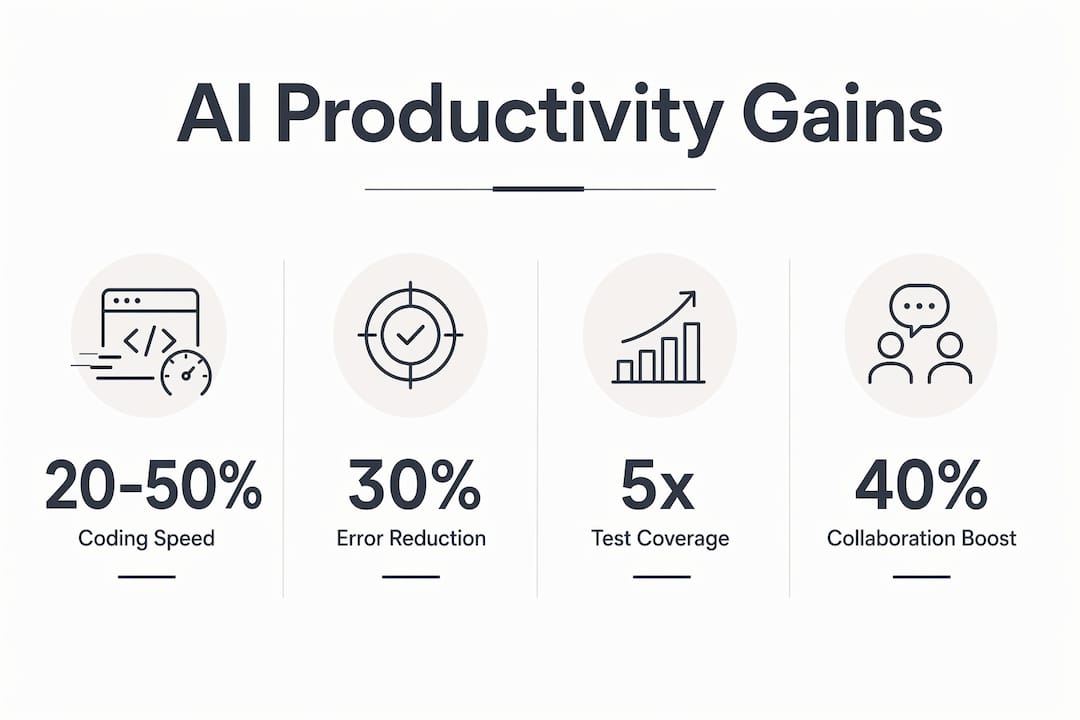
The practical bottleneck is context assembly and planning, not raw coding speed. AI enables developers to handle more concurrent projects by compressing the time spent on implementation, but the gains are unevenly distributed. AI accelerates tasks developers already enjoy, such as writing new features, but fails to automate meetings, stakeholder management, and organisational bureaucracy. The net time gain at the individual level is therefore smaller than headline figures suggest.
| Productivity dimension | What the data shows |
|---|---|
| Individual coding speed | 20 to 50% faster for AI-native developers on implementation tasks |
| Concurrent project capacity | Developers report handling more parallel workstreams due to compressed implementation cycles |
| Team-level throughput | 5 to 10x gains projected for hybrid human-AI teams with end-to-end AI SDLC integration |
| Non-coding time | AI does not reduce meetings or administrative overhead, limiting net individual gains |
The implication for project managers is direct: AI productivity gains are most visible at the team and portfolio level, not the individual sprint level. Reframe your measurement accordingly. Track cycle time, defect escape rate, and concurrent project throughput rather than story points per developer.
What are the risks of AI-augmented software development?
The risks of AI adoption in software development are specific, measurable, and frequently underestimated by teams focused on speed gains. A 25% increase in AI adoption correlates with a 1.5% decrease in delivery throughput and a 7.2% decrease in delivery stability. This means teams moving fastest with AI are often simultaneously degrading their release reliability.
The debugging problem is acute. 66% of developers find debugging AI-generated “almost right” code more time-consuming than writing the equivalent code manually. AI-generated code is syntactically correct and structurally plausible, which makes errors harder to locate. A human-written bug often reflects a misunderstanding the developer can retrace. An AI-generated bug may reflect a subtle context misinterpretation with no obvious audit trail.
Technical debt accumulates faster under AI-assisted development than most teams anticipate. Increased code churn, duplicated logic across AI-generated modules, and inconsistent naming conventions compound over time. Without deliberate governance, codebases become harder to maintain even as they grow faster.
“AI agent performance requires observability and workflow design to avoid unmanageable technical debt and spiralling costs.”, Developer’s Digest, May 2026
Security is a distinct concern. AI agents with broad repository access and execution permissions create a large blast radius if compromised or misdirected. Scoped permissions, automated security scanning on all AI-generated code, and clear accountability frameworks are not optional governance overhead. They are the minimum viable controls for responsible AI use in production environments.
What are the best practices for integrating AI into software teams?
Effective AI integration in software development requires deliberate design of trust, observability, and role structure. Teams that treat AI as a drop-in replacement for developers consistently underperform those that redesign workflows around AI’s actual capabilities and limitations.
- Build trust progressively. Atlassian’s internal research confirms that AI trust should progress stepwise, from reactive suggestions to supervised automation to autonomous coordination. Skipping stages destroys developer confidence and produces unreviewable output.
- Implement observability from day one. Log every AI agent action, track latency, and monitor token consumption. Without this, you cannot diagnose failures, control costs, or demonstrate compliance. Observability is the foundation of sustainable AI agent operations.
- Scope agent permissions tightly. Grant AI agents the minimum access required for each task. A code generation agent does not need deployment credentials. A monitoring agent does not need write access to the main branch.
- Appoint AI Champions within teams. These are senior developers responsible for maintaining foundational skills, reviewing AI-generated architecture decisions, and coaching colleagues on effective prompting and task decomposition. This role directly counters the skill degradation risk identified in GenAI adoption research.
- Invest in documentation as AI infrastructure. Clean, structured documentation is the primary context source for AI agents. Teams that treat documentation as an afterthought will find their AI tools producing lower-quality output than competitors who maintain it rigorously.
For a broader view of AI tools for builders across professional workflows, the patterns of governance and trust-building apply well beyond software teams.
Key takeaways
AI in software development delivers measurable productivity gains, but only when teams redesign workflows, maintain human oversight, and govern AI agents with observability and scoped permissions.
| Point | Details |
|---|---|
| AI spans the full SDLC | AI tools now operate across planning, coding, testing, deployment, and monitoring, not just code generation. |
| Developer roles are shifting | The core skill is now designing intent and orchestrating agents, not writing lines of code. |
| Productivity gains are real but uneven | AI-native teams gain 20 to 50% on implementation tasks; non-coding overhead remains largely unchanged. |
| Delivery stability can decrease | A 25% rise in AI adoption correlates with a 7.2% drop in delivery stability without proper governance. |
| Observability and trust progression are non-negotiable | Logging agent actions and building trust stepwise prevents technical debt accumulation and team disengagement. |
Why the ‘designer of intent’ framing matters more than you think
Having operated AI agents across finance and software workflows, the most consistent mistake I observe is teams treating AI adoption as a tooling decision rather than an organisational redesign. They install GitHub Copilot or Cursor, watch productivity metrics improve for a quarter, and then wonder why delivery stability has declined and their codebase has become harder to maintain.
The developer-as-orchestrator model is not a metaphor. It is a literal description of where value creation now sits. The developers who will be most effective in 2026 and beyond are those who can decompose complex systems into verifiable units of work, write specifications precise enough for an agent to act on, and review outputs with the critical eye of someone who understands what correct looks like.
I am also sceptical of the 5 to 10x productivity projections without qualification. Those numbers assume end-to-end AI lifecycle integration with mature governance, clean documentation, and experienced orchestrators. Most teams are nowhere near that baseline. The honest near-term expectation is 20 to 40% faster implementation cycles with a meaningful increase in review and governance overhead. That is still a strong return, but it requires investment, not just adoption.
The question of whether AI will take your job is less relevant than whether you will develop the skills to direct it effectively. The developers and project managers who treat AI fluency as a core professional competency, rather than a productivity shortcut, are the ones building durable careers.
, Hayat
Work with an AI agent operator on your software projects

Meethayat builds and operates AI agent systems for organisations that want to move beyond ad-hoc AI tool adoption into structured, governed, and measurable AI integration. If your team is seeing the productivity gains plateau, delivery stability decline, or technical debt accumulate faster than expected, the issue is almost always workflow design and agent governance rather than tool selection.
Meethayat’s AI agent operator services cover agent design, observability implementation, permission scoping, and team capability development. Whether you are integrating AI into an existing SDLC or building an AI-native development function from the ground up, the engagement is structured around your specific context, not a generic framework. Explore how AI agent operator expertise differs from standard AI consulting before you decide on your next step.
FAQ
What is the role of AI in software development?
AI acts as an autonomous collaborator across the full software development lifecycle, handling code generation, test creation, deployment automation, and runtime monitoring. Developer roles are shifting from writing code to orchestrating AI agents and specifying intent.
Which AI tools are most widely used by developers in 2026?
GitHub Copilot, Claude Code, and Cursor are among the most widely adopted AI coding tools, each operating at different levels of autonomy from inline suggestions to multi-file agentic code generation.
Does AI actually improve developer productivity?
AI-native teams report 20 to 50% productivity improvements on implementation tasks, though gains are concentrated in coding rather than meetings or administrative work, which AI does not meaningfully reduce.
What are the biggest risks of using AI in software development?
A 25% increase in AI adoption correlates with a 7.2% decrease in delivery stability, and 66% of developers find debugging AI-generated code more time-consuming than writing it manually. Technical debt accumulation and skill degradation are the other primary risks without proper governance.
How should teams govern AI agents in a software project?
Scope agent permissions tightly, implement full observability and logging from the outset, build trust progressively rather than deploying autonomous agents immediately, and appoint AI Champions to maintain foundational developer skills and oversight.