The role of AI in cybersecurity: 2026 practitioner guide


Artificial intelligence in cybersecurity is defined by its capacity to detect threats, investigate incidents, and discover vulnerabilities at a speed and scale no human team can match alone. The role of AI in cybersecurity has shifted from a supporting tool to a core operational layer within modern Security Operations Centres (SOCs). Human-guided AI agents now reduce investigation times from over 30 minutes to under two minutes while maintaining accuracy. Microsoft’s MDASH system orchestrates more than 100 specialised AI agents to uncover critical vulnerabilities in production systems. This guide explains how these systems work, where they outperform traditional methods, and how to implement them without creating new attack surfaces.
How AI improves threat detection and incident response
AI-driven threat detection works by analysing vast volumes of telemetry data to identify patterns and anomalies that signature-based tools miss entirely. Traditional security information and event management (SIEM) platforms generate thousands of alerts daily, most of which are noise. Machine learning for cybersecurity changes this by correlating signals across endpoints, network traffic, and identity logs simultaneously, surfacing only the alerts that warrant analyst attention.

The most significant operational gain comes from agentic workflows embedded directly into SOC processes. Rather than an analyst manually querying logs, an AI agent performs the initial triage, enriches the alert with context from threat intelligence feeds, and presents a structured investigation summary. Human-guided AI agents in SOC workflows have reduced investigation times from 30 minutes to under two minutes. That compression frees senior analysts to focus on adversary attribution and containment decisions rather than repetitive data gathering.
The common AI approaches deployed in modern SOCs include:
- Supervised learning: Trained on labelled datasets of known malicious behaviour to classify threats with high confidence.
- Anomaly detection: Establishes behavioural baselines for users, devices, and services, then flags deviations in real time.
- Agentic workflows: Multi-step AI processes that autonomously gather evidence, reason across data sources, and produce validated findings for human review.
- Natural language processing (NLP): Parses unstructured threat intelligence reports and maps indicators of compromise to active detections.
Pro Tip: When deploying AI-driven alert triage, configure human validation checkpoints at the escalation stage rather than the triage stage. This preserves the speed benefit while keeping a qualified analyst accountable for every containment decision.
The benefits of AI in security are most visible in mean time to detect (MTTD) and mean time to respond (MTTR) metrics. Organisations that integrate AI agents into their incident response playbooks consistently report measurable reductions in both. The key is not the AI model itself but the quality of the workflow built around it.
AI-driven vulnerability discovery: multi-agent systems versus traditional scanning
Traditional vulnerability scanning tools such as static application security testing (SAST) and dynamic application security testing (DAST) operate on predefined rule sets. They identify known vulnerability patterns within a single file or function but cannot reason across complex, multi-file codebases or understand the logical chain that makes a flaw exploitable. This is the structural ceiling that AI breaks through.
Microsoft’s MDASH (multi-model agentic scanning harness) orchestrates over 100 specialised AI agents that perform discovery, debate, and validation in parallel. One agent identifies a candidate vulnerability, a second attempts to disprove it, and a third validates exploitability. This adversarial internal process reduces false positives and produces proof-of-concept evidence that security engineers can act on immediately. MDASH has already discovered critical remote code execution flaws in the Windows kernel TCP/IP stack that conventional tools did not surface.
Arm’s Metis system takes a complementary approach. It uses Retrieval-Augmented Generation (RAG) architecture to ingest source code, build files, and documentation together, giving the AI model the contextual understanding needed to trace vulnerabilities across module boundaries. This surpasses traditional static analysis in identifying logic flaws that only become dangerous in combination.
| Capability | Traditional SAST/DAST | Multi-agent AI systems |
|---|---|---|
| Cross-file reasoning | Limited to single function or file | Full codebase traversal with context |
| False positive rate | High, rule-based | Lower, due to internal debate and validation |
| Zero-day discovery | Rare, relies on known signatures | Active, over 1,000 zero-days found as of April 2026 |
| Speed of analysis | Hours to days | Minutes to hours |
| Human effort required | High (manual triage of results) | Lower (AI pre-validates findings) |
The engineering lesson from MDASH is that successful AI security depends more on the agentic system built around the model than on any single model’s raw capability. Organisations that simply prompt a frontier model and expect vulnerability reports will be disappointed. The architecture of orchestration, validation, and human handoff is what produces reliable results.
Pro Tip: Before deploying a multi-agent vulnerability scanner, map your codebase’s module dependencies explicitly. Agents with poor dependency context produce fragmented findings. A well-structured repository with clear build manifests dramatically improves AI analysis quality.
The dual-use nature of AI: attackers versus defenders
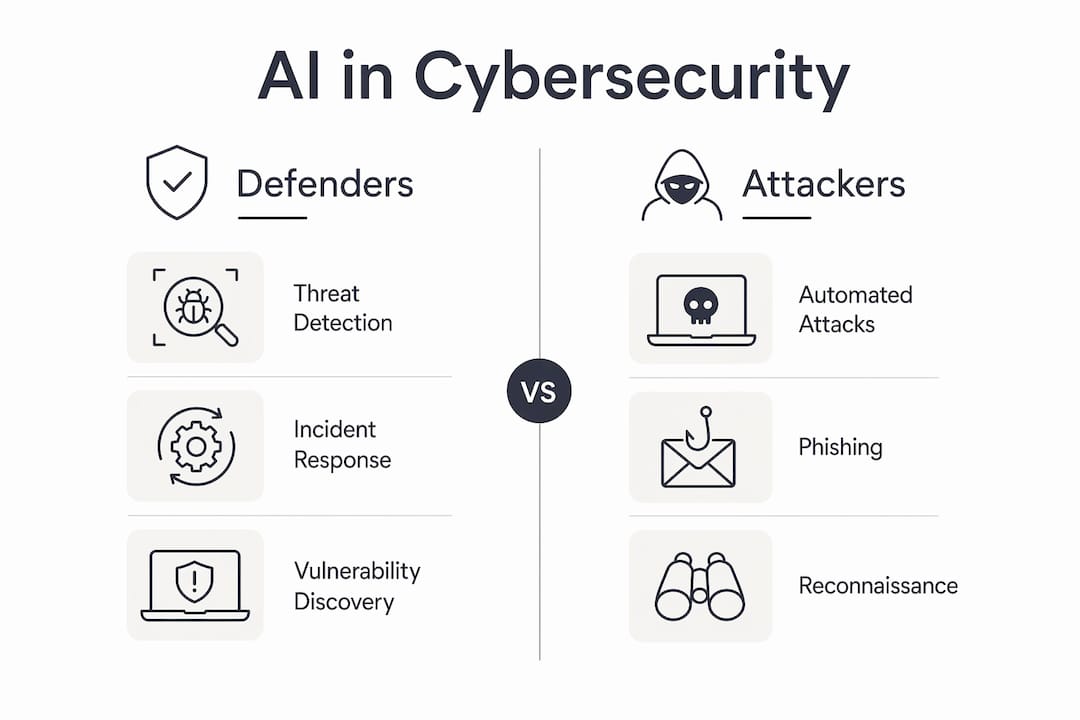
AI lowers the technical barrier for attackers and raises the ceiling for defenders simultaneously. Cyber attackers have used AI models to automate 80 to 90% of complex tactical operations, including reconnaissance, spear-phishing content generation, and exploit adaptation. This means a threat actor with limited technical expertise can now execute campaigns that previously required a skilled team.
The defender’s structural advantage, however, is significant. The NCSC notes that defenders can shape their own environment in ways attackers cannot, using AI to correlate signals across their entire estate and detect stealthy intrusions before they escalate. Critically, AI-driven attacks currently generate noticeable security alerts, giving defenders a detection window that skilled monitoring can exploit.
The risks specific to AI infrastructure itself deserve separate attention:
- Prompt injection attacks: Malicious inputs designed to manipulate AI agent behaviour, causing agents to exfiltrate data or bypass controls.
- AI infrastructure hijacking: Attackers who gain access to an AI agent’s execution environment can use its elevated privileges to move laterally across systems.
- Supply chain risks: Third-party AI models or plugins introduced into the agentic stack may carry backdoors or data exfiltration capabilities.
- Model poisoning: Training data manipulation that causes an AI model to misclassify threats or suppress alerts for specific attack patterns.
“AI lowers the technical barriers for attackers but provides greater benefits to defenders who implement multi-layered defence strategies and carefully vet AI tools.”, Red Canary
The practical implication is that defence-in-depth remains the correct strategic posture. AI does not replace layered controls; it accelerates the detection and response layer within them. Organisations that treat AI as a silver bullet and reduce investment in network segmentation or identity governance will create exploitable gaps.
Practical considerations for implementing AI in security workflows
Integrating artificial intelligence in cybersecurity workflows requires treating AI infrastructure with the same rigour applied to privileged access workstations. AI infrastructure must be guarded as high-privilege assets, with container isolation, short-lived credentials, and supply chain audits to prevent attacker lateral movement via AI agents. This is not optional hardening; it is a prerequisite for safe deployment.
A structured implementation approach for enterprise security teams:
- Classify AI agents as privileged systems. Apply the same access controls, audit logging, and change management processes used for domain controllers and certificate authorities.
- Shift security left into developer tooling. Embedding AI security controls upstream in CI/CD pipelines and developer environments addresses vulnerabilities earlier, when remediation costs are lowest. GitHub Copilot Autofix and Microsoft Defender for DevOps are production examples of this pattern.
- Vet every third-party AI component. Treat AI plugins, model providers, and agent frameworks as supply chain dependencies. Review their data handling, update cadence, and incident disclosure history before integration.
- Implement identity controls for agents. AI agents that call APIs or access data stores must operate under least-privilege service identities with scoped permissions and automatic rotation.
- Maintain human validation in the loop. For high-stakes decisions such as isolating an endpoint or blocking a user account, require a named analyst to approve the AI’s recommendation. Tools like Microsoft’s Agent 365 SDK support configurable human-in-the-loop checkpoints natively.
Pro Tip: Run a tabletop exercise specifically for AI agent compromise scenarios before go-live. Simulate an attacker who has gained control of your triage agent and trace the blast radius. Most teams discover privilege scope issues they would not have caught through standard penetration testing.
Security teams and developers must collaborate closely, embedding AI protections within daily tools to maintain the balance between speed and governance. The organisations that get this right treat AI security not as a project but as an ongoing operational discipline.
Key takeaways
AI in cybersecurity delivers its greatest value when agentic systems combine automated detection speed with structured human oversight, governed by the same controls applied to any high-privilege infrastructure.
| Point | Details |
|---|---|
| Agentic SOC workflows | AI agents reduce investigation times from 30 minutes to under two minutes with human validation at escalation. |
| Multi-agent vulnerability discovery | Systems like MDASH use 100+ agents with internal debate to find zero-days that traditional SAST tools miss. |
| Dual-use risk is real | Attackers automate 80 to 90% of tactical operations with AI; defenders counter this with layered monitoring and signal correlation. |
| AI infrastructure is a target | Treat AI agents as high-privilege systems with container isolation, short-lived credentials, and supply chain audits. |
| Shift security left | Embedding AI controls in CI/CD pipelines and developer tools reduces vulnerability remediation cost and time. |
Why I think most organisations are implementing AI security backwards
Most security teams I speak with are deploying AI as a detection layer on top of an existing, under-governed security stack. They add an AI-powered SIEM overlay, watch the alert volume drop, and declare success. What they have actually done is obscure the underlying problem rather than fix it.
The organisations getting genuine value from AI in security are doing the opposite. They are treating AI as infrastructure first, which means governing it, auditing it, and hardening it before they ask it to protect anything else. The MDASH architecture is instructive here: Microsoft did not build a smarter prompt. They built an engineering harness with 100 specialised agents, internal adversarial validation, and structured human handoff. That is an infrastructure decision, not a tooling decision.
From my work building and operating AI agents for enterprises, the pattern I see repeatedly is that the agentic stack design determines outcomes far more than model selection. A well-orchestrated GPT-4o agent with proper context management and human checkpoints will outperform a poorly orchestrated frontier model every time. The same principle applies in security: the workflow architecture around the AI is the product.
The other thing I would push back on is the assumption that AI primarily benefits attackers. The NCSC’s point about defenders shaping their own environment is underappreciated. Attackers operate in your estate on your terms. If you have built the monitoring infrastructure correctly, AI-assisted intrusions generate detectable signals. The defender who has invested in AI-driven correlation has a structural advantage that a threat actor cannot easily replicate. The question is whether your organisation has done the foundational work to exploit that advantage. Most have not, and that is the real gap.
, Hayat
Work with an AI agent operator who understands security

Deploying AI agents in a security context is not a configuration exercise. It requires an operator who understands agentic stack design, privilege governance, and the specific failure modes that emerge when AI systems interact with sensitive infrastructure. Hayat Amin builds and operates AI agents for enterprises and SMEs, with direct experience in designing human-in-the-loop workflows that meet both operational and security requirements. If your organisation is evaluating AI-driven security workflows and needs expert guidance on safe deployment, the AI agent operator guide explains the difference between an operator and a consultant and why it matters for security-critical implementations. For a practical starting point, the enterprise AI agent buyer guide covers deployment patterns, vetting criteria, and governance frameworks in detail.
FAQ
What is the role of AI in cybersecurity?
The role of AI in cybersecurity is to automate threat detection, accelerate incident investigation, and discover vulnerabilities at a scale and speed that human analysts cannot sustain alone. AI agents integrated into SOC workflows reduce investigation times from over 30 minutes to under two minutes while maintaining accuracy.
How does machine learning improve threat detection?
Machine learning for cybersecurity establishes behavioural baselines across users, devices, and services, then flags anomalies in real time rather than relying on static signatures. This approach surfaces novel attack patterns that rule-based tools miss, particularly in lateral movement and credential abuse scenarios.
Can AI be used against defenders as well as by them?
Attackers have used AI to automate 80 to 90% of complex tactical operations, lowering the barrier for advanced campaigns. Defenders counter this by using AI to correlate signals across their entire estate and by maintaining monitoring infrastructure that detects the noticeable alerts that AI-driven attacks generate.
What is Microsoft MDASH and why does it matter?
MDASH (multi-model agentic scanning harness) is Microsoft’s system that orchestrates over 100 specialised AI agents to discover and prove critical vulnerabilities, including remote code execution flaws in the Windows kernel. It matters because it demonstrates that multi-agent orchestration, not single-model prompting, is the architecture that produces reliable vulnerability discovery at enterprise scale.
How should organisations secure their AI security infrastructure?
AI agents must be treated as high-privilege systems with container isolation, short-lived credentials, least-privilege service identities, and supply chain audits. Human validation checkpoints should be built into any AI workflow that triggers containment or access-blocking actions.