The role of AI in customer service: SME guide


The role of AI in customer service is to automate routine interactions, accelerate resolution times, and deliver personalised experiences at a scale no human team can match alone. Intercom’s Fin AI automated over 81% of support volume while absorbing a 300% increase in demand without additional headcount, saving between $7.5M and $9M annually. That single data point reframes the conversation for SME leaders: AI in support services is no longer a cost experiment. It is a structural shift in how customer relationships are managed, and the businesses that treat it as such will outpace those that do not.
What tasks does AI automate and enhance in customer service?
Conversational AI, the industry term covering AI chatbots, voice agents, and automated ticketing systems, handles the high-volume, low-complexity work that consumes most of a support team’s day. The practical categories include:
- Chatbot triage: Classifying inbound queries and routing them to the correct department or knowledge base without human intervention.
- Voice agent call handling: Identifying the reason for a call and resolving it without a live agent. The Home Depot’s AI voice agents identify call reasons in under 10 seconds and resolve issues four times faster than traditional systems.
- Automated ticketing: Drafting responses, summarising ticket history, and suggesting resolutions directly inside platforms like Zendesk. Fivetran’s AI integration into Zendesk reduced human effort per ticket by contextualising each case before an agent even reads it.
- Proactive outreach: Triggering follow-up messages based on customer behaviour, purchase history, or unresolved issues.
The performance gap between AI and traditional support is measurable. Klarna’s AI assistant resolves issues in under 2 minutes compared to 11 minutes for human agents, handling 2.3 million conversations monthly with 25% fewer repeat enquiries. That 25% reduction in repeat contacts is the more telling figure: it signals that AI is not just faster, it is producing better first-contact resolution.
| Metric | Human agents | AI-powered agents |
|---|---|---|
| Average resolution time | 11 minutes | Under 2 minutes |
| Repeat enquiry rate | Baseline | 25% lower |
| Call reason identification | Variable | Under 10 seconds |
| Volume scalability | Linear (headcount) | Non-linear (software) |
Pro Tip: Map your top 20 inbound query types before selecting an AI tool. If 60% or more are factual, transactional, or procedural, you have a strong automation case without touching complex or emotionally sensitive interactions.
How does AI compare with human agents in customer service?
AI and human agents are not competing for the same work. They are suited to fundamentally different categories of interaction, and conflating the two is the most common mistake SME leaders make when planning an artificial intelligence customer experience strategy.

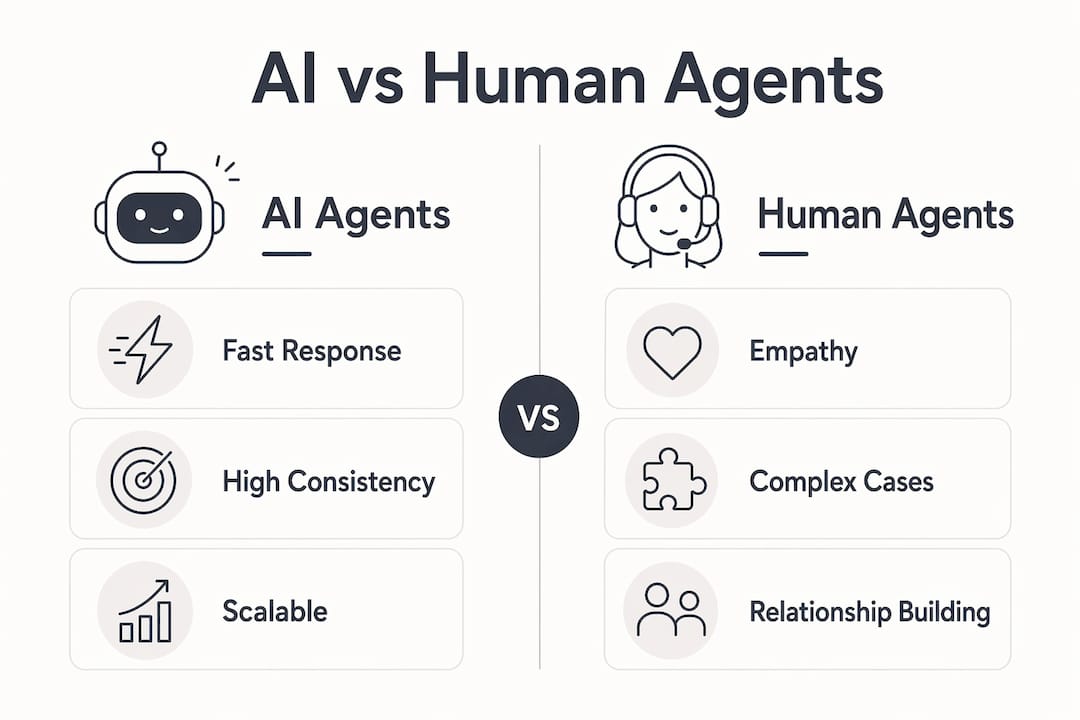
AI excels at speed, consistency, and scale. It does not have bad days, does not forget procedures, and does not require shift cover. Human agents bring contextual judgement, emotional attunement, and the ability to handle genuinely novel situations where no procedure exists. The distinction matters because customers calibrate their expectations accordingly: they accept a bot for a tracking query and expect a person for a billing dispute involving financial hardship.
| Characteristic | AI agent | Human agent |
|---|---|---|
| Response speed | Seconds | Minutes to hours |
| Consistency | High (rule-bound) | Variable |
| Emotional empathy | Low | High |
| Complex judgement | Limited | Strong |
| Cost per interaction | Low | High |
| Availability | 24/7 | Shift-dependent |
Klarna’s 2025 experience is instructive here. After aggressive AI deployment, the company’s CEO cautioned that over-cutting human staff unbalances premium support quality. The rebalancing that followed was not a retreat from AI. It was a recognition that certain customer segments and interaction types require human presence to protect brand value. For SMEs, where brand reputation is often built on personal relationships, this lesson carries extra weight.
The RRR Design Framework offers a practical decision rule: automate only where objectives are clear and the cost of an error is acceptable. If a wrong answer damages a customer relationship or creates a compliance risk, that interaction belongs with a human agent, at least until AI confidence thresholds are demonstrably high.
Pro Tip: Segment your query types into three buckets: fully automatable, human-assisted (AI drafts, human approves), and human-only. Start deploying AI only in the first bucket. Expand to the second once your AI is trained on six months of real interaction data.
What strategic considerations should SMEs make when implementing AI?
Customer service automation done poorly costs more than it saves. The risks are not technical. They are organisational and relational. IBM CEO Arvind Krishna advises businesses to prioritise AI in low-risk areas first, specifically answering service calls, where the upside is immediate and the downside is contained. That principle is the right starting point for any SME scoping an AI deployment.
The strategic pitfalls most SMEs encounter fall into four categories:
- Over-automation: Removing human touchpoints from interactions that customers expect to be personal, which erodes trust faster than any efficiency gain can compensate for.
- Under-scoping: Deploying AI without defining success metrics, leaving the business unable to assess whether the investment is working.
- Knowledge gaps: Launching an AI tool without a well-structured internal knowledge base, which produces confident but incorrect answers and damages credibility.
- Role neglect: Failing to re-architect support teams around AI, leaving human agents doing work that AI should handle while AI handles work that humans should own.
The RRR framework principle of automating to protect relationships, not merely to cut costs, is the strategic lens that separates sustainable AI deployments from ones that generate short-term savings and long-term churn. For SMEs, where each customer relationship carries proportionally more revenue weight than in enterprise, this distinction is not abstract. It is a P&L consideration.
Role re-architecting deserves specific attention. An AI-first support model requires new functions: AI-operations managers who maintain knowledge bases, monitor confidence scores, and retrain models on edge cases. These roles did not exist in traditional support teams. Building them is not optional if you want AI to perform at the level the case studies suggest is possible.
Pro Tip: Before signing any AI vendor contract, define three things: the query types you are automating, the escalation path when AI fails, and the human role that owns AI quality. If you cannot define all three, you are not ready to deploy.
What practical steps can SMEs follow to integrate AI into support?
A structured rollout separates SMEs that extract measurable value from AI from those that accumulate software subscriptions with no discernible impact. The following sequence reflects what works in practice.
- Audit your current support data. Pull 90 days of ticket data and categorise by query type, resolution time, and repeat contact rate. This baseline tells you where AI will have the highest impact and gives you the benchmark against which to measure improvement.
- Start with a high-leverage, low-risk pilot. SharkNinja’s deployment of Salesforce Agentforce began with product unboxing support, a bounded, procedural use case with clear success criteria and low consequences for errors. That scope discipline is what made the pilot measurable and scalable.
- Build your knowledge base before you build your bot. AI tools like Intercom’s Fin AI and Salesforce Agentforce are only as good as the content they are trained on. Write clear, structured procedures and FAQs before deployment, not after.
- Hire or designate an AI-operations owner. This person manages knowledge base quality, monitors AI performance metrics, and owns the escalation logic. Without this role, AI quality degrades over time as products, policies, and customer expectations change.
- Run structured adversarial testing. SharkNinja’s team used a practice they called “attack the bot”, where frontline agents deliberately tried to break the AI by submitting edge-case queries. This surfaces failure modes before customers encounter them and builds agent confidence in the system.
- Establish a feedback loop. Track AI resolution rate, customer satisfaction scores, and escalation frequency weekly. Use agent feedback to identify gaps and retrain the model on real interaction data from your specific customer base.
For SMEs considering AI automation for SaaS or service businesses, the pilot-to-scale model consistently outperforms big-bang deployments. The data you collect in a 60-day pilot is worth more than any vendor’s benchmark.
Pro Tip: Give your AI a name and a defined persona before launch. Customers who know they are talking to an AI and find it helpful report higher satisfaction than customers who feel deceived. Transparency is not a weakness in AI-powered customer service. It is a trust signal.
Key takeaways
The impact of AI on service quality depends entirely on how deliberately it is deployed. SMEs that scope carefully, build strong knowledge bases, and re-architect their teams around AI will see the efficiency and experience gains the data promises.
| Point | Details |
|---|---|
| AI automates volume, not relationships | Deploy AI on transactional queries; protect human agents for complex, emotionally sensitive interactions. |
| Speed gains are measurable and significant | Klarna reduced resolution time from 11 minutes to under 2 minutes, with 25% fewer repeat contacts. |
| Over-automation carries real costs | Klarna’s own rebalancing shows that cutting human staff too aggressively damages premium service quality. |
| Knowledge base quality determines AI quality | Train AI on structured, accurate procedures before deployment, not as an afterthought. |
| Re-architect teams around AI | Create AI-operations roles to manage quality, retrain models, and own escalation logic. |
What I have learned deploying AI in SME customer service
The most common mistake I see SME leaders make is treating AI deployment as a technology project rather than an operational redesign. They buy a tool, connect it to their helpdesk, and expect results. What they get instead is a bot that confidently answers questions incorrectly, frustrates customers, and erodes the trust the business spent years building.
The businesses that get this right treat AI as a new team member that needs onboarding, training, and a clear job description. The knowledge base is the onboarding document. The escalation logic is the job description. The AI-operations owner is the line manager. When you frame it that way, the decisions become much clearer.
I have also observed that the cultural shift is harder than the technical one. Human agents who have built their identity around being the expert often resist AI, not because they fear redundancy, but because they fear irrelevance. The SMEs that handle this well reframe the agent’s role explicitly: from answer-provider to quality-owner. That shift in framing changes the dynamic entirely and turns your most experienced agents into your best AI trainers.
The RRR principle of automating to protect relationships resonates with everything I have seen in practice. Efficiency is the output of good AI deployment. Trust is the input. Get the trust architecture right first, and the efficiency follows.
, Hayat
How Meethayat helps SMEs deploy AI-powered customer support
Meethayat builds and operates AI agents for SMEs, covering the full deployment cycle from knowledge base architecture and agent configuration through to ongoing quality management and performance optimisation. If you are at the scoping stage and uncertain whether to hire an AI consultant or an AI agent operator, the 2026 hire guide on the Meethayat site explains the distinction clearly and helps you identify which engagement model fits your situation. For SMEs ready to move from strategy to deployment, the AI agent operator service covers end-to-end implementation with a focus on measurable customer service outcomes.
FAQ
What is the role of AI in customer service?
AI in customer service automates routine, high-volume interactions such as query triage, ticket drafting, and call handling, while enabling human agents to focus on complex and emotionally sensitive cases. The result is faster resolution times, lower cost per interaction, and improved first-contact resolution rates.
What are examples of AI-powered customer service in practice?
Klarna’s AI assistant handles 2.3 million conversations monthly, resolving issues in under 2 minutes. The Home Depot uses Google Cloud’s Gemini-based voice agents to identify call reasons in under 10 seconds and resolve issues four times faster than traditional systems. Intercom’s Fin AI automated 81% of support volume for Intercom’s own team.
How should SMEs decide what to automate in customer service?
The RRR Design Framework recommends automating only where objectives are clear and the cost of an error is acceptable. Start with transactional, procedural queries and expand automation only after validating AI accuracy on real interaction data.
Does AI in customer service replace human agents?
AI replaces specific task categories, not human agents entirely. Klarna’s experience shows that over-cutting human staff damages premium service quality. The sustainable model pairs AI for volume and speed with human agents for judgement, empathy, and complex resolution.
What does an AI-operations role involve in a customer service team?
An AI-operations owner manages the knowledge base, monitors AI confidence scores and resolution rates, retrains the model on edge cases, and owns the escalation logic when AI fails. This role is required for AI-first support teams to maintain quality as products and customer expectations evolve.