The role of AI in API testing: 2026 guide


The role of AI in API testing has shifted from experimental novelty to practical necessity, yet most teams still misunderstand what that means in practice. AI does not replace your QA engineers. It changes what they spend their time on. 45% of QA teams now use AI, yet adoption without a clear mental model of AI’s actual capabilities creates as many problems as it solves. This guide cuts through the noise and gives you a precise, experience-grounded view of what AI does well, where it falls short, and how to integrate it without creating a false sense of coverage.
Table of Contents
- Key takeaways
- The role of AI in API testing: four core capabilities
- What AI cannot do in API testing
- AI tools for API testing: general vs specialised
- Integrating AI into your API testing workflow
- My perspective on AI and API testing
- How Meethayat can support your AI testing strategy
- FAQ
Key takeaways
| Point | Details |
|---|---|
| AI augments, not replaces | AI handles repetitive, high-volume test generation whilst human testers own business logic and exploratory work. |
| Four core capabilities | Test generation, self-healing scripts, intelligent test selection, and root cause analysis are the primary AI contributions. |
| Specialised platforms outperform general AI | Domain-specific tools generate significantly more meaningful tests than general-purpose LLMs applied to API specs. |
| Human oversight is non-negotiable | Daily review of AI-flagged outputs and hallucination monitoring are required for reliable results. |
| Start deterministic, then layer AI | Build a solid, deterministic test foundation before introducing AI to avoid compounding errors. |
The role of AI in API testing: four core capabilities
The clearest way to understand what AI brings to API testing is to look at the four capabilities that consistently deliver measurable results. These are not theoretical features. They are production-grade functions that reduce regression time by 50% and cut flaky tests by 85% in documented deployments.
Test generation from specifications. AI models ingest OpenAPI specs, Swagger definitions, or user stories and produce test cases covering standard request-response patterns, boundary values, and error codes. What used to take a senior engineer several hours per endpoint now takes seconds. The quality depends heavily on the input format. Token-efficient specification formats like LAPIS improve AI reasoning accuracy and reduce cost by compressing verbose OpenAPI specs into LLM-native structures. If you are feeding a 4,000-line YAML file to a general-purpose model, you are leaving performance on the table.
Self-healing test scripts. API schemas change. Endpoints get renamed, request bodies gain new required fields, and response structures evolve. Traditional test suites break silently or noisily, and someone spends a morning fixing selectors and assertions. Agentic AI platforms adapt dynamically to schema changes, detecting structural drift and updating test logic without manual intervention. This alone justifies adoption for teams managing more than 20 active endpoints.
Intelligent test selection. Not every test needs to run on every commit. AI analyses code change diffs and risk signals to select the subset of tests most likely to catch regressions. This is particularly valuable in CI/CD pipelines where full suite execution adds meaningful latency. The result is faster feedback loops without sacrificing coverage on the areas that matter.
Automated root cause analysis. When a test fails, the question is always: is this a code defect, a test error, an environment issue, or a transient fluke? AI classifies failures within seconds with high accuracy across these four categories, directing engineers to the right fix immediately rather than requiring manual triage. Teams running hundreds of daily API tests report 6 to 10 times faster failure analysis with AI-assisted classification.
- Test generation reduces authoring time per endpoint from hours to minutes
- Self-healing scripts eliminate the most common source of maintenance overhead
- Intelligent selection cuts CI pipeline duration without reducing meaningful coverage
- Root cause classification removes the guesswork from failure triage
Pro Tip: When setting up AI-driven test generation, provide the AI with your authentication flows and known edge cases as supplementary context alongside the spec. The model produces significantly more targeted tests when it understands your API’s security boundaries upfront.
What AI cannot do in API testing
Here is where most teams get into trouble. AI-generated tests cover 60 to 80% of standard scenarios accurately, but that remaining 20 to 40% is precisely where the most consequential bugs live.
Business logic is the primary gap. An AI model can verify that a POST to "/orders` returns a 201 status code. It cannot verify that an order placed after 5pm on a Friday should not trigger same-day dispatch, or that a promotional discount should not stack with a loyalty reward unless the customer is in a specific tier. AI generates structural tests but cannot infer implicit business logic. Those rules exist in product documentation, stakeholder conversations, and the institutional knowledge of your team. No amount of spec ingestion retrieves them.
Hallucinations are a second risk that teams routinely underestimate. AI models confidently generate test assertions that look correct but test the wrong thing. A hallucinated test might assert a 200 response for a request that should return a 403, passing silently while a real security gap goes undetected. QA engineers review 10 to 20 flagged cases daily in mature human-in-the-loop workflows to catch these errors before they become baseline assumptions.
Calibrating hallucination detection requires continuous threshold monitoring. Faithfulness scores above 0.80 and hallucination rates below 0.10 are the current industry benchmarks. Falling below these thresholds means your AI-generated test suite is producing unreliable assertions at a rate that undermines its value.
- AI cannot test multi-step cross-endpoint flows without explicit orchestration guidance
- Exploratory testing, where a human deliberately probes unexpected paths, remains entirely human territory
- Product context, such as which failures are acceptable in a degraded mode, requires human judgement
- Validating AI output against actual business requirements cannot be automated away
Pro Tip: Maintain a “business logic register” alongside your test suite. Document the rules AI cannot infer, and assign ownership to specific engineers. This register becomes the checklist your team runs against every AI-generated test batch.
AI tools for API testing: general vs specialised
Not all AI tooling for API testing is equivalent. The gap between general-purpose AI applied to testing and purpose-built AI-native platforms is substantial and quantifiable.

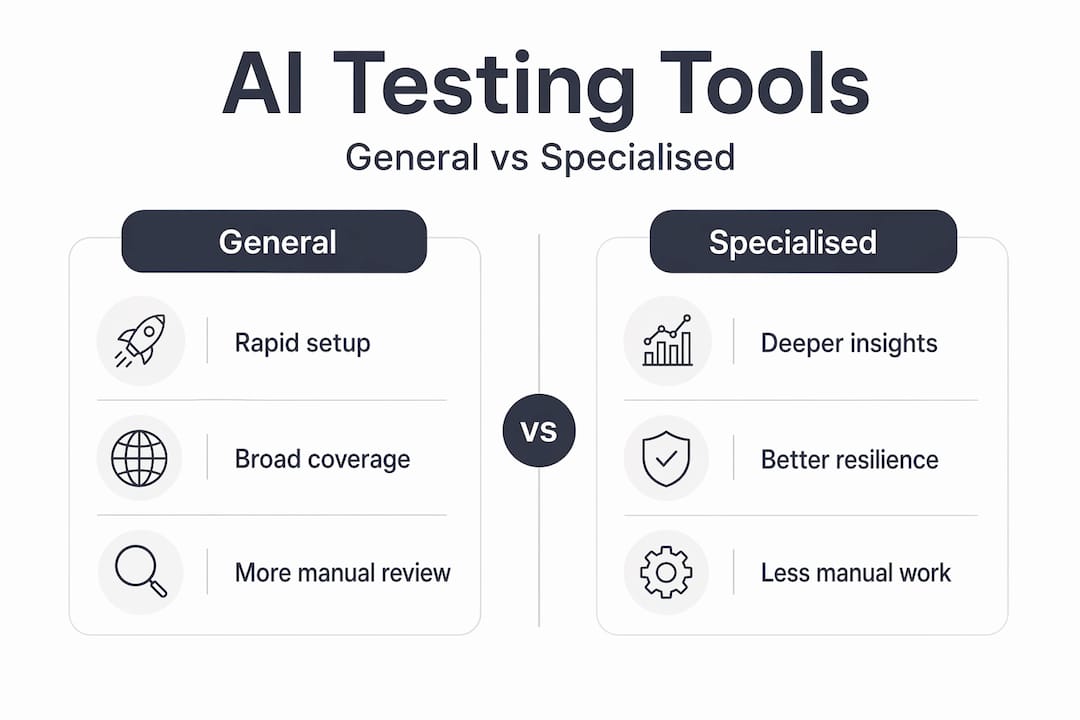
General-purpose tools generate 120 to 150 tests per API spec, covering the obvious happy paths and a handful of error codes. Specialised AI-native platforms generate over 800 tests per spec, with meaningfully deeper coverage of edge cases, security scenarios, and data boundary conditions. That is a 6x difference in test volume, but more importantly, it is a qualitative difference in the types of scenarios covered.
| Capability | General-purpose AI | Specialised AI-native platform |
|---|---|---|
| Tests generated per spec | 120 to 150 | 800+ |
| Edge case coverage | Limited | Extensive |
| Security scenario generation | Minimal | Built-in |
| Self-healing capability | Rare | Standard |
| Domain knowledge embedded | None | Significant |
| Engineering time saved | Moderate | High |
The engineering time saving is worth examining carefully. General-purpose tools reduce test authoring time but often increase review time because output quality is inconsistent. Specialised platforms embed domain knowledge about API patterns, authentication schemes, and common vulnerability classes, which means less post-generation correction. For teams evaluating AI tools for enterprise testing, the total cost of ownership calculation must include review and maintenance overhead, not just initial generation speed.
The practical recommendation: use general-purpose AI for rapid prototyping and early-stage projects where coverage depth is less critical. Invest in a specialised platform once you are managing production APIs with security, compliance, or SLA obligations.
Integrating AI into your API testing workflow
Adoption without structure produces unreliable results. These are the practices that separate teams getting genuine value from AI in their testing from those generating noise.
-
Start with a deterministic foundation. Before introducing AI, build a core suite of hand-authored tests covering your critical paths, authentication flows, and known business rules. Combining deterministic tests with AI reduces black-box risks and gives you a stable baseline against which AI-generated tests can be validated.
-
Introduce AI incrementally. Begin with test generation for one or two well-documented endpoints. Review the output manually, calibrate your hallucination detection thresholds, and expand only when you trust the output quality.
-
Establish a human review cadence. Assign ownership of AI output review to specific engineers. Human intervention remains critical for validating AI-generated tests against business impact and product priorities. This is not optional overhead. It is the mechanism that keeps your test suite honest.
-
Optimise your input formats. If you are using LLM-based test generation, transform your OpenAPI specs into compact, token-optimised formats before ingestion. Verbose specs increase cost, reduce accuracy, and produce more hallucinations.
-
Sandbox AI execution. AI agents that autonomously execute tests must operate in isolated environments with no write access to production data. Define explicit boundaries for what the AI agent can and cannot do within your infrastructure.
-
Monitor and refine continuously. Track hallucination rates, test pass rates, and coverage metrics over time. Treat your AI testing configuration as a system that requires tuning, not a tool you configure once and forget.
Pro Tip: Set a monthly review of your AI tool’s performance metrics alongside your standard sprint retrospective. Teams that treat AI testing configuration as a living system consistently outperform those that treat it as a one-time setup.
My perspective on AI and API testing
I have spent considerable time building and operating AI agents for SMEs, and the pattern I see most consistently is this: teams that get the most from AI in testing are the ones that were already disciplined about testing before AI arrived.
AI is a force multiplier for deterministic testing, not a substitute for it. If your test suite was inconsistent, poorly maintained, or missing coverage of critical flows, AI will amplify those problems. It will generate tests that look comprehensive whilst masking the same gaps that existed before. The confidence AI creates can be more dangerous than the uncertainty it replaces.
What I have learned from operating these systems is that the human-in-the-loop is not a concession to AI’s limitations. It is the design. The teams that treat AI review as a burden to be minimised are the ones that eventually discover a hallucinated assertion sitting in their suite for months, silently passing whilst a real defect goes undetected.
The future for QA professionals is not fewer engineers. It is engineers who understand how to design, calibrate, and govern AI testing systems. That is a more demanding skill set than writing test cases manually. The engineers who develop it now will be disproportionately valuable as AI adoption accelerates across the industry.
, Hayat
How Meethayat can support your AI testing strategy
If you are at the point of deciding how to integrate AI into your API testing and broader engineering workflows, the question is rarely which tool to choose. It is how to design the system around the tool so that it produces reliable, auditable results.

Meethayat works with engineering teams and SMEs to design and operate AI agent systems that deliver measurable outcomes, including in testing, quality assurance, and process automation. As an AI agent operator, Hayat Amin builds agentic stacks that combine AI capability with the human oversight structures your team actually needs. If you are weighing whether to hire internally or work with a specialist, the AI agent operator vs consultant guide is a practical starting point. Reach out directly to discuss your specific testing and automation context.
FAQ
What is the role of AI in API testing?
AI automates test generation, self-healing script maintenance, intelligent test selection, and root cause analysis in API testing. It accelerates coverage and reduces manual overhead whilst human testers retain responsibility for business logic and exploratory work.
Can AI fully replace manual API testers?
No. AI-generated tests cover 60 to 80% of standard scenarios but cannot infer implicit business rules, handle complex multi-step flows, or perform exploratory testing. Human oversight remains necessary for reliable results.
How does AI improve API testing speed?
AI reduces regression testing time by up to 50% through intelligent test selection and automated failure classification. Self-healing scripts also eliminate the manual effort of updating tests after API schema changes.
What are the risks of using AI in API testing?
The primary risks are hallucinated test assertions that appear correct but test the wrong behaviour, and over-reliance on AI coverage without validating against actual business requirements. Daily human review and hallucination rate monitoring mitigate these risks.
Which is better: general-purpose AI or specialised API testing platforms?
Specialised AI-native platforms generate over 800 tests per API spec compared to 120 to 150 for general-purpose tools, with significantly deeper edge case and security coverage. For production APIs with compliance or SLA requirements, specialised platforms are the stronger choice.