Role of AI in product roadmaps: 2026 guide


The role of AI in product roadmaps is a fundamental shift from static annual planning to dynamic, data-driven decision-making that reshapes how product teams prioritise, sequence, and validate features. Gartner projects that 40% of enterprise applications will include task-specific AI agents by end of 2026. That figure alone makes quarterly roadmap updates a structural necessity, not a preference. Traditional annual roadmaps cannot accommodate model retraining cycles, probabilistic delivery timelines, or the dual demands of serving both human users and AI agents calling APIs. Product managers and executives who understand this shift early will hold a measurable planning advantage.
How does AI change prioritisation in product roadmaps?
AI-driven product management changes prioritisation by processing customer behavioural signals, support data, and market trends at a scale no human team can match. Tools like RICE (Reach, Impact, Confidence, Effort) calculators, when fed with machine learning outputs, generate initial impact and effort estimates that teams then adjust with strategic context. The AI provides the quantitative baseline. The product manager applies the business judgement.
The practical workflow looks like this:
- Generate estimates with AI. Use machine learning models to score features by predicted user impact and engineering effort, drawing on historical delivery data and usage telemetry.
- Apply confidence ranges. AI outputs are probabilistic, not deterministic. A feature scored at 8/10 impact carries an implicit confidence interval. Teams should document that range explicitly in the roadmap.
- Validate with qualitative signals. Stakeholder alignment, regulatory constraints, and brand considerations do not appear in training data. Human review of AI-generated scores is non-negotiable.
- Sequence with strategic intent. AI can rank features by predicted value. Only a product leader can sequence them against a market window, a partnership timeline, or a competitive response.
The risk of over-indexing on AI-generated prioritisation scores is real. Teams that treat model outputs as final decisions rather than informed starting points tend to deprioritise features that matter for long-term retention but score poorly on short-term engagement metrics.
Pro Tip: Validate every AI-generated prioritisation score against at least one qualitative signal, whether that is a customer interview, a sales team observation, or a support ticket cluster. Scores without context are just numbers.
PMs must evolve to balance AI automation with strategic human decisions, because AI accelerates feature development but does not replace discretion. That balance is the defining skill for product leadership in 2026.

What planning challenges arise when integrating AI into roadmaps?
AI product roadmaps require a fundamentally different planning architecture. The core challenge is that traditional roadmaps assume deterministic delivery: a feature is scoped, built, and shipped. AI features do not behave that way. Model performance depends on data quality, evaluation cycles, and retraining schedules, all of which introduce genuine timeline uncertainty.
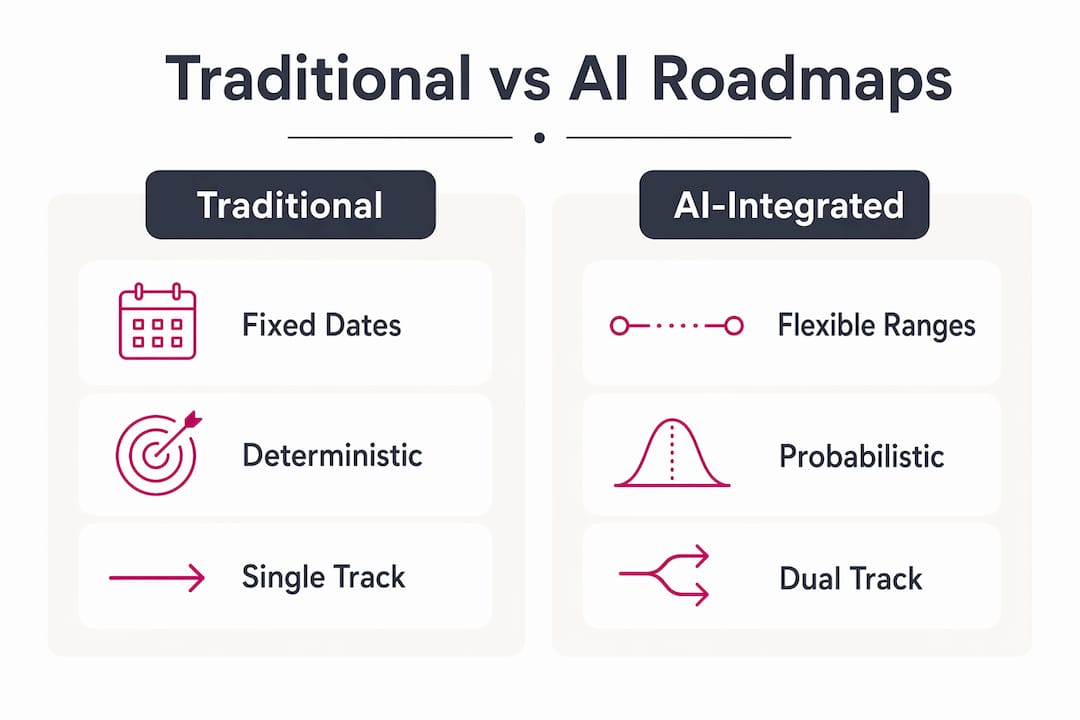
The dual-track planning model addresses this directly. One track covers deterministic work: standard features, infrastructure, and integrations with predictable delivery windows. The second track covers probabilistic AI model work, where milestones are expressed as outcome ranges rather than fixed dates. A team might commit to “70% likely to ship the recommendation engine by Q3” rather than a hard date. That framing is more honest and more useful for stakeholder communication.
The five planning components that most AI roadmaps underinvest in are:
- Evaluation infrastructure (evals). Rigorous eval infrastructure is a prerequisite for reliable AI in production. Teams should benchmark continuously against 50, 100 golden examples. Skipping this step consistently results in model regression and feature abandonment.
- Failure-mode design. Refusal handling, confidence thresholds, and output filtering must be embedded from day one. Teams that treat guardrails as a post-launch concern discover them as a launch blocker.
- Human-in-the-loop UX. Users need visible mechanisms to correct, override, or report AI outputs. This is a product design requirement, not a nice-to-have.
- Observability metrics. Standard engagement metrics do not capture AI performance. Agent task completion rates must sit alongside traditional user metrics in your analytics stack.
- Retraining cadence. Model drift is silent and damaging. The roadmap must include scheduled retraining windows as first-class deliverables.
The consequence of ignoring these components is severe. 50% of generative AI pilots are abandoned after proof-of-concept due to failure to plan for production reliability and evaluation. That is not a technology failure. It is a planning failure.
| Planning Component | Traditional Roadmap | AI-Integrated Roadmap |
|---|---|---|
| Delivery commitment | Fixed date | Outcome range (e.g., 70% likely by Q3) |
| Quality assurance | QA test suite | Eval suite with golden examples |
| Failure handling | Bug tracking | Guardrail design and refusal logic |
| Performance metrics | User engagement | Agent task completion + user engagement |
| Update cadence | Annual or bi-annual | Quarterly minimum |
Pro Tip: Treat eval infrastructure as a priority lane on your roadmap from sprint one. Teams that add it retrospectively spend three times as long recovering from model regressions as teams that build it in from the start.
How does AI affect product strategy and competitive differentiation?
AI compresses feature differentiation and reshapes cost structures across SaaS and B2B products. Economic stress testing in roadmaps is the mechanism that separates teams building genuine competitive moats from those building features that competitors will replicate within two quarters. The question every product executive must answer is: does this AI capability create a structural advantage, or does it commoditise within 12 months?
Engineering velocity has increased 7× due to AI-assisted development, but user adoption bandwidth remains constant. That asymmetry is the most underappreciated strategic fact in product management today. You can ship faster than your users can absorb. The bottleneck has moved from engineering to discovery and validation. Product managers who respond by doubling down on user research, prototype testing, and adoption measurement will outperform those who treat the 7× velocity gain as a reason to ship more features.
The strategic roadmap must distinguish between two distinct feature categories:
| Dimension | AI as Product | AI as Enabler |
|---|---|---|
| Definition | AI capability is the core value proposition | AI accelerates or improves an existing workflow |
| Example | An LLM-powered contract analysis tool | AI-assisted search within a document management system |
| Roadmap priority | Requires dedicated eval, model, and UX tracks | Integrated into existing feature delivery tracks |
| Competitive risk | High: replicable by well-funded competitors | Lower: differentiation comes from workflow depth |
| Success metric | Model accuracy, task completion rate | Time-on-task reduction, user satisfaction |
AI changes feature differentiation and cost models in ways that demand scenario modelling to identify sustainable advantages. Topline Strategy’s AI impact assessment frameworks for B2B and SaaS companies recommend mapping each AI investment against three scenarios: commoditisation within 12 months, partial differentiation for 24 months, and durable moat beyond 36 months. That framing forces honest conversations about where to concentrate investment.
What steps help product managers successfully incorporate AI into roadmaps?
Practical integration of AI into product planning requires structural changes across four areas: roadmap cadence, talent strategy, cross-functional collaboration, and maturity assessment.
- Adopt quarterly roadmap updates. Static annual plans cannot accommodate AI agent workflow changes or model retraining cycles. Quarterly reviews allow teams to incorporate new model capabilities, deprecate underperforming features, and respond to shifts in the AI agents landscape without destabilising the broader plan.
- Address the talent premium directly. Machine learning engineering skills focused on generative AI and large language models command a 40, 60% salary premium compared to standard ML roles. Hiring plans that ignore this premium will lose candidates to better-prepared competitors. Budget accordingly and consider fractional or operator models for specialist AI roles.
- Integrate cross-functional design from the start. Guardrail design, eval frameworks, and observability architecture require engineering, UX, and data science working together from the first sprint. Sequential handoffs between these functions produce the gaps that cause pilot failures.
- Use AI maturity assessments to sequence investment. Not every organisation is ready for the same AI features. A maturity assessment maps current data infrastructure, ML capability, and organisational readiness against the feature roadmap. It prevents teams from committing to AI capabilities they cannot yet support in production.
- Prioritise discovery over execution velocity. Given the 7× increase in engineering speed, the constraint is user adoption, not delivery. Discovery-focused workflows, including continuous user interviews, rapid prototype testing, and adoption tracking, are now the primary lever for roadmap quality.
Understanding how to hire an AI agent operator is increasingly relevant for product teams managing complex agentic workflows across finance, legal, and GTM functions.
Pro Tip: Balance AI-driven automation with human oversight at every stage. Automated prioritisation, automated testing, and automated deployment all require human review gates. Remove those gates and you remove the mechanism that catches model drift before it reaches production.
Key takeaways
AI-integrated product roadmaps require dual-track planning, quarterly update cadences, and embedded eval infrastructure to avoid the 50% pilot abandonment rate that plagues teams without these structures.
| Point | Details |
|---|---|
| Dual-track planning is mandatory | Separate deterministic and probabilistic tracks to manage AI timeline uncertainty honestly. |
| Eval infrastructure is non-negotiable | Build 50, 100 golden examples into your eval suite from sprint one to prevent model regression. |
| Discovery outweighs execution speed | With 7× engineering velocity, user adoption is the bottleneck; invest in research, not just shipping. |
| Talent premium requires budget planning | GenAI and LLM skills command a 40, 60% salary premium; plan hiring budgets accordingly. |
| Quarterly cadence replaces annual planning | AI agent penetration at 40% of enterprise apps by 2026 makes static annual roadmaps obsolete. |
Where traditional roadmap thinking falls short with AI
Having worked across product strategy, AI agent operations, and financial planning, I have seen one pattern repeat itself more than any other: product teams treat AI features like software features. They scope them, assign them to a sprint, and expect them to ship on a fixed date. They do not.
The probabilistic nature of model-driven work is not a project management inconvenience. It is a fundamental property of the technology. Teams that resist outcome ranges in favour of fixed commitments are not being rigorous. They are setting themselves up for the credibility damage that comes when a model underperforms in production and the roadmap shows it was supposed to ship six weeks ago.
The second pattern I observe is the underinvestment in evals. Every team I have spoken with that abandoned a generative AI pilot post-proof-of-concept had the same root cause: they had no systematic way to measure whether the model was getting better or worse. They were flying blind. Eval infrastructure feels like overhead until the moment it becomes the only thing standing between you and a production regression.
The cross-functional collaboration point is also more demanding than most product leaders anticipate. Guardrail design is not a UX task or an engineering task. It requires both disciplines working from the same threat model. That kind of collaboration does not happen through a handoff document. It requires shared ownership from the first sprint.
My practical advice: treat your AI roadmap as a living document with a quarterly review gate, a dedicated eval lane, and explicit outcome ranges for every model-dependent feature. That structure will not eliminate uncertainty. It will make uncertainty manageable.
, Hayat
How Meethayat supports ai-integrated product roadmaps
Product teams building AI capabilities face a specific operational gap: they need someone who can design, deploy, and manage AI agent workflows across complex business functions, not just advise on strategy.

Meethayat’s AI Agent Operator services address that gap directly. Whether you are a startup integrating your first LLM feature or an enterprise managing AI agents across finance, legal, and GTM workflows, the operator model provides the specialist execution capacity your product roadmap requires. For teams deciding between advisory and operational AI support, the AI Agent Operator vs AI Consultant guide sets out exactly where each model delivers value. If your roadmap includes agentic workflows and you need the operational expertise to run them reliably, that is the starting point.
FAQ
What is the role of AI in product roadmaps?
The role of AI in product roadmaps is to enable dynamic, data-driven prioritisation, probabilistic planning, and continuous feature validation. AI replaces static annual planning with quarterly, outcome-based roadmap structures that accommodate model retraining and agent workflows.
Why do so many AI pilots fail after proof-of-concept?
50% of generative AI pilots are abandoned post-proof-of-concept due to inadequate planning for production reliability and evaluation infrastructure. Teams that skip eval design and guardrail planning in the roadmap phase consistently encounter this outcome.
How should product teams handle AI feature timelines?
AI features should use outcome ranges rather than fixed delivery dates, for example “70% likely to ship by Q3,” because model training and evaluation cycles introduce genuine timeline uncertainty that fixed commitments cannot accommodate.
What metrics should AI product roadmaps track?
AI product roadmaps must track agent task completion rates alongside standard user engagement metrics. These two streams reflect distinct usage patterns from human users and AI agents calling APIs, and conflating them produces misleading performance data.
How does the GenAI talent premium affect roadmap planning?
Machine learning engineers specialising in generative AI and large language models command a 40, 60% salary premium over standard ML roles. Product roadmaps that include AI features must account for this premium in hiring plans or risk losing specialist candidates to competitors with higher budgets.