Responsible AI framework: a 2026 practitioner's guide


Most organisations treat responsible AI as a policy document, something drafted by legal, signed off by the board, and filed away until an audit. That framing is wrong, and it’s costly. A responsible AI framework is a live operational system that translates abstract ethical principles into concrete organisational controls, applied at every stage of the AI lifecycle. This guide covers what that means in practice: how frameworks are structured, which principles they embed, how to implement them without drowning in bureaucracy, and where most organisations go wrong.
Table of Contents
- Key takeaways
- What is a responsible AI framework?
- Responsible AI principles in practice
- Building a governance structure that works
- Global standards and trends in 2026
- Common pitfalls and how to avoid them
- My perspective on what actually makes these frameworks work
- How Meethayat can help you operationalise this
- FAQ
Key takeaways
| Point | Details |
|---|---|
| Frameworks are operational, not documentary | A responsible AI framework governs AI from design through deployment and ongoing oversight, not just at launch. |
| Multi-disciplinary governance is non-negotiable | Effective councils include legal, engineering, ethics, and business units to resolve conflicts between principles and timelines. |
| Risk-proportionate controls save time | Classify AI systems by risk level and apply controls proportionate to that classification, avoiding blanket overhead. |
| Vendor oversight is a blind spot | Organisations using third-party AI models remain accountable and must build monitoring obligations into supplier contracts. |
| Dynamic responsibility beats static checklists | Frameworks must adapt to evolving AI contexts, regulatory changes, and socio-technical shifts across the system lifecycle. |
What is a responsible AI framework?
A responsible AI framework is the structured set of governance mechanisms, policies, and controls an organisation uses to design, deploy, and oversee AI systems in line with its ethical commitments and regulatory obligations. The key word is structured. Without explicit structure, ethical intent stays abstract and accountability becomes diffuse.
Frameworks include governance roles, risk classifications, bias audits, and continuous monitoring processes. They are not a single document. They are a system of systems, organised around the full AI lifecycle from initial problem scoping to model decommissioning.
The core components of a mature framework typically include:
- Governance structures: Ethics boards, AI governance councils, and designated accountability roles (such as an AI risk owner or AI product owner).
- Policy layer: Acceptable use policies, data standards, incident response protocols, and human oversight requirements.
- Risk classification: Tiered categorisation of AI systems by potential impact (low, medium, high, and unacceptable risk), aligned with frameworks like the EU AI Act.
- Bias and performance monitoring: Ongoing audits of model behaviour for drift, discrimination, and unintended consequences.
- Audit trails and documentation: Records of design reviews, risk assessments, deployment decisions, and incident logs.
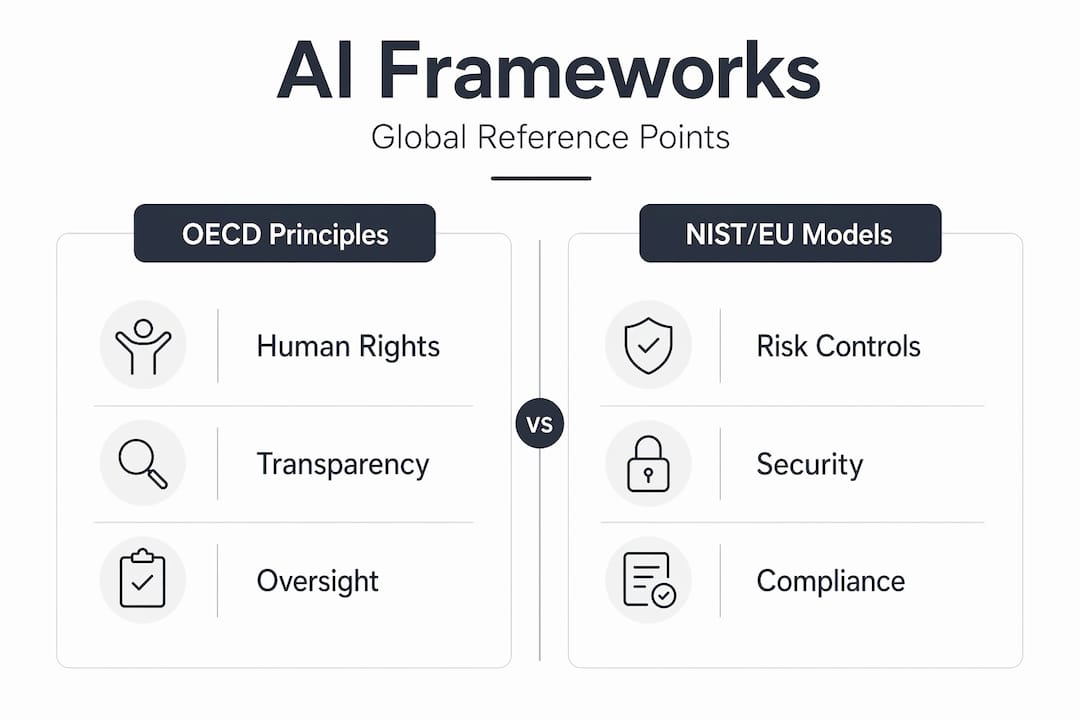
Three global reference points shape how most organisations build their frameworks in 2026: the OECD AI Principles (which emphasise human-centred values and transparency), the NIST AI Risk Management Framework (which provides a structured four-function approach across govern, map, measure, and manage), and the EU AI Act (which introduces binding risk-based obligations for AI providers and deployers operating in Europe).
| Framework | Origin | Primary focus | Binding? |
|---|---|---|---|
| OECD AI Principles | International | Human-centric values, transparency | No (voluntary) |
| NIST AI RMF | USA | Risk management lifecycle | No (voluntary) |
| EU AI Act | European Union | Risk-based regulatory obligations | Yes (within EU) |
| ISO/IEC 42001 | International | AI management system standard | Certification-based |
Responsible AI principles in practice
The principles embedded in an AI ethics framework are not philosophical exercises. They have direct operational implications for how systems are built and governed.
Fairness means identifying and mitigating bias in training data, model architecture, and output distributions. In lending, hiring, or healthcare, biased outputs carry legal and reputational consequences. Fairness audits must be built into development sprints, not tagged on post-deployment.
Transparency and explainability require that AI decisions can be articulated in terms a non-specialist can act on. This matters acutely in regulated sectors. Ethical guardrails covering fairness, safety, privacy, compliance, and transparency need to be embedded as system requirements, not retrospective annotations.
Accountability means assigning clear ownership at every stage: who approved the model for production, who monitors its performance, and who is responsible when something goes wrong. Diffuse accountability is the same as no accountability.
Privacy and security require that data governance, consent mechanisms, and access controls are baked into the system from the start, not added as compliance afterthoughts. Security controls should be layered cumulatively through each development phase to avoid re-engineering at deployment.
Safety and human oversight mean embedding intervention mechanisms so that humans can pause, correct, or override AI outputs in high-stakes scenarios. Global standards require human-in-the-loop controls as a baseline expectation for leadership-level governance.
Pro Tip: Map each responsible AI principle to a specific role, process, or system control during framework design. A principle with no owner and no mechanism is decoration, not governance.
Building a governance structure that works
Most frameworks fail not because the principles are wrong, but because the governance structure is either too thin or too cumbersome to operate.
-
Establish a cross-functional AI governance council. Cross-disciplinary councils including legal, ethics, engineering, and business units are the mechanism through which tensions between ethical principles and delivery timelines get resolved. A governance body that consists only of technologists will miss regulatory risk. One that excludes engineers will produce unenforceable policies.
-
Develop tiered policies. Start with a baseline acceptable use policy that applies to all AI initiatives. Layer on data-specific standards (training data provenance, consent, retention) and then incident response protocols that define what constitutes an AI incident, who must be notified, and within what timeframe.
-
Classify AI systems by risk. Not every AI system warrants the same level of oversight. A document summarisation tool carries a different risk profile than a credit-scoring model. Use risk tiers (aligned to the EU AI Act or your internal risk taxonomy) to apply controls proportionate to impact. This keeps governance practicable without creating compliance gaps.
-
Build vendor and third-party oversight into contracts. Vendor accountability is the most frequently neglected component in AI governance. When your organisation licences a third-party model, you remain accountable for its outputs. Supplier contracts should specify monitoring obligations, incident notification timelines, and the right to audit model behaviour.
-
Schedule annual framework reviews. Continuous monitoring and audit trails form the auditable backbone of compliance and ethical operation. Annual reviews, supplemented by automated monitoring tools, keep frameworks aligned with evolving regulatory requirements and operational realities.
Pro Tip: Before creating new governance infrastructure, map your framework requirements to existing enterprise risk management processes. Integrating AI governance into your current risk committee and audit cycle is faster, cheaper, and more durable than building a parallel structure from scratch.
Global standards and trends in 2026
Responsible AI is dynamic and contextual rather than a fixed metric. A framework that was adequate in 2023 may be materially insufficient in 2026, particularly for organisations operating under the EU AI Act’s phased implementation schedule or deploying generative AI at scale.

Two structural trends define framework design in 2026. The first is security-by-default and modular architecture. Rather than building bespoke governance for each AI project, modular framework design establishes foundational controls at the enterprise level and allows project teams to add specific guardrails without reinventing the baseline. This scales without proportionally scaling compliance overhead.
The second is AI competency as a governance requirement. Emerging frameworks now treat user and developer competence as a core element of responsible deployment, not just an HR objective. AI user competency is treated as critical to responsible AI operation beyond oversight mechanisms alone. For organisations deploying agentic AI systems, this is particularly relevant: agents that operate autonomously across workflows require operators with a deep understanding of where failures can propagate.
Industry-specific adaptations are accelerating. Financial services firms are incorporating AI governance into existing model risk management (MRM) frameworks. Healthcare providers are mapping AI controls to clinical safety standards. The underlying structure is converging across sectors even as the specific obligations differ.
Common pitfalls and how to avoid them
Even well-resourced organisations undermine their frameworks through predictable operational failures.
- Treating frameworks as documents. A policy that no one enforces and no system reflects is not a framework. It is a risk. Operationalisation, including clear process ownership, system-level controls, and regular testing, is what separates a working framework from a compliance artefact.
- Neglecting vendor oversight. Organisations often licence rather than own AI models, making third-party risk assessment non-optional. Build monitoring obligations and incident notification clauses into every AI supplier agreement before deployment begins.
- Under-resourced governance councils. A council that meets quarterly and lacks decision-making authority over AI deployments will not resolve the tensions it was created to manage. Governance needs teeth: the authority to delay or halt deployments that fail risk assessments.
- No continuous monitoring. Post-deployment model drift, demographic performance degradation, and data distribution shifts are not hypothetical risks. They are routine. Monitoring infrastructure must be in place before go-live, not retrofitted after an incident.
- Overcomplexity. Successful frameworks map to existing laws and workflows rather than imposing parallel bureaucracies. Complexity that cannot be sustained operationally will be quietly abandoned, leaving organisations exposed.
Pro Tip: Run a gap analysis against your current AI deployments before designing your framework. Identify which systems already carry governance gaps and prioritise controls there first. A targeted retrofit is more defensible than a theoretically perfect framework that is six months from implementation.
My perspective on what actually makes these frameworks work
I’ve worked across finance and AI operations long enough to see the pattern clearly. Organisations invest heavily in writing responsible AI policies and almost nothing in making them operational. The gap between the document and the deployment is where governance fails.
What I’ve found consistently is that the most effective frameworks are the ones embedded inside existing enterprise risk management cadences. When the AI governance review sits inside the same rhythm as the credit risk committee or the quarterly operational risk report, it gets taken seriously. When it’s a standalone programme with its own reporting line and no connection to business decisions, it becomes ceremonial.
The vendor oversight piece troubles me most. I’ve seen organisations deploy large language models under licence, assume the vendor’s responsible AI commitments cover their obligations, and then discover they have no visibility into model updates, no contractual right to audit outputs, and no incident notification pathway. Accountability does not transfer with a licence agreement. You remain the accountable party.
My view is that the future of responsible AI governance is less about adding more controls and more about building AI competency into teams. Policies without competent people to implement and challenge them are not governance. They are theatre.
, Hayat
How Meethayat can help you operationalise this

Designing a responsible AI framework on paper is straightforward. Operationalising it across live systems, third-party models, and cross-functional teams is where most organisations stall. Meethayat works with SMEs and enterprise teams as an AI agent operator to build and run AI governance into the agentic stack from the outset, covering risk classification, vendor oversight protocols, and continuous monitoring. If you are evaluating how to structure AI accountability in your organisation, the AI agent operator vs consultant guide on Meethayat sets out where each role fits and which governance gaps each can close. The starting point is always operational, not theoretical.
FAQ
What is a responsible AI framework?
A responsible AI framework is the structured set of governance roles, policies, risk classifications, and monitoring processes an organisation uses to deploy and oversee AI ethically. It covers the full AI lifecycle from design through to decommissioning.
How does an AI ethics framework differ from an AI policy?
An AI ethics framework is broader and operational: it includes governance structures, risk management processes, and continuous monitoring. An AI policy is a single document that may form one component of a framework but cannot substitute for the governance infrastructure required to enforce it.
What are the core responsible AI principles?
The core principles embedded in most frameworks are fairness, transparency, explainability, accountability, privacy, security, and human oversight. Each principle must map to a specific organisational control, process owner, or system requirement to be effective.
Which global AI governance models should organisations reference?
The three primary references in 2026 are the OECD AI Principles, the NIST AI Risk Management Framework, and the EU AI Act. Organisations operating in Europe face binding obligations under the EU AI Act; others can use OECD and NIST as voluntary but widely recognised benchmarks.
What are the best practices for responsible AI in vendor management?
Best practices include incorporating monitoring obligations into supplier contracts, retaining audit rights over third-party model behaviour, and establishing incident notification timelines with vendors before deployment. Accountability for AI outputs does not transfer to the vendor when you licence their model.