Outsource finance function: SME guide for 2026


Outsourcing the finance function means delegating defined finance activities to specialist external providers while retaining internal control and decision rights. For US small to mid-sized enterprises, this covers everything from basic bookkeeping and payroll to full FP&A, management accounts, and fractional CFO advisory. The model is not new, but the 2026 service market has matured significantly. Providers now offer tiered outsourced finance services with clear pricing, documented close processes, and security certifications that make the decision far more structured than it was five years ago. US GAAP compliance, sales tax obligations, and payroll complexity make the case for specialist support even stronger for growing SMEs.
What finance functions can SMEs outsource?
The scope of outsourced finance for SMEs runs wider than most owners expect. Common outsourced activities include bookkeeping, payroll processing, accounts payable and receivable, sales tax support, monthly financial statements, cash flow forecasting, and board-level reporting. These are not purely transactional tasks. Providers increasingly bundle advisory services alongside the operational work.

Service tiers define what you get and what you pay. The table below maps the four main tiers used across the US market in 2026.
| Service tier | Typical monthly cost (USD) | What is included | Best fit |
|---|---|---|---|
| Basic bookkeeping | $300, $800 | Transaction coding, bank reconciliation | Sole traders, early-stage startups |
| Full-service bookkeeping | $800, $2,500 | AP/AR, payroll, monthly reports | SMEs under $5M revenue |
| Controller level | $2,500, $6,000 | Close management, compliance, reporting | SMEs $5M, $20M revenue |
| Full finance department | $6,000, $15,000+ | FP&A, CFO advisory, board reporting | Growth-stage SMEs |
These 2026 pricing tiers reflect a market where providers have standardised their offerings. That standardisation works in your favour because it makes comparison straightforward.
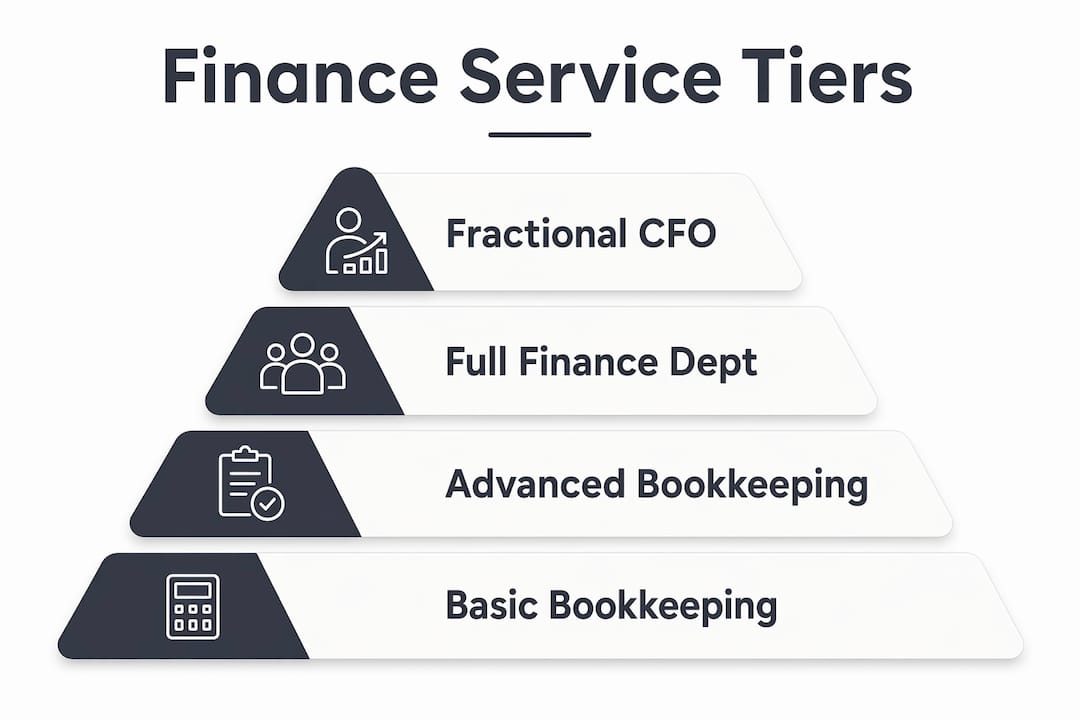
Fractional CFO services sit at the top of this stack. They include cash flow modelling, fundraising support, financial modelling, and board-level reporting. For SMEs that cannot justify a full-time CFO salary, this tier delivers strategic financial leadership at a fraction of the cost.
Pro Tip: Match your service tier to your transaction volume and reporting complexity, not just your revenue. A $3M business with multi-state payroll and inventory will need controller-level support. A $6M SaaS business with clean recurring revenue may manage well at full-service bookkeeping.
How can SMEs maintain control when outsourcing finance?
Control over finance is not lost through outsourcing. It depends entirely on how you design the governance structure before the contract is signed. Internal control ownership means retaining decision rights over final payments, exception approvals, and board reporting inside your business, regardless of who processes the underlying transactions.
Three control layers protect SMEs in outsourced arrangements:
- Process controls: Documented month-end close calendars, task checklists, and hard input deadlines. The close process must operate like an operating system with defined workflows, not an informal arrangement.
- Data access controls: Role-based access to accounting platforms such as QuickBooks Online, Xero, or NetSuite. Your provider reads and posts; your internal owner approves and releases.
- Decision rights: Segregation of duties between vendor setup, invoice approval, and payment release. Keeping payment release in-house is the single most important control for AP fraud prevention.
Security certifications matter as much as process design. Require providers to demonstrate SOC 2 Type II or ISO 27001 certification before signing. For SMEs subject to audit, SOC 1 Type II reports provide auditor assurance over outsourced controls across a 6, 12 month period. This is not optional if your lender or investor requires audited accounts.
Month-end close targets for outsourced engagements typically run 5, 10 business days for SMEs with payroll, AP, and AR in scope. Set this expectation in writing before go-live. Ambiguity here is the most common source of friction in outsourced finance relationships.
Pro Tip: Create a one-page handoff protocol that defines what your provider delivers, by when, and what your internal reviewer signs off before the books are closed. Treat this document as a living policy, not a one-time setup task.
What are the key steps to outsource your SME’s finance function?
A structured approach prevents the most common failure modes: scope creep, security lapses, and delayed closes. Follow these five steps in sequence.
-
Assess your existing finance processes. Map every finance task currently performed in-house. Identify which are transactional (bookkeeping, payroll, AP/AR) and which require internal judgement (approvals, exceptions, board reporting). The transactional tasks are your outsourcing candidates.
-
Define scope in writing before you speak to providers. A written scope statement specifies deliverables, frequencies, deadlines, and exclusions. Unclear scope is the leading cause of failed outsourcing engagements. Do not rely on a provider’s standard service description.
-
Evaluate providers on four criteria: domain expertise in your industry, security certifications (SOC 2 Type II minimum), assigned team stability, and pricing transparency. Ask for a documented close workflow before you sign. Providers who cannot produce one are not ready to manage your books.
-
Plan the transition with a 30-day parallel run. Run your internal process and the provider’s process simultaneously for one close cycle. This surfaces data gaps, access issues, and timing mismatches before they affect your reporting.
-
Establish ongoing management routines. Schedule a monthly review call covering close performance, open items, and any scope changes. Track close duration against your agreed target. Review provider performance formally at six months and twelve months.
The table below summarises the key pitfalls at each step and how to avoid them.
| Step | Common pitfall | How to avoid it |
|---|---|---|
| Assess processes | Missing hidden tasks | Interview every person who touches finance |
| Define scope | Vague deliverables | Use itemised scope with named outputs and dates |
| Evaluate providers | Ignoring security | Require SOC 2 Type II certificate before shortlisting |
| Transition | No parallel run | Run one full close cycle in parallel before cutover |
| Ongoing management | No performance tracking | Agree close KPIs and review monthly |
Payroll services are often the first function SMEs outsource because the compliance risk of payroll errors is immediate and the processing is highly repeatable. Bundling payroll with bookkeeping at step one reduces the number of providers you need to manage.
How does outsourcing finance improve efficiency and reduce costs?
Outsourced finance functions reduce operating costs by 20, 60% compared to equivalent in-house teams. The range is wide because savings depend on service scope, business complexity, and the cost of your local labour market. A New York-based SME replacing a $90,000 controller with a $3,500 per month outsourced controller service saves over $60,000 annually before benefits and overhead.
The efficiency gains go beyond cost. Key operational improvements include:
- Faster close cycles. Providers with dedicated close teams and documented workflows consistently hit the 5, 10 business day target. In-house teams at SMEs without a dedicated controller often run 15, 20 days.
- Access to specialist software. Providers operate at scale on platforms like QuickBooks Online, Xero, NetSuite, and Sage Intacct. SMEs gain access to these tools and the expertise to use them without paying for licences and training independently.
- Reduced error rates. Dedicated bookkeeping teams with review layers produce fewer posting errors than a part-time in-house bookkeeper managing multiple responsibilities.
- Flexibility as you grow. Moving from full-service bookkeeping to controller-level support requires a scope change, not a hiring process. This matters when revenue growth is uneven.
The AI-driven cost reduction layer is now a real differentiator. Providers deploying AI agents for invoice ingestion, bank reconciliation, and expense categorisation are closing books faster and at lower cost than those using purely manual processes. SMEs should ask prospective providers directly which tasks are automated and which are manual.
Key takeaways
Outsourcing the finance function delivers measurable cost savings and faster close cycles only when SMEs retain internal control over approvals, define scope precisely, and vet providers for security certifications before signing.
| Point | Details |
|---|---|
| Service tiers define cost and scope | Monthly costs range from $300 for basic bookkeeping to $15,000+ for a full finance department. |
| Internal control must be by design | Retain payment release rights and approval authority in-house regardless of what is outsourced. |
| Security certifications are non-negotiable | Require SOC 2 Type II or ISO 27001 from any provider handling your financial data. |
| Scope ambiguity causes most failures | Write an itemised scope statement with named deliverables and deadlines before signing. |
| Cost savings are significant but variable | Outsourcing reduces finance operating costs by 20, 60% depending on scope and business complexity. |
Why control frameworks matter more than provider selection
Three exits as CFO taught me one consistent lesson: the SMEs that struggle with outsourced finance are not the ones who chose the wrong provider. They are the ones who outsourced without designing the governance structure first.
The instinct is to find a good firm and trust them. That instinct is wrong. A capable provider operating inside a poorly designed control framework will still produce late closes, missed reconciliations, and reporting that nobody trusts. The framework has to come first.
The second thing I see consistently underestimated is the month-end close protocol. Owners treat it as an administrative detail. It is not. A documented close calendar with hard input deadlines, a defined “done” checklist, and a named internal reviewer is the difference between a finance function that works and one that creates noise every month.
The growing availability of fractional CFO services changes the calculus for SMEs significantly. You can now access strategic CFO advisory at a cost that fits a $5M revenue business. That was not true five years ago. The combination of outsourced transactional finance and fractional CFO oversight is, in my view, the most cost-effective finance model available to US SMEs in 2026.
The one warning I give every founder: do not outsource a broken process. Fix the process first, document it, then hand it over. Outsourcing amplifies what is already there.
, Hayat
Meethayat’s finance outsourcing and fractional CFO services
Hayat Amin brings three CFO exits and a hands-on AI agent practice to SME finance outsourcing engagements. The service model covers fractional CFO advisory, finance function design, and AI agent deployment for finance workflows including invoice ingestion, reconciliation, and reporting automation.

For SMEs ready to move beyond basic bookkeeping and build a finance function that supports growth, Meethayat offers structured engagements from controller-level oversight to board-ready FP&A. AI agent integration is available as a standalone layer or as part of a broader finance outsourcing design. Explore the fractional CFO services page for current engagement formats, or review the AI agent operator service to understand how automation fits into your finance stack.
FAQ
What does it cost to outsource finance for an SME in 2026?
Monthly costs range from $300 for basic bookkeeping to $15,000 or more for a full outsourced finance department with CFO advisory. Controller-level services typically cost $2,500, $6,000 per month.
Which finance functions should an SME outsource first?
Payroll and bookkeeping are the most common starting points because they are highly repeatable and carry immediate compliance risk if handled incorrectly. AP and AR management typically follow.
How do SMEs avoid losing control when outsourcing finance?
Retain internal decision rights over payment release, exception approvals, and board reporting. Require a documented close workflow and role-based data access from your provider before go-live.
What security certifications should I require from a finance outsourcing provider?
Require SOC 2 Type II as a minimum. If your business is subject to external audit, ask whether the provider can deliver a SOC 1 Type II report covering a 6, 12 month operating period.
What is a fractional CFO and how does it differ from outsourced bookkeeping?
A fractional CFO provides strategic financial leadership, including cash flow modelling, fundraising support, and board reporting, on a part-time basis. Outsourced bookkeeping covers transactional processing. The two services are complementary, not interchangeable.