How to defend patent infringement as a tech startup


Patent infringement defence is the legal process by which a company challenges claims that it has used another party’s patented technology without authorisation. For tech startups, the stakes are immediate and existential. A single complaint can freeze fundraising, distract leadership, and drain cash reserves before a single hearing takes place. The good news is that tools like Inter Partes Review (IPR), venue transfer motions, and Alice motions give well-advised startups real power to fight back. The key is knowing how to deploy them, and when.
What immediate steps should a startup take after a patent complaint?
The first 30 days after a patent infringement complaint are critical. The sequencing of your legal actions in that first month shapes the entire trajectory of the case, including costs, timelines, and your negotiating position.
1. Issue a document preservation hold immediately. Every email, design file, code commit, and internal memo related to the accused product must be preserved. Destroying or losing documents after a complaint lands is a litigation catastrophe.

2. Calendar every deadline. Patent litigation has hard procedural deadlines. Missing a response window or an IPR filing deadline forfeits options that cannot be recovered.
3. Investigate prior art aggressively. Prior art is any publicly available evidence that the claimed invention existed before the patent’s filing date. Finding strong prior art early gives you leverage for IPR petitions, invalidity arguments, and settlement negotiations.
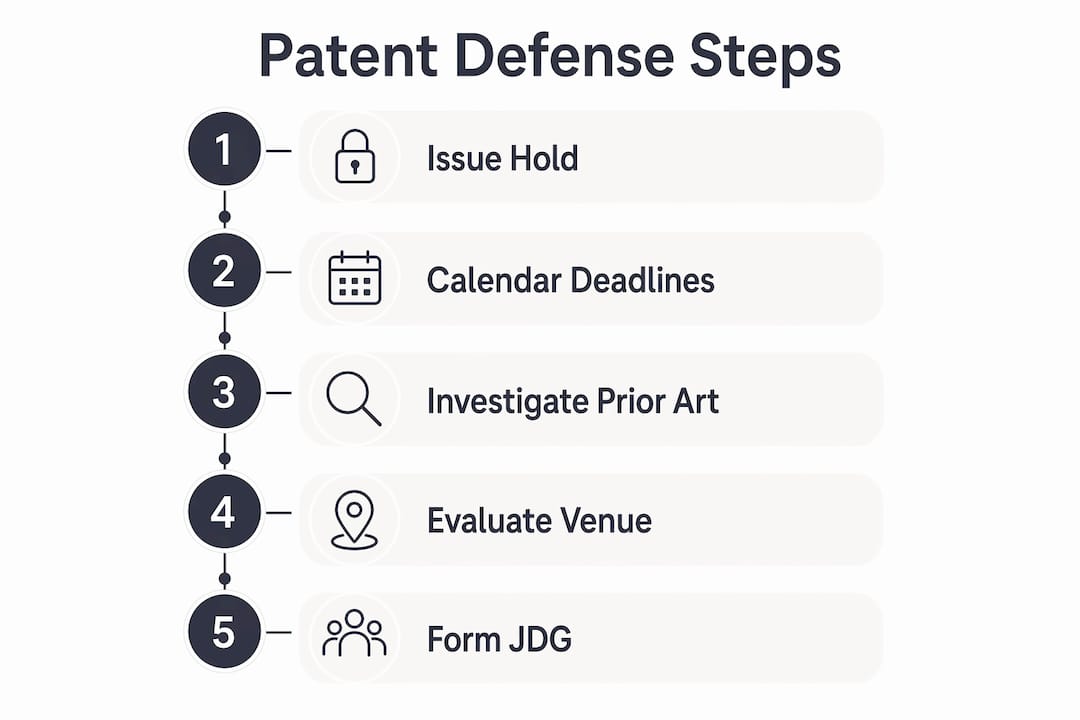
4. Evaluate venue. Many patent plaintiffs file in plaintiff-friendly districts. Venue transfer motions under Rule 12(b)(3) can move the case to a more neutral forum, which materially affects litigation costs and outcomes.
5. Consider forming a Joint Defence Group (JDG). If the plaintiff has sued multiple defendants with similar technology, a JDG allows you to share legal costs and coordinate strategy without waiving privilege.
Pro Tip: File an IPR petition within one year of being served. Missing this window permanently closes one of the most cost-effective defences available to a tech startup.
Beyond these five steps, assess whether a Rule 12(b)(6) motion applies. This motion argues that the complaint fails to state a legally valid claim, and early procedural motions like this one can end weak cases before discovery costs escalate.
How can a patent portfolio strengthen your infringement defence?
A patent portfolio is not just an offensive weapon. It is your most durable defensive asset. Patents built for defence deter copycats, create cross-licensing leverage, raise company valuation, and protect your most profitable products from litigation pressure.
The table below compares the two primary portfolio roles in infringement defence:
| Portfolio role | Primary function | Defensive value |
|---|---|---|
| Defensive shield | Blocks competitors from copying core technology | Reduces exposure to infringement claims |
| Cross-licensing leverage | Creates basis for licence negotiations | Turns a lawsuit into a bilateral negotiation |
Cross-licensing is particularly powerful against operating companies. If the plaintiff also makes products, your portfolio may cover their technology. That changes the dynamic from defendant to co-negotiator.
Claim drafting quality determines whether your patents survive IPR. Effective claim drafting anticipates IPR challenges at the time of filing, not after a lawsuit arrives. Startups that treat patent prosecution as a box-ticking exercise end up with portfolios that collapse under scrutiny.
Pro Tip: Build your portfolio so that losing two or three patents in IPR does not gut your overall position. Depth and claim diversity matter as much as individual patent strength.
Startups often treat patents as cost items rather than assets. That mindset is the single biggest portfolio mistake. A well-constructed portfolio improves your defence posture, your fundraising narrative, and your exit valuation simultaneously.
What specialised legal procedures reduce infringement lawsuit risk?
Applying standard operating-company litigation tactics to a patent lawsuit, particularly one filed by a non-practising entity (NPE), is a reliable way to overspend and underperform. NPE lawsuits require specialised procedural approaches rather than full federal trial tactics.
The most effective procedural tools for tech startups include:
- Inter Partes Review (IPR): An IPR petition filed at the USPTO within one year of service can cancel the asserted patent claims entirely. IPR petitions place immediate pressure on plaintiffs and often lead to case stays in district court.
- Standing challenges: Many patent trolls operate through shell LLCs that lack proper ownership documentation. Demanding proof of ownership early can force dismissal or a significantly cheaper settlement.
- Alice motions: Under the Alice Corp. v. CLS Bank International Supreme Court decision, patents covering abstract ideas implemented on a computer are invalid. Many software patents fail this test. An Alice motion under Rule 12(b)(6) can dispose of the case before discovery.
- Declaratory judgment actions: If you have reason to believe a patent holder is about to sue, filing a declaratory judgment action first lets you choose the venue and control the litigation timeline.
- Venue transfer motions: Rule 12(b)(3) motions challenge improper venue. Shifting the case away from a plaintiff-friendly district reduces both litigation cost and plaintiff leverage.
“Applying typical operating-company defences to NPE lawsuits often leads to overspending. Specialised procedural motions such as IPR and venue transfers are more effective.”, Lumenci, Essential Strategies for Patent Infringement Defences
Pro Tip: Treat procedural motions as your first line of attack, not a fallback. Early aggressive use of IPR and venue challenges forces plaintiffs to reassess the economics of pursuing your startup.
How does founder mindset affect patent litigation outcomes?
Founders frequently lose defensible patent disputes not because the law is against them, but because they fight the wrong case. Founders focused on emotional narratives rather than pragmatic legal and business realities consistently undermine their own defence.
The most common mindset errors include:
- Refusing to concede minor mistakes. Conceding small errors early preserves credibility with judges and juries. Defending every point signals bad faith and damages your overall position.
- Prioritising technical sophistication over jury perception. A technically correct argument that a jury cannot follow is a losing argument. Your counsel must translate complexity into plain narrative.
- Fighting every claim equally. Not all asserted claims carry equal risk. Concentrating resources on the claims that matter most is more effective than spreading defence effort uniformly.
- Ignoring settlement windows. An overly technical or emotional defence can squander early settlement opportunities that would have resolved the case at a fraction of trial cost.
The practical fix is straightforward. Engage counsel who specialises in tech startup patent litigation, not general IP litigators. Specialists understand the economics of NPE cases, the procedural tools available, and the settlement dynamics that govern most outcomes. They also know when to fight and when to negotiate.
What budget should a startup allocate for patent defence?
Growing tech companies should budget 0.5% to 2% of their annual R&D spend on patent prosecution and maintenance. That range reflects both the cost of building a portfolio and the reserves needed to respond to infringement claims.
| Company stage | Recommended patent output | Budget as % of R&D |
|---|---|---|
| Early stage | 5, 10 applications per year | 0.5%, 1% |
| Growth stage | 10, 30 applications per year | 1%, 2% |
These figures cover prosecution and maintenance. Litigation defence costs sit on top of this baseline. A contested IPR petition costs significantly less than a full federal trial, which is precisely why early procedural strategy matters so much for cash-constrained startups.
Pro Tip: Engage a patent strategist for startups before you receive a complaint, not after. Proactive portfolio planning reduces both the likelihood of being sued and the cost of defence when it happens.
Resource allocation should prioritise claim quality over application volume. Thirty weak patents provide less protection than ten well-drafted ones that survive IPR scrutiny. A patent strategist vs patent attorney comparison is worth making here: strategists focus on portfolio architecture and business alignment, while attorneys focus on prosecution mechanics. You need both perspectives, but the strategic layer drives outcomes.
Key takeaways
Defending a tech startup against patent infringement requires early procedural action, a well-built portfolio, and a pragmatic legal mindset, not just reactive litigation.
| Point | Details |
|---|---|
| Act within 30 days | Issue preservation holds, calendar deadlines, and evaluate IPR filing immediately after a complaint. |
| Use IPR as a primary tool | File an IPR petition within one year of service to challenge patent validity cost-effectively. |
| Build a defensive portfolio | Draft claims to survive IPR scrutiny and create cross-licensing leverage against operating-company plaintiffs. |
| Challenge standing early | Demand proof of ownership from NPE plaintiffs; shell LLCs often lack proper documentation. |
| Budget proactively | Allocate 0.5%, 2% of R&D spend to patent prosecution and maintain reserves for litigation response. |
What I have learned defending startups in patent disputes
Patent litigation is one of the few areas where doing nothing is almost always the worst option. The founders I have seen struggle most are those who wait for the situation to clarify before acting. By the time it does, they have missed IPR windows, lost venue challenges, and handed the plaintiff a structural advantage that is very difficult to reverse.
The procedural tools available to startups today are genuinely powerful. IPR petitions, Alice motions, and standing challenges have changed the economics of patent litigation in ways that favour well-advised defendants. The problem is that most founders do not know these tools exist until they are already deep into expensive discovery.
My honest view is that the mindset shift matters as much as the legal tactics. Treating your patent portfolio as a living business asset, rather than a compliance cost, changes how you build, how you negotiate, and how you defend. A startup with ten well-drafted patents and a clear cross-licensing strategy sits in a fundamentally different position than one with thirty weak filings and no coherent portfolio logic.
The other lesson I keep returning to is the value of conceding ground strategically. Founders who insist on defending every claim, every decision, and every line of code tend to lose the cases they should win. Credibility with a judge or jury is finite. Spend it on the claims that matter.
If you are facing a complaint now, get specialised counsel today. If you are not facing one yet, use that time to build the portfolio and the budget that will make you a harder target.
, Hayat
Work with a patent strategist who understands tech startups
Building a defence before a complaint arrives is the most cost-effective approach available to any tech startup. Meethayat offers patent strategy services designed specifically for technology founders, covering portfolio architecture, claim drafting oversight, IPR preparation, and litigation support coordination.

Hayat Amin brings a three-times exited CFO’s financial discipline to patent strategy, combining IP expertise with the commercial realities that matter to founders and investors. Whether you need to build a patent portfolio for defence or respond to an active infringement claim, Meethayat provides the strategic layer that bridges your technical team and your legal counsel. Explore the patent strategist for startups guide to understand what to look for and how to engage.
FAQ
What is the first thing a startup should do after receiving a patent complaint?
Issue a document preservation hold immediately and calendar all procedural deadlines. The first 30 days determine the entire litigation trajectory, including your ability to file an IPR petition.
What is Inter Partes Review and why does it matter for startups?
Inter Partes Review (IPR) is a USPTO proceeding that can cancel asserted patent claims before a federal trial. It is one of the most cost-effective defences available, and it must be filed within one year of being served.
How do you defend against a patent troll as a startup?
Demand proof of patent ownership immediately, as many NPE plaintiffs operate through shell LLCs with incomplete documentation. Combine this with an IPR petition and a venue transfer motion to change the economics of the case against you.
How much should a startup budget for patent defence?
Budget 0.5% to 2% of annual R&D spend on patent prosecution and maintenance, with additional reserves for litigation response. Early procedural actions like IPR cost significantly less than full federal trial.
What is an Alice motion in patent litigation?
An Alice motion challenges a patent as invalid because it covers an abstract idea implemented on a computer. It is filed under Rule 12(b)(6) and can dismiss many software patent claims before discovery begins.