How to automate compliance monitoring with AI agents


For CFOs and compliance officers at small to medium-sized enterprises, the decision to automate compliance monitoring with an AI agent is no longer a future-state consideration. It is a present-day operational necessity. Manual compliance workflows consume hundreds of hours annually, introduce human error at every handoff, and fail to scale as regulatory requirements multiply. AI agents now offer a credible path to real-time compliance monitoring, automated evidence collection, and audit-ready documentation. This guide walks you through preparation, implementation, troubleshooting, and ongoing governance so you can move from manual chaos to intelligent compliance management with confidence.
Table of Contents
- Preparing your organization for AI-driven compliance automation
- Step-by-step implementation of AI agents for compliance monitoring
- Troubleshooting common challenges and mistakes in AI compliance automation
- Verifying and sustaining compliance with AI agents over time
- Why focusing on AI governance and human oversight is the key to successful compliance automation
- Explore expert fractional CFO and AI agent operator services to optimize compliance
- Frequently asked questions
Key Takeaways
| Point | Details |
|---|---|
| AI automates compliance | AI agents drastically reduce manual compliance workload by automating audits and evidence collection. |
| Governance is critical | Formal AI governance frameworks and human oversight ensure reliable and regulatory-ready outputs. |
| Phased implementation | Preparing, executing, and verifying AI systems in stages improves adoption success and risk mitigation. |
| Avoid common pitfalls | Clear internal standards and ongoing reviews prevent errors and maintain audit integrity. |
| Expert support accelerates results | Fractional CFOs and AI agent operators efficiently guide SMEs through AI compliance automation. |
Preparing your organization for AI-driven compliance automation
Before you deploy a single AI agent, you need an honest assessment of your current compliance processes. Map every workflow: policy attestations, control testing, evidence gathering, audit preparation, and exception reporting. Identify which tasks are rule-based and repetitive (prime candidates for AI compliance automation) and which require contextual human judgment (where AI assists but does not decide).
The gap between AI adoption and AI governance is wider than most CFOs expect. Nearly 70% of financial firms use AI in compliance functions, but only 50% have formal governance frameworks in place. That gap is where regulatory exposure lives. Establishing AI governance frameworks before deployment is not bureaucratic overhead. It is the foundation that determines whether your AI outputs will hold up under regulatory scrutiny.

Stakeholder buy-in matters more than most implementation plans acknowledge. Compliance teams often resist automation because they fear displacement or distrust AI outputs. Frame the change correctly: AI agents handle the evidence collection and audit trail generation; your team focuses on judgment, escalation, and regulatory interpretation. That reframing reduces friction and accelerates adoption.
Key preparation steps:
- Audit your current compliance process inventory and flag automation candidates
- Define acceptable AI output standards (format, source requirements, confidence thresholds)
- Establish a formal AI governance policy aligned with your regulatory environment (SEC, FINRA, SOC 2, HIPAA, or others relevant to your industry)
- Identify a human oversight owner for each automated compliance workflow
- Budget for training, not just technology
Pro Tip: If your organization lacks internal AI expertise, consider hiring an AI agent operator before purchasing compliance monitoring software. The operator designs the agentic stack to fit your specific regulatory environment, which is a far better sequence than buying tools and then figuring out governance.
Step-by-step implementation of AI agents for compliance monitoring
With preparation complete, implementation follows a logical sequence. Skipping steps here is the primary reason AI compliance projects stall or produce unreliable outputs.
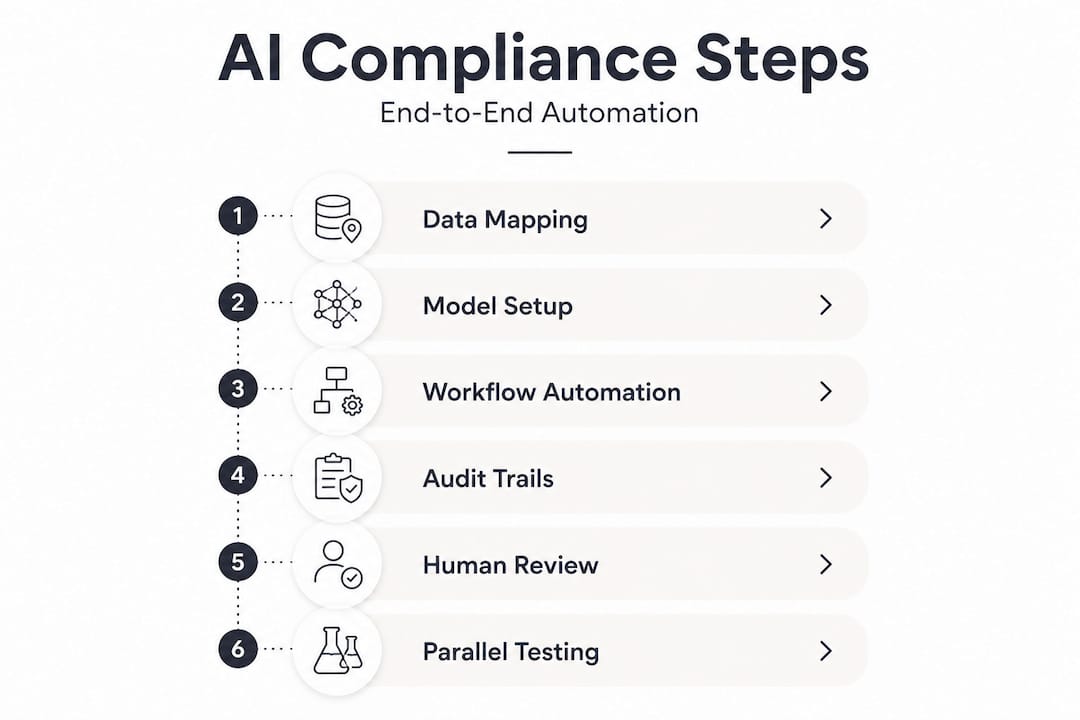
1. Map data sources and establish API connections. AI agents require authoritative, structured data to produce reliable compliance outputs. Connect your agents to source systems via API: your ERP, HR platform, cloud infrastructure logs, and any third-party data providers relevant to your regulatory obligations. Avoid agents that rely on manual file uploads. The Salesforce FastTrack platform demonstrates what API-first architecture delivers: a 24x reduction in audit execution time by replacing manual evidence collection with deterministic, automated retrieval.
2. Configure AI models for your specific compliance controls. Generic AI models produce generic outputs. Map each AI agent to a specific control framework (SOC 2 Trust Service Criteria, ISO 27001, PCI DSS, or your internal policy set). Define what “compliant” looks like for each control in machine-readable terms.
3. Automate evidence collection workflows. Replace manual evidence requests with scheduled AI agent runs that pull, timestamp, and catalog evidence automatically. This is where the labor savings are most immediate and measurable.
4. Build automated audit trail generation. Every AI agent action should produce a logged, timestamped record. This is non-negotiable for regulatory compliance. Your audit trail is the proof layer that regulators and external auditors will examine.
5. Embed human review checkpoints. Automate the collection; keep humans in the validation loop. Configure your workflow so that AI-flagged exceptions route to a named reviewer with a defined response SLA (service-level agreement).
6. Validate outputs before going live. Run parallel testing: AI agent outputs alongside your existing manual process for at least one full compliance cycle. Discrepancies reveal either data gaps or misconfigured controls. When you are ready to deploy AI agents at scale, this validation data becomes your baseline for ongoing performance measurement.
| Implementation phase | Key action | Success metric |
|---|---|---|
| Data integration | API connections to source systems | Zero manual file uploads |
| Control configuration | Map agents to specific frameworks | 100% control coverage |
| Evidence automation | Scheduled agent runs | Evidence collected on time, every cycle |
| Audit trail | Logged, timestamped agent actions | Complete chain of custody |
| Human review | Exception routing with SLA | Review completion rate above 95% |
| Validation | Parallel testing with manual process | Output accuracy above 98% |
Pro Tip: Engage an AI implementation consultant for the control configuration phase specifically. Mapping regulatory requirements to AI agent logic is where domain expertise in both compliance and AI architecture pays for itself.
Troubleshooting common challenges and mistakes in AI compliance automation
Even well-designed implementations encounter friction. Knowing where the failure modes concentrate helps you address them before they become audit findings.
The most common pitfalls:
- No internal standards defined upfront. AI agents produce outputs calibrated to the instructions they receive. Without firm-specific definitions of what constitutes acceptable evidence, agents default to generic outputs that may not satisfy your auditors. The Norm Ai integration with Microsoft 365 Copilot makes this explicit: defining internal standards before deployment is required to avoid generic outputs and maintain defensible audit trails.
- Over-reliance on AI without human review. Automated compliance checks are not self-certifying. An AI agent can confirm that a control was tested; it cannot assess whether the control design is appropriate for a novel regulatory interpretation. Human review is not optional.
- Incomplete API data sources. If your agent pulls evidence from a system that has gaps (missing records, inconsistent timestamps, or incomplete access logs), the compliance output inherits those gaps. Validate every data source before connecting it to an agent.
- Replacing fragile manual processes too quickly. If your existing compliance process is poorly documented, automating it at speed simply automates the dysfunction. Stabilize the process first, then automate.
- Insufficient team training. Compliance staff who do not understand what the AI agent is doing and why will either distrust the outputs or rubber-stamp them without review. Both outcomes create regulatory exposure. For a broader view of implementation risks, the discussion on enterprise AI agent challenges covers additional failure patterns worth reviewing.
“The risk is not that AI compliance agents fail loudly. It is that they fail quietly, producing outputs that look complete but are missing the evidentiary depth that regulators expect. That is the failure mode that reaches the CFO’s desk as a material finding.”
Address each of these risks in your implementation plan before go-live, not after your first audit cycle.
Verifying and sustaining compliance with AI agents over time
Deployment is not the finish line. AI-driven compliance solutions require ongoing governance to remain accurate, current, and defensible as regulations evolve and your business changes.
1. Schedule regular output reviews. Assign a compliance lead to review AI agent outputs on a defined cadence (monthly at minimum, weekly for high-risk control areas). AI outputs should be treated as preliminary findings, not final determinations.
2. Maintain automated reporting and audit trails. Your compliance monitoring software should generate reports that are ready for external auditors without manual reformatting. If your team is reformatting AI outputs before sharing them with auditors, that is a process gap to close.
3. Adopt a structured AI governance framework. ComplyAI delivers tools that support supervisory review, performance evaluation, and audit readiness through structured governance for responsible AI in compliance functions. The principle applies universally: governance documentation is what converts AI outputs into defensible compliance evidence.
4. Plan for regulatory and model updates. Regulations change. AI models change. Your agent configuration must be reviewed whenever a material regulatory update occurs in your jurisdiction or industry. Build this into your compliance calendar.
5. Scale governance alongside scale of automation. As you add more agents and automate more controls, the governance burden grows proportionally. For guidance on governing AI agents at enterprise scale, the frameworks used for larger deployments translate directly to SME environments.
| Governance dimension | Manual approach | AI-assisted approach |
|---|---|---|
| Evidence collection | Manual requests, email chains | Automated API pulls, timestamped |
| Audit trail | Spreadsheets, shared drives | Structured logs, version-controlled |
| Exception handling | Ad hoc, undocumented | Routed, tracked, SLA-managed |
| Regulatory updates | Reactive, manual policy edits | Scheduled review, agent reconfiguration |
| Scalability | Linear with headcount | Scales with data volume, not staff |
Why focusing on AI governance and human oversight is the key to successful compliance automation
Here is the uncomfortable truth that most AI compliance vendors will not tell you: the technology is the easy part. Any competent AI agent operator can connect your systems, configure control mappings, and automate evidence collection in a matter of weeks. What determines whether that automation holds up under regulatory scrutiny is the governance layer wrapped around it.
Having operated as a CFO through three exits and built agentic stacks for SMEs across multiple regulatory environments, the pattern is consistent. Organizations that treat AI compliance automation as a technology project get fragile outputs. Organizations that treat it as a governance project with technology as the execution layer get defensible, scalable compliance programs.
The framing from Salesforce’s engineering team captures this precisely: AI does not replace human judgment but compresses implementation overhead, enabling faster delivery of compliance-grade systems at high standards. That is the right mental model. AI compresses the labor. Humans provide the judgment. Governance documents the decisions.
The importance of human oversight is not a concession to AI skeptics. It is the structural requirement that makes AI compliance outputs legally and regulatorily defensible. Multi-stage human review, defined escalation paths, and documented governance decisions are what separate an AI compliance program that survives an audit from one that creates findings.
Invest in the people who operate and govern your AI agents. That investment generates more long-term compliance value than any additional layer of automation.
Explore expert fractional CFO and AI agent operator services to optimize compliance
Implementing AI compliance automation without the right expertise is where SMEs lose time and money. The technology choices are consequential, the governance requirements are non-trivial, and the regulatory stakes are real.

Fractional CFO services provide the financial and regulatory oversight needed to align AI compliance investments with your business strategy and risk appetite. AI agent operator services cover the technical design, deployment, and ongoing governance of your compliance agentic stack. Together, these roles eliminate the most common failure modes: governance gaps, misconfigured agents, and compliance outputs that do not hold up under scrutiny. If you are evaluating where to start, the guide on hiring AI agent operators outlines exactly what to look for and how to structure the engagement for maximum impact.
Frequently asked questions
What is an AI agent in compliance monitoring?
An AI agent is an automated software tool that performs compliance monitoring tasks such as evidence collection, policy checking, and audit preparation, reducing manual workload and improving accuracy. AI agents automate evidence collection and improve audit workflows by replacing error-prone manual steps with deterministic, API-driven processes.
How does AI automation reduce compliance audit times?
AI automation removes the manual, sequential steps of evidence requests and document chasing, replacing them with parallel, API-based data collection and real-time validation. The Salesforce FastTrack platform demonstrates a 24x reduction in audit execution time as a direct result of this architecture.
What are the risks of automating compliance with AI?
The primary risks are unreliable outputs from poorly defined internal standards, compliance failures from incomplete data sources, and regulatory exposure from insufficient human review. The Norm Ai integration illustrates why defining internal standards before deployment is essential to maintaining defensible audit trails.
How can SMEs maintain governance over AI compliance systems?
SMEs maintain governance through structured review processes, documented decision trails, and formal AI governance frameworks. ComplyAI provides tools that support supervisory review and audit readiness with the structured governance that regulators expect from AI-assisted compliance programs.
What roles help SMEs successfully adopt AI compliance automation?
Fractional CFOs provide the financial strategy and regulatory alignment, while AI agent operators handle the technical design and governance of the agentic stack. Together, these roles cover the full implementation lifecycle from business case through ongoing compliance verification.