How AI reduces business costs: 2026 SME guide


AI reduces business costs by automating repetitive tasks, cutting errors, and improving decision quality across finance, customer service, and supply chain operations. The industry term for this discipline is AI cost optimisation, and it covers everything from deploying chatbots to redesigning entire workflows with agentic tools. JPMorgan Chase saved approximately $1.5 billion by rolling out generative AI across 250,000 desktops. MassMutual cut contact centre resolution times from ten minutes to one. For SME leaders, the question is not whether AI delivers savings. The question is how to capture them without wasting budget on the wrong approach.
How AI reduces operational costs in business
AI delivers cost reduction with AI through three core mechanisms: task automation, error minimisation, and process optimisation. Each operates differently, and understanding the distinction helps you prioritise where to deploy first.
Task automation removes labour from repetitive, rules-based work. Invoice processing, payroll reconciliation, data entry, and compliance checks are all candidates. When you automate these, you redeploy staff to higher-value work rather than simply cutting headcount.

Error minimisation reduces the cost of mistakes. In finance and operations, a single misposted transaction or a missed compliance flag can cost multiples of the original task value. AI models trained on historical data catch anomalies that human reviewers miss under volume pressure.
Process optimisation is where AI technology in business creates compounding returns. Supply chain forecasting tools reduce excess inventory. Demand planning models cut procurement waste. Accenture identifies procurement and supply chain as prime candidates for rapid AI-driven savings precisely because the cost base is large and the data is already structured.
Key operational areas where AI delivers measurable savings:
- Finance and accounting: Automated invoice ingestion, three-way matching, and variance analysis reduce the cost per transaction and free FP&A teams for forward-looking work.
- Customer service: AI-powered chatbots and virtual assistants handle tier-one queries at a fraction of the cost of human agents, with AI tools reducing outsourcing and labour costs while maintaining service quality.
- HR and onboarding: IBM reduced HR operating expenses by 40% with AI-enabled chatbots resolving 90% of employee inquiries, cutting IT costs by $600 million through strategic platform consolidation.
- Sales and marketing: Generative AI cuts content production time significantly, reducing agency spend and accelerating go-to-market cycles.
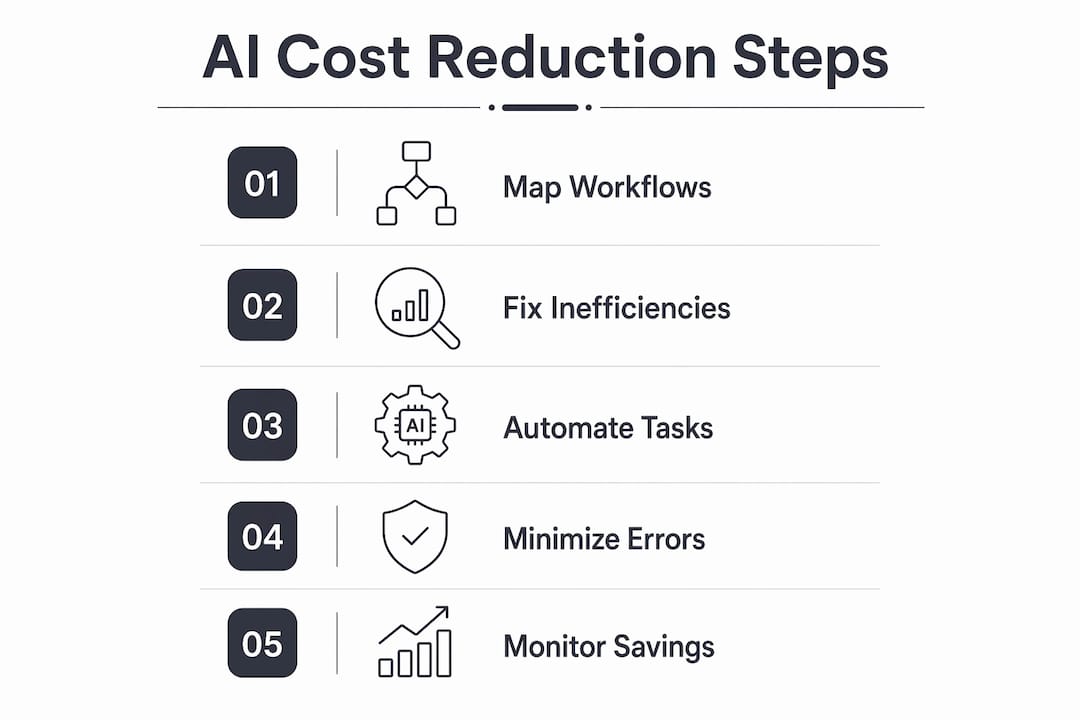
Pro Tip: Before deploying any AI tool, map the current process end-to-end. If the process has known inefficiencies, fix those first. Automating a broken workflow locks in the cost of that breakage at scale.
How do you measure AI cost savings accurately?
Measuring AI cost savings requires moving beyond headcount reduction as the primary metric. AI success should focus on enterprise-level outcomes such as decision speed, customer resolution rates, and unit economics rather than solely on labour hours saved. This distinction matters because many SMEs invest in AI, see modest headcount changes, and conclude the return is poor. The actual savings are often hiding in speed, quality, and capacity.
A practical measurement framework covers four levels:
- Unit economics: Track cost per inference, cost per customer interaction, and cost per automated task. These granular metrics reveal whether your AI deployment is becoming more or less efficient over time.
- Process cycle time: Measure how long key processes take before and after AI deployment. MassMutual’s reduction from ten minutes to one minute per contact centre resolution is a cycle time metric, not a headcount metric.
- Error and rework rates: Quantify the cost of errors in the pre-AI baseline, then track reduction post-deployment. Rework is a hidden cost that rarely appears in standard P&L reporting.
- Capacity released: Calculate the hours freed by automation and track what those hours are redirected to. Capacity released to higher-margin work is a real financial benefit even when no roles are eliminated.
Token caching and workload routing to appropriate model types can reduce AI operational costs by 30, 50%. That figure illustrates why infrastructure decisions matter as much as deployment decisions. Running every task through the most powerful model is the AI equivalent of using a freight lorry to deliver a letter.
Pro Tip: Build a simple cost-per-outcome dashboard from day one. Tracking cost per resolved ticket, cost per processed invoice, or cost per qualified lead gives you the data to justify further investment and identify where to cut underperforming tools.
Does workflow redesign determine ai’s true cost impact?
The biggest mistake in AI cost optimisation is automating broken processes. Automating inefficient workflows creates what practitioners call workflow debt: the cost of fixing embedded inefficiencies later, compounded by the technical complexity of unwinding automated systems. The process redesign question must come before the technology selection question, not after.
“Companies that integrate AI implementation with cost transformation strategies achieve durable savings by redesigning workflows rather than automating existing inefficiencies.”, BCG
BCG’s research on AI-first cost advantage shows that leaders prioritise early wins to fund deeper transformation, creating a self-sustaining cycle of efficiency and cost reduction. The practical implication for SMEs is to sequence deployment carefully.
The table below outlines a stepwise approach to workflow redesign with AI:
| Phase | Action | Expected Outcome |
|---|---|---|
| Audit | Map current workflows, identify bottlenecks and error rates | Baseline cost data and redesign priorities |
| Redesign | Eliminate redundant steps before applying AI | Cleaner processes that AI can automate reliably |
| Deploy | Apply AI agents to redesigned workflows | Measurable cost reduction without embedded inefficiency |
| Measure | Track unit economics and cycle times | Data to justify next phase of investment |
| Scale | Use early savings to fund deeper reinvention | Self-funding transformation cycle |
AI agents are particularly effective in HR, finance, and customer service when deployed against redesigned workflows. An agent handling employee leave requests, for example, delivers consistent outcomes only when the approval logic is clear and documented. If the underlying policy is ambiguous, the agent will surface that ambiguity at scale rather than resolve it.
Which AI tools offer the best ROI for smes?
SMEs face a specific challenge: limited capital means the upfront investment in AI technology must generate returns quickly. The AI impact on operational cost varies significantly by tool category, and choosing the wrong starting point delays payback.
The comparison below covers the four tool categories most relevant to SMEs:
| Tool Category | Typical Use Case | Upfront Cost | Time to Savings |
|---|---|---|---|
| Generative AI (e.g. ChatGPT, Claude) | Content creation, summarisation, drafting | Low | Immediate |
| AI chatbots and virtual assistants | Customer support, internal helpdesk | Low to medium | 1, 3 months |
| Workflow automation platforms | Process automation, data routing | Medium | 2, 4 months |
| Agentic AI tools | Autonomous multi-step task management | Medium to high | 3, 6 months |
Generative AI tools such as ChatGPT and Claude deliver the fastest payback because the marginal cost per output is low and deployment requires no integration work. A marketing team using Claude to draft campaign copy reduces agency spend from the first week.
AI chatbots and virtual assistants sit in the middle ground. Chatbots and virtual assistants significantly reduce outsourcing and labour costs while improving customer experience, but they require training data and integration with your CRM or helpdesk platform. The investment is modest; the returns compound over time as the model improves.
Agentic AI tools represent the highest ceiling for cost reduction but also the highest implementation complexity. These tools handle autonomous, multi-step tasks: processing an invoice, flagging an anomaly, routing it for approval, and updating the ledger without human intervention. For SMEs with structured, high-volume back-office processes, the ROI case is strong. For those without clean data and documented workflows, the risk of workflow debt is real.
Prioritise the areas where your cost base is largest and your data is cleanest. That combination delivers the fastest return and the most reliable baseline for measuring AI cost savings.
Key takeaways
AI cost optimisation delivers the strongest returns when process redesign precedes technology deployment, and when success is measured through unit economics rather than headcount alone.
| Point | Details |
|---|---|
| Automate clean processes first | Fix workflow inefficiencies before deploying AI to avoid locking in costly errors at scale. |
| Measure unit economics | Track cost per interaction, per invoice, and per resolved ticket rather than relying on headcount metrics. |
| Sequence your deployment | Start with generative AI and chatbots for fast payback, then fund deeper agentic deployments from early savings. |
| Prioritise high-cost areas | Focus on procurement, customer service, and finance where the cost base is large and data is structured. |
| Redesign before you automate | Workflow debt is the primary reason AI budgets grow without proportional returns. |
The uncomfortable truth about AI cost savings
Having operated as a CFO across three exits and now building AI agents for SMEs, I have seen the same pattern repeat. Leadership teams approve an AI budget, deploy a tool against an existing process, and then measure the outcome against headcount. When the headcount does not move, they conclude the AI has underperformed. The tool has not underperformed. The measurement framework has.
Only 4% of companies achieve AI cost savings exceeding 30%, while nearly 40% see savings of only 0, 10%. That gap is not a technology gap. It is a process and measurement gap. The companies achieving 30% or more have redesigned their workflows, aligned their metrics to unit economics, and treated AI deployment as an operational transformation rather than a software purchase.
The other uncomfortable truth is that customer experience is a cost lever, not just a satisfaction metric. MassMutual’s reduction in contact centre resolution time did not just cut cost per interaction. It reduced repeat contacts, escalations, and the downstream cost of unresolved queries. When you measure AI impact only on the cost side, you miss half the return.
My advice to SME leaders is this: before you select a tool, define the outcome you are buying. Cost per resolved ticket. Cost per processed invoice. Revenue per sales hour. Then build your deployment around that metric. The technology is mature enough. The constraint is almost always the clarity of the business case.
, Hayat
How Meethayat helps smes deploy AI for real cost reduction
Meethayat works with SME leadership teams to design and operate AI agent deployments that target measurable cost reduction, not theoretical efficiency gains. The work starts with process audits and workflow redesign, then moves to agent deployment across finance, customer service, and operations.

If you are weighing whether to bring in a specialist or work with a generalist consultant, the AI agent operator vs AI consultant comparison on Meethayat covers the distinction in practical terms. For teams ready to deploy, the AI agent operator service page outlines how Meethayat embeds directly into your agentic stack to deliver outcomes, not recommendations. The difference between advice and execution is where most AI projects stall.
FAQ
What is AI cost optimisation?
AI cost optimisation is the practice of using artificial intelligence to reduce operational expenses through automation, error reduction, and workflow redesign. It covers tool selection, process redesign, and measurement frameworks aligned to unit economics.
How much can AI realistically reduce business costs?
Only 4% of companies achieve savings exceeding 30%, while nearly 40% see 0, 10% savings. Results depend heavily on process quality, measurement approach, and whether workflows are redesigned before automation.
Which business functions benefit most from AI cost reduction?
Finance, customer service, HR, and procurement deliver the strongest returns because they combine high transaction volumes with structured data. IBM cut HR operating costs by 40% using AI chatbots; JPMorgan Chase saved $1.5 billion across fraud prevention and advisory services.
What is workflow debt and why does it matter?
Workflow debt occurs when AI is deployed against inefficient processes, locking in those inefficiencies at scale. Fixing workflow debt after deployment is significantly more expensive than redesigning the process first.
How should smes prioritise their first AI deployment?
Start with the highest-cost, most data-rich process in your business. Generative AI tools and chatbots offer the fastest payback with the lowest integration risk, making them the right entry point before moving to more complex agentic deployments.