How AI handles unstructured data: a technical guide


Unstructured data is defined as any information that lacks a predefined schema, including emails, PDFs, audio recordings, images, and video files. 90% of enterprise information is unstructured, yet most organisations extract only a fraction of its value. AI processes this data through a multi-stage pipeline combining natural language processing (NLP), computer vision, embeddings, and knowledge graphs to convert raw inputs into queryable, structured outputs. Understanding how AI handles unstructured data is no longer optional for data analysts and IT professionals. It is the difference between an organisation that reacts to data and one that reasons with it.
What are the key AI techniques for processing unstructured data?
AI converts unstructured inputs into analysable formats using five core techniques. Each addresses a different data modality and a different layer of meaning.
- Natural language processing (NLP): NLP parses text from documents, emails, and contracts to extract meaning, sentiment, and intent. Transformer-based models such as BERT and GPT variants tokenise text and generate contextual representations that go well beyond keyword matching.
- Computer vision: Convolutional neural networks and vision transformers classify, detect, and segment content within images and video frames. A scanned invoice, for example, becomes a structured record after optical character recognition (OCR) and layout analysis extract field values.
- Speech recognition: Automatic speech recognition (ASR) converts audio into text transcripts. Those transcripts then feed into NLP pipelines for further analysis, making call recordings and meeting audio fully searchable.
- Entity recognition and knowledge graphs: Named entity recognition (NER) identifies people, organisations, dates, and locations within text. Entity recognition and knowledge graph construction then map relationships between those entities, converting disconnected data points into a queryable knowledge network.
- Embeddings and vector databases: Embedding models convert text, images, or audio into dense numerical vectors. Those vectors are stored in a vector database and retrieved by semantic similarity, enabling search that understands context rather than just keywords.
Each technique addresses a specific gap. NLP handles language. Computer vision handles visual content. ASR handles audio. Together, they form the perceptual layer of any AI data processing architecture.
Pro Tip: Do not treat embeddings as a one-size-fits-all solution. Domain-specific embedding models, trained on legal, financial, or medical corpora, consistently outperform general-purpose models on retrieval tasks within those domains.

How is an unstructured data processing pipeline designed?
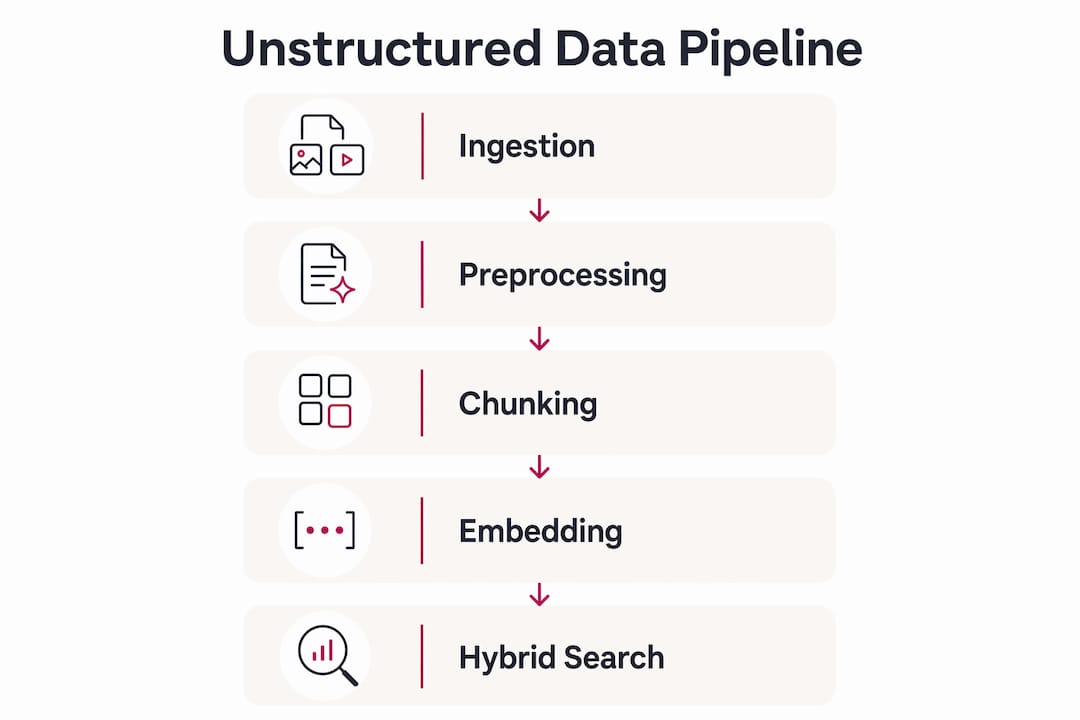
A well-designed pipeline transforms raw, messy inputs into AI-ready structured chunks through six sequential stages. Skipping or under-investing in any stage degrades every stage that follows.
-
Ingestion and parsing: The pipeline begins by pulling data from source systems, whether SharePoint, email servers, cloud storage, or APIs. Parsers extract raw content from PDFs, DOCX files, HTML pages, and image formats. OCR handles scanned documents where no machine-readable text exists.
-
Preprocessing: Raw text is cleaned by removing boilerplate, correcting encoding errors, and normalising whitespace. Filtering removes duplicate or low-quality content that would otherwise introduce noise downstream. Standardising date formats, currency symbols, and entity spellings reduces ambiguity for the model.
-
Chunking: The cleaned text is split into segments that fit within a model’s context window. Chunking strategy directly impacts retrieval quality. Chunks that are too large dilute relevance signals. Chunks that are too small lose the surrounding context a model needs to answer accurately.
-
Embedding generation: Each chunk is passed through an embedding model to produce a vector representation. The choice of model matters. A financial services firm processing earnings call transcripts will see better results from a finance-tuned embedding model than from a general-purpose one.
-
Indexing and hybrid search: Vectors are stored in a vector database and indexed for approximate nearest-neighbour search. Hybrid search combines vector similarity with keyword filtering (BM25 or similar), which reduces false positives and improves precision on domain-specific queries.
-
Iterative tuning: Pipeline quality is not fixed at deployment. Retrieval metrics, answer relevance scores, and user feedback all signal where chunking, embedding, or indexing parameters need adjustment.
| Stage | Primary goal | Common failure mode |
|---|---|---|
| Ingestion and parsing | Extract raw content from all sources | Missing file types or encoding errors |
| Preprocessing | Remove noise and standardise content | Boilerplate retained, duplicates included |
| Chunking | Segment content for context windows | Chunks too large or too small |
| Embedding | Generate semantic vector representations | Wrong model for the domain |
| Indexing and search | Enable fast, relevant retrieval | Pure vector search without keyword fallback |
| Iterative tuning | Improve retrieval quality over time | Pipeline treated as static after launch |
Unified compute frameworks that combine CPU-bound extraction with GPU-bound inference reduce latency across this pipeline. They avoid the costly data transfers that arise when extraction and inference run on separate, siloed systems.
Pro Tip: Test chunking strategies against a representative sample of your actual queries before committing to a chunk size. A 512-token chunk that works well for FAQ retrieval often performs poorly on long-form contract analysis.
What governance considerations are critical for unstructured data AI?
Governance is the part of unstructured data analysis that most organisations underinvest in, and it is the part most likely to cause failures in production. Only 38% of organisations have catalogued their unstructured data for AI use. That gap means the majority are building pipelines on top of data they do not fully understand.
The governance challenges specific to unstructured data fall into four areas:
- Bias controls: 50% of organisations have implemented bias controls for unstructured data. The other half are exposing their AI outputs to systematic distortions from imbalanced training corpora or skewed document collections. Bias in a contract analysis model, for example, can produce consistently incorrect risk assessments.
- Data lineage: Fewer than half of organisations can trace the lineage of their unstructured data. Without lineage tracking, you cannot audit why a model produced a specific output, which makes regulatory compliance and error correction extremely difficult. Automating compliance monitoring with AI agents requires lineage as a foundation.
- Metadata enrichment: Raw files without metadata are opaque to AI systems. Tagging documents with source, date, author, and content type gives the semantic layer the context it needs to retrieve and rank results accurately.
- Privacy and security: Unstructured data frequently contains personally identifiable information (PII) embedded in free text. Automated PII detection and redaction must run before data enters any shared embedding or retrieval system.
The role of data governance in AI systems is not a compliance checkbox. It is the mechanism that keeps AI outputs trustworthy enough to act on.
How does AI integrate structured and unstructured data for better analytics?
The most powerful enterprise AI architectures do not choose between structured and unstructured data. They combine both. Effective AI architectures combine SQL-based precision for structured data with NLP-driven semantic analysis for unstructured content.
The table below shows where each approach excels and where it falls short when used alone.
| Data type | Processing method | Strength | Limitation when used alone |
|---|---|---|---|
| Structured (tables, databases) | SQL engines, BI tools | Exact aggregations, fast queries | Cannot interpret free text or images |
| Unstructured (documents, audio) | NLP, embeddings, vector search | Semantic understanding, context | No precise numerical computation |
| Combined | Semantic layer over SQL plus NLP | Full context with numerical accuracy | Higher architectural complexity |
A practical example: a financial analyst querying customer churn needs both the structured transaction history (SQL) and the unstructured support ticket text (NLP) to understand why customers leave. Neither source alone gives the full picture.
Schema-free AI frameworks address the challenge of querying data sources where the structure is inconsistent or unknown. These frameworks let large language models (LLMs) plan their assumptions about data structure before executing a query, which reduces errors caused by missing fields or varying schemas. This is particularly relevant for organisations that ingest data from multiple external partners with different formatting conventions.
Unstructured data provides the rich context that structured tables alone cannot supply. For agentic AI systems that must reason and act autonomously, that context is not a nice-to-have. It is a prerequisite for safe, accurate decision-making. AI consultants who understand how to blend these architectures are increasingly valuable as enterprises move from pilot projects to production systems.
Key takeaways
AI handles unstructured data through a multi-stage pipeline of ingestion, preprocessing, chunking, embedding, and hybrid search, with governance and structured data integration determining whether outputs are trustworthy enough to act on.
| Point | Details |
|---|---|
| Scale of the problem | 90% of enterprise data is unstructured, yet most organisations have not catalogued it for AI use. |
| Core techniques | NLP, computer vision, ASR, entity recognition, and embeddings each address a different data modality. |
| Pipeline design | Chunking strategy and embedding model selection are the two variables with the greatest impact on retrieval quality. |
| Governance gap | Fewer than half of organisations track data lineage, which makes auditing and compliance extremely difficult. |
| Combined architectures | Pairing SQL engines with NLP-driven semantic layers delivers insights that neither approach produces alone. |
The uncomfortable truth about unstructured data readiness
Most organisations treat unstructured data as a storage problem. They archive it, back it up, and assume that deploying an AI model on top of it will produce results. It does not work that way.
The gap between having unstructured data and extracting value from it is almost entirely an engineering and governance problem. I have seen finance teams sit on years of contract data, board minutes, and analyst reports, then wonder why their AI assistant gives vague answers. The issue is never the model. The issue is that nobody chunked the documents correctly, nobody tagged the metadata, and nobody checked whether the embedding model was appropriate for legal and financial language.
The statistic that fewer than half of organisations track data lineage is the one that concerns me most. You cannot improve what you cannot trace. When an AI system produces a wrong answer from unstructured data, lineage is the only mechanism that lets you find the source and fix it. Without it, you are debugging in the dark.
The organisations that will extract the most value from unstructured data analysis in the next two years are not the ones with the largest data lakes. They are the ones that treat pipeline tuning as a continuous process, invest in metadata enrichment from day one, and build governance into the architecture rather than bolting it on afterwards. Agentic AI systems that reason over unstructured data are only as reliable as the pipelines and governance frameworks beneath them.
, Hayat
Meethayat’s AI agent operator service for unstructured data
Data analysts and IT professionals who have mapped their pipeline gaps often reach the same conclusion: building and maintaining a production-grade unstructured data pipeline requires both AI engineering depth and operational discipline.

Meethayat’s AI Agent Operator service is built for exactly that context. Hayat Amin designs and operates agentic stacks that ingest diverse data types, including documents, emails, and audio, apply governance controls from the outset, and deliver outputs that finance, legal, and GTM teams can act on. The service covers pipeline architecture, embedding selection, metadata enrichment, and iterative tuning. If you are evaluating whether to build internally or engage an operator, the AI Agent Operator vs AI Consultant guide sets out the decision criteria clearly.
FAQ
What is unstructured data in AI?
Unstructured data is any information without a predefined schema, such as emails, PDFs, images, audio, and video. AI processes it using NLP, computer vision, and embeddings to extract structured, queryable outputs.
How does NLP process unstructured text data?
NLP tokenises text, generates contextual embeddings, and applies models such as named entity recognition and sentiment analysis to extract meaning from raw documents. Transformer architectures like BERT underpin most modern NLP pipelines.
What is chunking in an AI data pipeline?
Chunking splits documents into segments sized to fit within a model’s context window. Chunk size directly affects retrieval quality. Chunks that are too large dilute relevance; chunks that are too small lose essential context.
Why is data lineage important for unstructured data AI?
Data lineage tracks the origin and transformation history of every data point. Without it, organisations cannot audit AI outputs, correct errors at source, or demonstrate regulatory compliance. Fewer than half of organisations currently track lineage for unstructured data.
How does AI combine structured and unstructured data?
Effective architectures pair SQL engines for precise numerical queries with NLP-driven semantic layers for unstructured content. Schema-free AI frameworks extend this further by letting LLMs reason over data sources with inconsistent or unknown structures.