Chatbot vs AI agent: what businesses need to know


A chatbot is a system that responds to user input with predefined or generated text, whereas an AI agent independently plans, acts, and achieves goals across multiple systems. The distinction matters because choosing the wrong tool wastes budget and creates operational gaps. Understanding what is a chatbot vs AI agent is the first decision any business professional should make before deploying conversational technology. Tools like Microsoft Copilot and Google’s Gemini sit closer to the agent end of this spectrum, while a basic FAQ bot on a SaaS website sits firmly at the chatbot end.
What is a chatbot vs AI agent: core capabilities compared
Chatbots generate text responses and do not perform external actions. They operate reactively, waiting for a user prompt and returning a reply. That reply may come from a decision tree, a keyword match, or a large language model (LLM), but the system stops at the text boundary. It does not write to a database, trigger a workflow, or call an API.

AI agents operate in continuous loops. They call tools, observe results, and adapt their next action based on what they find. Agents pursue goals with autonomy, which means they can break a complex objective into sub-tasks, execute each one, and report back when the goal is complete. That is a fundamentally different operating model.
The progression from chatbot to copilot to agent reflects increasing capability: conversational, then assistive, then fully operational. A chatbot answers. A copilot suggests. An agent acts. Most businesses currently use chatbots but are evaluating agents, which is precisely why this distinction carries commercial weight.
The key differences break down as follows:
- Chatbots follow scripts or LLM prompts to produce text replies. They are reactive and stateless between sessions.
- AI agents hold state across a workflow, use tools (APIs, databases, calendars), and make decisions without human prompts at each step.
- Rule-based chatbots (older generation) use decision trees. LLM-powered chatbots use models like GPT-4o but still stop at text output.
- AI agents have action authority. They can send emails, update records, and trigger downstream processes.
- Agentic capability is the term used by security and governance professionals to describe a system that acts with runtime independence.
Pro Tip: If a vendor calls their product an “AI agent” but it cannot write to any external system, it is a chatbot with better marketing. Ask specifically: what actions can it take, and on which systems?
How do AI agents and chatbots differ in real business applications?
The practical gap between these two technologies becomes clear when you map them to specific business tasks. Chatbots are suited to low-volume support, routine FAQs, and information lookup. AI agents handle dynamic tasks such as processing refunds, updating CRM records, and scheduling across multiple calendars. The task type determines the right tool.
Here are the most common deployment patterns by business function:
- Customer support triage, A chatbot handles the first contact: greets the user, collects the issue type, and provides a knowledge base answer. An AI agent takes over when the resolution requires a system action, such as issuing a refund or escalating to a live agent with full context already written into the ticket.
- Sales and CRM workflows, A chatbot qualifies a lead through a scripted conversation. An AI agent then creates the CRM record in Salesforce or HubSpot, schedules the follow-up call, and sends the confirmation email without human intervention.
- Finance operations, In fintech, AI agents in financial workflows handle invoice ingestion, payment matching, and exception flagging. A chatbot cannot do this because it has no write access to the accounting system.
- SaaS onboarding, A chatbot walks a new user through product features. An AI agent provisions the account, sets permissions, and triggers the welcome sequence in the marketing platform.
The table below summarises the deployment split across common business contexts:
| Business context | Chatbot role | AI agent role |
|---|---|---|
| Customer support | FAQ answers, triage | Refund processing, ticket creation |
| Sales | Lead qualification | CRM updates, meeting scheduling |
| Finance | Balance enquiries | Invoice matching, payment workflows |
| HR | Policy questions | Onboarding provisioning, leave approvals |
| SaaS operations | Feature guidance | Account setup, permission management |
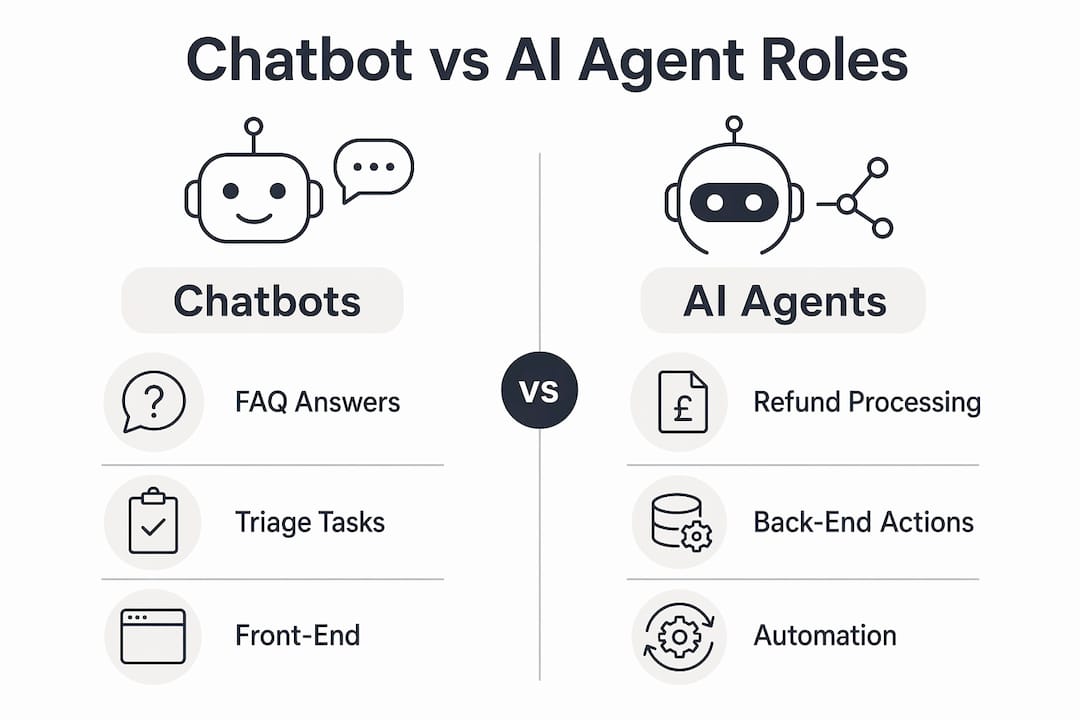
Hybrid enterprise deployments combine chatbots for front-end engagement with AI agents for back-end automation. This is the model Meethayat recommends for SMEs entering agentic deployment for the first time. The chatbot handles volume. The agent handles complexity.
What are the security and governance risks of AI agents?
Security is where the chatbot versus AI agent distinction becomes critical for IT and finance leaders. A chatbot is a read-only conversational tool. Its worst failure mode is a wrong answer. An AI agent holds credentials, inherits permissions, and can take actions that affect live systems. The risk profile is categorically different.
Agentic capability requires governance like an employee. The system must be granted credentials, those credentials must be scoped to the minimum necessary permissions, and every action must be logged. This is not a usability feature. It is a privilege boundary, and breaching it has operational consequences.
“AI agents are identities in systems with inherited permissions. Their actions can cause significant operational risks if mismanaged.”, NHIMG Agentic Capability Glossary
80% of organisations report agents acting beyond intended scope, which reveals how common misconfiguration is in early deployments. That figure should give any CTO or CFO pause before granting broad system access to an agent without proper scoping.
The governance requirements for AI agents include:
- Credential scoping, Grant the agent only the permissions it needs for its defined workflow. No broad admin access.
- Audit trails, Every agent action must be logged with a timestamp, the triggering input, and the outcome.
- Approval gates, High-stakes actions require human approval before execution. Payment releases and data deletions are the clearest examples.
- Human-in-the-loop checkpoints, Define which decision points require a human sign-off. Build these into the agent’s workflow before deployment.
Frameworks like OWASP’s LLM Top 10 and the NIST AI Risk Management Framework provide structured starting points for agent governance. Neither was designed specifically for agentic systems, but both cover the access control and audit requirements that matter most.
Pro Tip: Before deploying an AI agent in any finance or legal workflow, map every system it will touch and assign a data classification level to each. If any system holds sensitive personal data or financial records, require human approval for write actions.
How to decide between a chatbot and an AI agent for your organisation
The decision comes down to four variables: task complexity, required autonomy, system integration depth, and governance capacity. Most organisations need both, but they need to deploy them in the right sequence.
Start with this assessment:
- Task complexity, Does the task require a single text response, or does it require reading from one system and writing to another? Single response: chatbot. Multi-system action: agent.
- Interaction volume, High-volume, repetitive queries (hundreds per day) suit chatbots. Lower-volume, high-value workflows suit agents.
- Autonomy tolerance, How comfortable is your team with a system acting without human review? Start with agents in low-stakes workflows and expand as trust builds.
- Integration requirements, Chatbots need a front-end interface. Agents need API access, credentials, and error-handling logic for every connected system.
- Governance readiness, Do you have audit logging in place? Can you scope credentials at the role level? If not, deploy a chatbot first and build governance infrastructure in parallel.
Effective enterprise deployments are hybrid, combining chatbots for front-end engagement and AI agents for back-end automation. This is not a compromise. It is the architecture that delivers the best risk-adjusted return. The operational benefits of AI agents for SMEs are well documented, but they only materialise when the agent is deployed in the right workflow with the right controls.
Gradual adoption matters. Deploy a chatbot first to understand your interaction patterns. Use that data to identify which workflows justify agent-level autonomy. Then build the agent with scoped credentials and approval gates already in place.
Key takeaways
AI agents deliver operational value that chatbots cannot match, but they require governance infrastructure that most organisations build only after their first deployment mistake.
| Point | Details |
|---|---|
| Chatbot definition | A chatbot responds to user input with text and takes no external system actions. |
| AI agent capabilities | An AI agent plans, calls tools, and executes multi-step workflows across connected systems. |
| Security distinction | AI agents hold credentials and require scoped permissions, audit trails, and approval gates. |
| Hybrid deployment | Combining chatbots for triage with AI agents for back-end workflows delivers the best risk-adjusted outcome. |
| Decision criteria | Choose based on task complexity, autonomy tolerance, integration depth, and governance readiness. |
Why the naming confusion costs businesses real money
The market conflates these terms constantly, and it is not accidental. Vendors label basic LLM chatbots as “agents” because the word commands a higher price point. I have reviewed agentic stack proposals for SMEs where the “AI agent” on offer was, on closer inspection, a GPT-4o chatbot with a webhook. It could not write to any system. It had no memory between sessions. It was a chatbot with a premium invoice.
The confusion runs deeper than marketing, though. Many business leaders assume that because a tool uses a large language model, it is an agent. The model is not the differentiator. The action authority is. A system that uses GPT-4o to answer questions is still a chatbot. A system that uses a smaller model to update a Salesforce record is an agent. The architecture determines the category, not the underlying model.
What I find most telling is the governance gap. Organisations that deploy genuine AI agents without proper credential scoping almost always discover the problem through an incident rather than an audit. An agent updates the wrong records, sends an email to the wrong recipient, or triggers a payment it was not authorised to release. These are not hypothetical risks. They are the predictable outcome of granting broad permissions to an autonomous system without approval gates.
My practical advice: treat every AI agent deployment as you would a new employee with system access. Define the scope before granting credentials. Build the audit trail before the first live action. And never deploy an agent in a finance or legal workflow without a human-in-the-loop checkpoint for write actions. The role of AI agents in SaaS is expanding fast, but the organisations getting the most value are those that deploy deliberately, not those that deploy first.
, Hayat
Deploy AI agents with the right governance from day one
Meethayat builds and operates AI agents for SMEs across finance, legal, and GTM workflows. The work starts with architecture: mapping which tasks justify agent-level autonomy, scoping credentials to the minimum necessary permissions, and building approval gates before the first live deployment.
If you are evaluating whether your organisation needs a chatbot, an agent, or a hybrid of both, the AI agent operator services page sets out exactly how Meethayat structures these engagements. For businesses comparing operator and consultant models before making a hiring decision, the operator vs consultant comparison is the clearest starting point. Governance-first deployment is not a constraint. It is what makes agents worth deploying at all.
FAQ
What is the main difference between a chatbot and an AI agent?
A chatbot responds to user input with text and takes no external actions. An AI agent plans, calls tools, and executes multi-step workflows across connected systems with runtime independence.
Can a chatbot become an AI agent?
Not without architectural changes. A chatbot requires action authority, API integrations, credential management, and state persistence to function as an agent. Upgrading the underlying model alone does not achieve this.
What are the security risks of deploying AI agents?
AI agents act as identities in systems with inherited permissions. Misconfigured agents can act beyond their intended scope, exposing data or triggering unauthorised actions. Scoped credentials and audit trails are non-negotiable.
When should a business use a chatbot instead of an AI agent?
Use a chatbot for high-volume, repetitive queries that require only a text response. Chatbots suit routine FAQs and information lookup where no system action is needed.
What is a hybrid chatbot and AI agent deployment?
A hybrid deployment uses a chatbot for front-end user engagement and an AI agent for back-end workflow execution. This model balances volume handling with operational automation and is the standard architecture for enterprise deployments.