Board reporting for tech startups: 2026 guide


Board reporting in tech startups is the systematic process of preparing, distributing, and using concise, insightful materials that enable boards to govern effectively and drive strategic outcomes. Most founders treat it as an administrative burden. The ones who exit well treat it as a leadership discipline. This guide covers the full workflow: prerequisites, report structure, distribution timing, and the AI tools that cut preparation time without sacrificing strategic clarity. Whether you are at seed stage or Series B, the principles in this board reporting tech startup guide apply directly to your next board meeting.
What does a board reporting tech startup guide actually cover?
Effective startup board reporting rests on three foundations: the right data, the right structure, and the right people reviewing it. Miss any one of these and your board meeting becomes a status update rather than a decision session.
The must-have elements before you write a single slide
Every board pack requires a defined set of KPIs, a consistent template, and a secure distribution channel. Without these, each reporting cycle starts from scratch and quality degrades over time. Board packs typically contain financial summaries, KPI dashboards, sales pipeline overviews, risk registers, and clearly stated asks for the board. Consistent structure across cycles allows trend tracking and informed decision-making.
The governance roles matter as much as the content. Startup boards function best with one founder seat, one investor seat, and a reserved independent seat to provide accountability and diverse perspectives. The independent director role is critical for governance health, even if that seat is initially vacant.
AI platforms such as I’mBoard and document management tools such as SeedLegals reduce the mechanical burden of assembling a pack. AI can draft summaries and assemble the pack automatically, cutting preparation time from a full day to roughly thirty minutes of editing. That time saving is only valuable if the human layer, meaning the CEO and CFO, applies strategic judgement to the output before it goes to the board.
Pro Tip: Select five to seven KPIs maximum and keep them consistent across at least three consecutive reporting cycles. Changing metrics every quarter makes trend analysis impossible and signals strategic uncertainty to your directors.
| Prerequisite | Purpose |
|---|---|
| Defined KPI set | Enables trend tracking and objective performance review |
| Board pack template | Reduces preparation time and ensures consistent structure |
| Secure distribution portal | Protects confidential data and confirms director access |
| Governance role clarity | Assigns accountability for report preparation and sign-off |
| AI drafting tool | Automates data aggregation and initial narrative generation |
How do you structure a board report that drives decisions?
A board report that drives decisions is built around decision points, not data dumps. The agenda frames what the board needs to resolve, not what the company has done. This distinction separates founders who get productive board meetings from those who get passive ones.
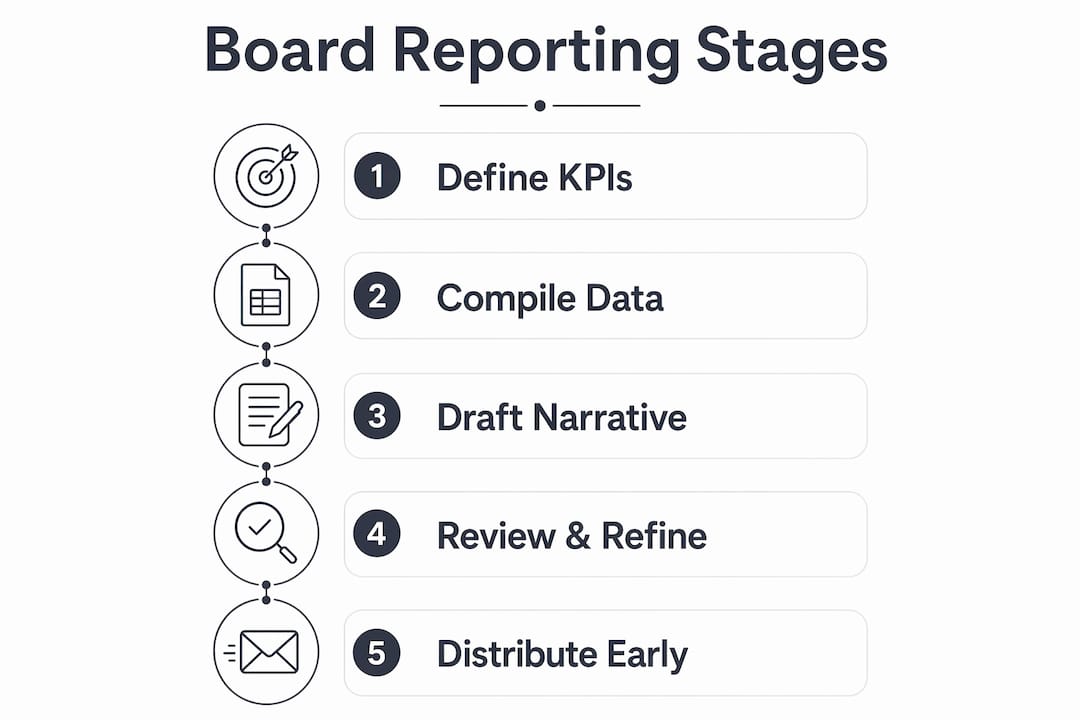
Start with an executive summary of no more than one page. AI tools can generate a first draft from your financial data and KPI outputs, but the CEO must rewrite the narrative layer. The summary should answer three questions: where are we, what changed, and what do we need from the board today.
The body of the report follows a fixed sequence:
- Financial summary (revenue, burn rate, runway, gross margin)
- Growth metrics (monthly active users, customer acquisition cost, net revenue retention)
- Sales pipeline (current quarter forecast, pipeline coverage ratio)
- Risk register (top three operational or market risks with mitigation status)
- Strategic asks (specific decisions or approvals required from the board)
Each KPI entry should include a one-line narrative answering the “So what?” question. A revenue figure without context is noise. “Revenue grew 18% month-on-month, driven by enterprise contract closures in the financial services vertical” is a signal. Directors read dozens of board packs. The ones that give them context get more engaged responses.
Pro Tip: Draft the strategic asks section first, before writing any other part of the report. Working backwards from what you need the board to decide forces clarity on which data points actually matter.

The tech startup governance guide principle here is simple: every slide should either inform a decision or support one. If a slide does neither, cut it.
What are the best practices for distributing board reports?
Distribution timing is not a courtesy. It is a governance requirement. Standard practice for venture-backed startups is to share board materials 48, 72 hours before meetings. This window protects meeting time for strategic discussion rather than first-time reading.
Sending materials the morning of the meeting is the single most common mistake founders make. Directors arrive unprepared, the first thirty minutes of the meeting become a reading session, and the strategic agenda never gets addressed. The 48, 72 hour rule is non-negotiable for effective reporting for startups at any stage.
The delivery format matters too. Secure board portals, rather than email attachments, provide version control, access logging, and document expiry. Tools such as Diligent Boards and BoardEffect offer these features at enterprise level. For early-stage startups, a shared secure folder with access controls and a clear naming convention achieves the same governance standard at lower cost.
| Meeting Format | Effectiveness | Best Used When |
|---|---|---|
| Pre-read plus live discussion | High | Materials distributed 48, 72 hours in advance |
| Slide walkthrough by CEO | Low | Rarely appropriate; signals poor preparation |
| Structured agenda with timed items | High | Board has reviewed pack and arrives with questions |
| Ad hoc update call | Medium | Between formal cycles for urgent decisions |
Directors do not want CEOs to read slides aloud. Experienced directors immediately notice when this happens and it reduces their confidence in the leadership team. The meeting should open with a brief verbal framing of the strategic asks, then move directly into discussion.
Pro Tip: Send a one-paragraph pre-read note with the board pack. State the two or three items you most need the board to engage on. This primes directors to arrive with relevant questions and cuts the time spent orienting the room.
How can founders avoid the most costly board reporting mistakes?
The most common mistake in startup board reporting is volume. Founders who are uncertain about what matters include everything. A 60-slide deck with 40 charts signals data anxiety, not analytical rigour. Board meetings are calibration sessions, not performance reviews. Their purpose is to resolve decisions and clarify priorities, not to demonstrate how much work the team has done.
Reporting forces founders to assess business health objectively, and that discipline accelerates problem resolution. Explaining a metric drop to the board produces faster root cause investigation than private internal review. This is governance working as intended.
The cadence of reporting must match company stage. Monthly reporting suits early-stage startups from seed to Series A, while quarterly reporting suits more mature companies. Frequency should reflect management needs, not what the technology makes easy to automate.
Key discipline points for sustaining governance quality over time:
- Document every board decision formally, including the rationale, within 48 hours of the meeting
- Maintain a clean cap table and keep equity approvals current; governance habits such as these are key to financing readiness
- Review KPI selection every six months and retire metrics that no longer reflect strategic priorities
- Solicit written feedback from directors after each cycle and adjust the pack structure accordingly
- Reserve an independent board seat from seed stage onward, even if initially vacant, to structurally improve accountability
AI tools are powerful for aggregating data and generating first drafts. AI lacks strategic understanding, however, so final narratives must be crafted by humans. The CEO who lets an AI write the strategic asks section without review is delegating judgement to a tool that has none.
For founders preparing for due diligence, consistent board reporting history is a material asset. Investors and acquirers review board minutes and packs as part of their process. A clean, consistent record signals a well-run company. A patchy or absent record raises questions that slow or kill transactions. You can read more about how buyers assess governance discipline in this guide on business valuation factors.
Key takeaways
Effective startup board reporting requires consistent structure, strategic narrative, and disciplined distribution to convert governance into a competitive advantage.
| Point | Details |
|---|---|
| Distribute materials early | Share board packs 48, 72 hours before meetings to protect discussion time. |
| Lead with decision points | Frame every report around what the board needs to decide, not what happened. |
| Limit KPIs to what matters | Five to seven consistent metrics outperform a dashboard of thirty changing ones. |
| Match cadence to stage | Monthly reporting suits seed to Series A; quarterly suits later-stage companies. |
| Preserve human judgement | Use AI to draft and aggregate, but let the CEO own every strategic narrative. |
Board reporting is a leadership test, not a compliance exercise
Three exits have taught me one consistent lesson: the quality of a founder’s board reporting is a direct proxy for the quality of their strategic thinking. Founders who produce clear, concise, decision-oriented packs are the same founders who know their numbers, understand their risks, and can articulate a path forward under pressure.
The governance discipline that board reporting compels is not a distraction from building the company. It is the mechanism by which you stay honest with yourself about whether the company is actually working. I have seen founders avoid improving their reporting because they were afraid of what the data would reveal. That avoidance is always more expensive than the conversation.
On AI: I use agentic tools to automate data aggregation and first-draft assembly for clients. The time saving is real. But I have never seen an AI tool that understands why a metric matters in the context of a specific company’s strategy. That interpretation is the CEO’s job. Founders who outsource that layer to AI are not saving time. They are creating a credibility gap with their board.
Independent directors are underused by early-stage founders. The instinct is to keep the board small and controllable. The reality is that a well-chosen independent director, with no equity agenda, asks the questions that investor directors and founders both avoid. That friction is valuable. Seek it out rather than defer it.
, Hayat
How Meethayat supports your board reporting and governance
Meethayat works with tech startup founders who need more than a template. As a three-times exited CFO and AI agent operator, Hayat Amin builds and operates the agentic infrastructure that automates data aggregation, KPI tracking, and board pack assembly for SMEs. The result is a reporting process that takes minutes to run rather than days to prepare.

For founders who need strategic financial leadership alongside the operational layer, fractional CFO services cover board pack preparation, financial narrative, and investor-ready reporting. If you are preparing for a fundraise, a due diligence process, or simply want your next board meeting to be the most productive one you have run, Meethayat is the place to start.
FAQ
What should a startup board pack include?
A board pack should include a financial summary, KPI dashboard, sales pipeline overview, risk register, and clearly stated asks for the board. Consistent structure across cycles enables trend tracking and informed decision-making.
How far in advance should board materials be sent?
Standard practice is to distribute board materials 48, 72 hours before the meeting. This gives directors time to review the pack and arrive prepared for strategic discussion.
How often should a tech startup report to its board?
Monthly reporting suits seed to Series A stage startups, while quarterly reporting suits more mature companies. Cadence should reflect management needs and company stage, not reporting tool capability.
Should founders use AI to write board reports?
AI tools are effective for data aggregation and first-draft assembly, cutting preparation from a full day to roughly thirty minutes of editing. Final narratives and strategic asks must be written by the CEO to preserve credibility and strategic accuracy.
What is the most common board reporting mistake founders make?
Overloading the board pack with data is the most frequent error. A focused pack of 15, 20 slides built around decision points outperforms a 60-slide data catalogue every time.