AI tools reduce operational costs: 2026 SME guide


AI tools reduce operational costs by automating routine workflows, cutting labour overheads, and improving decision speed across every function an SME runs. SMEs using AI for administrative workflows report 20, 30% reductions in administrative overhead. That figure is not a ceiling. When AI is applied across customer support, marketing, and inventory management, the artificial intelligence cost savings compound quickly. The critical condition is this: AI must be deployed on redesigned workflows, not broken ones.
Which operational areas benefit most from AI tools reducing costs?
The AI impact on business expenses is clearest in five functional areas. Each delivers measurable returns when the right tool type is matched to the right task.
Administrative workflows
Invoice processing, scheduling, and data entry are the highest-volume, lowest-value tasks in most SMEs. Automating these with AI agents or robotic process automation (RPA) tools cuts the time staff spend on manual input. Admin automation consistently delivers 20, 30% lower overhead costs. That saving funds the next phase of AI deployment.

Customer support
AI chatbots and autonomous agents handle routine queries, ticket routing, and first-line resolution without human intervention. Autonomous AI agents in contact centres reduce support staff hours by 25, 40%. That reduction lowers payroll costs without degrading service quality, provided the agent is well-configured and escalation paths are clear. For a deeper look at how this works in practice, the role of AI in customer service is worth reviewing.
Marketing and customer acquisition
AI tools for content generation, audience segmentation, and campaign optimisation reduce the cost per lead. Fewer wasted impressions and better targeting mean the same budget produces more qualified pipeline.
Inventory and supply chain
AI forecasting tools reduce overstock and stockout events by predicting demand more accurately than manual methods. This directly cuts warehousing costs and write-offs.
Energy and maintenance
Predictive maintenance tools use sensor data to flag equipment issues before failure. AI-driven tools across marketing, inventory, and energy deliver 10, 30% cost reductions in each area. Avoiding unplanned downtime is often worth more than the direct energy saving.
What do you need to prepare before deploying AI for cost reduction?
Most AI deployments underperform because the groundwork is missing. Preparation is not a formality. It determines whether your investment returns anything at all.
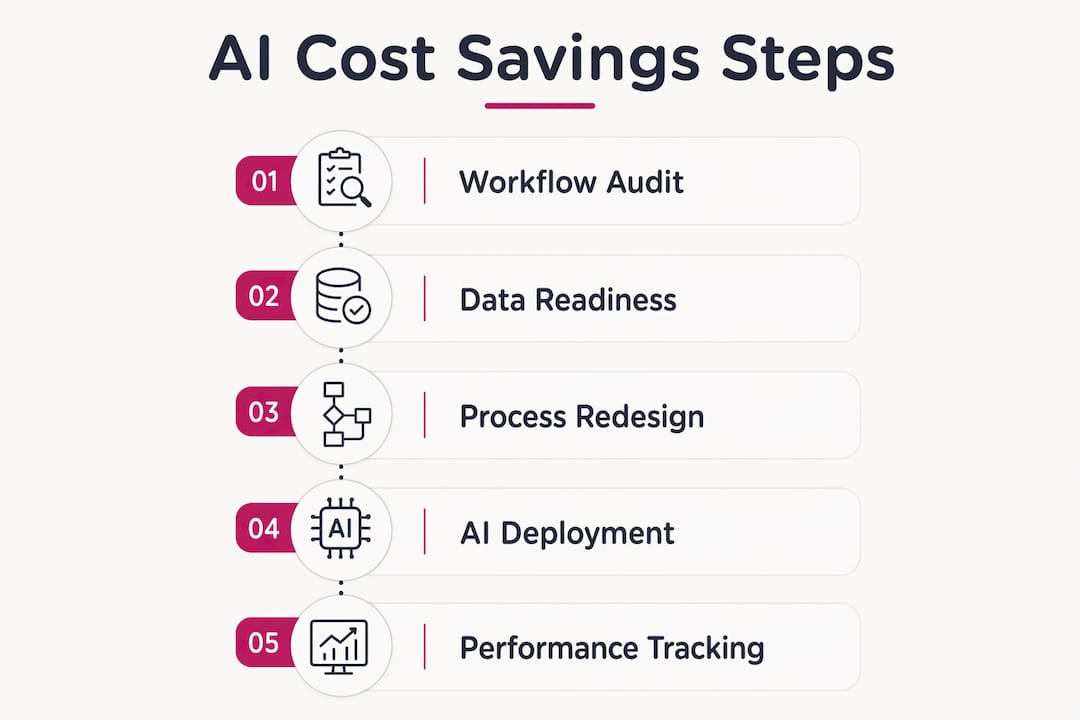
The first requirement is workflow audit. Every process you plan to automate must be mapped and assessed for efficiency before a single tool is deployed. Automating broken workflows exacerbates costs rather than cutting them. This is called workflow debt, and it is the single most common reason AI projects fail to reach their projected savings.
The second requirement is data readiness. AI tools need clean, accessible, structured data to function correctly. If your invoices live in three different formats across two systems, an AI agent will produce unreliable outputs until the data infrastructure is sorted.
The third requirement is a realistic budget that accounts for hidden costs. Per-token AI costs have fallen 98% since 2022, but enterprise AI bills rose 320% by mid-2026 due to increased usage and agentic system complexity. Token consumption at scale adds up fast. Build a dedicated AI compute budget and metre costs per workflow from day one.
The checklist before you start:
- Map every target process and identify inefficiencies
- Consolidate and clean the data those processes rely on
- Define success metrics at enterprise level, not just hours saved
- Allocate a ring-fenced AI compute budget
- Identify one or two high-volume, repetitive tasks for your first deployment
Pro Tip: Start with the task that has the highest volume and the clearest output. Invoice ingestion or meeting scheduling are ideal first deployments. They produce fast, measurable results and generate the budget and confidence to fund broader automation.
How to implement AI tools effectively: a step-by-step process
A phased approach is the most reliable way to reduce costs with AI technology without overextending your budget or your team.
-
Identify target processes. List every repetitive, manual, data-bound task in your business. Rank them by volume and cost. The top three are your starting point.
-
Select the right tool type. Match the tool to the task. Scheduling assistants handle calendar and booking workflows. Autonomous agents handle multi-step processes like invoice ingestion, approval routing, and supplier communication. RPA bots handle structured data extraction. Avoid over-engineering simple tasks with complex agentic systems. For guidance on setting up an AI scheduling assistant, the implementation steps are well-documented.
-
Run a proof of concept. Deploy on one process, in one team, for four to six weeks. Measure output quality, time saved, and error rate. Do not scale until the proof of concept is validated.
-
Train your staff. AI tools change how people work, not just what they do. Staff need to understand the new workflow, when to intervene, and how to escalate edge cases. Change management is not optional.
-
Define enterprise-level KPIs. Measuring AI impact at enterprise level means tracking better decisions and faster response times, not just hours saved. Build a CEO-level dashboard that shows AI’s contribution to revenue, cost, and speed outcomes.
-
Expand based on evidence. Leading companies fund AI cost transformations by using early automation wins to create budget and momentum for broader workflow reinvention. Let the first deployment pay for the second.
| Phase | Action | Success signal |
|---|---|---|
| 1. Audit | Map and rank target processes | Workflow debt identified and quantified |
| 2. Proof of concept | Deploy on one high-volume task | Output quality and time saving validated |
| 3. Scale | Expand to adjacent workflows | Cost savings fund next deployment |
| 4. Measure | Track enterprise-level KPIs | CEO dashboard shows business impact |
How to avoid the mistakes that undermine AI cost savings
40% of companies targeting AI cost savings of 11, 20% landed below 10% because they automated broken processes and used narrow success metrics. That is not a technology failure. It is a planning failure.
The most common mistakes are:
- Automating before redesigning. Layering AI onto an inefficient process makes the inefficiency faster, not cheaper. Redesign first.
- Measuring only at programme level. Tracking hours saved per tool misses the enterprise impact. If AI speeds up invoice approval but the CFO still makes the same decisions at the same pace, the value gap remains open.
- Ignoring token economics. Rightsizing AI model complexity to task and instrumenting workflow costs can yield up to 90% reduction in AI spend. Using a large language model for a task that a smaller, cheaper model handles equally well is a budget leak.
- Underestimating change management. Staff who do not trust or understand the AI tool will work around it. That creates parallel processes and higher costs, not lower ones.
“AI investments underperform when success is tracked only at programme level instead of enterprise outcomes, creating an ‘AI value gap’.”
Pro Tip: Instrument every AI workflow from the start. Track token consumption, error rates, and escalation frequency per process. This data tells you where to cut costs within your AI deployment itself, not just the costs the AI is meant to reduce.
For a broader view of why SMEs adopt AI and what actually drives results, the real drivers behind SME AI adoption in 2026 is a useful reference.
Key takeaways
AI tools deliver the strongest operational cost reductions when deployed on redesigned workflows, measured at enterprise level, and scaled from early wins that fund broader automation.
| Point | Details |
|---|---|
| Redesign before automating | Eliminate workflow debt before deploying AI to avoid amplifying existing inefficiencies. |
| Start with high-volume tasks | Invoice processing and scheduling deliver fast, measurable savings that fund the next phase. |
| Track enterprise-level KPIs | Measure decisions, speed, and revenue impact, not just hours saved per tool. |
| Control token costs | Instrument AI spend per workflow and match model complexity to task to avoid budget overruns. |
| Scale from proven wins | Use early deployment savings to fund broader workflow reinvention, as BCG research confirms. |
What three exits taught me about AI and operational costs
I have sat in the CFO chair through three exits, and the pattern I see in SME AI adoption is consistent. Business owners buy the tool before they fix the process. They measure the wrong thing. Then they conclude AI did not work.
The uncomfortable truth is that operational efficiency with AI tools is a finance and operations problem first, and a technology problem second. The AI is the easy part. Redesigning the workflow, getting the data clean, and building a measurement framework that connects tool output to business outcomes. That is where most SMEs stall.
What I have found actually works is treating the first AI deployment like a financial instrument. Define the return you expect, the cost you will incur, and the timeline for payback before you sign anything. If you cannot articulate those three numbers, you are not ready to deploy.
The other thing most articles miss is the compounding effect. The first automation saves you 20 hours a month. That is not the point. The point is that it funds the second deployment, which funds the third. Within 18 months, you have an agentic stack running across finance, support, and go-to-market functions. That is where the benefits of AI agents for SME operations become genuinely transformational in financial terms.
The SMEs that close the AI value gap are not the ones with the biggest budgets. They are the ones that measure at CEO level, redesign before they automate, and treat each deployment as a funded investment with a defined return.
, Hayat
How Meethayat helps SMEs deploy AI that actually cuts costs
Knowing the framework is one thing. Building and operating the agents is another.

Meethayat’s AI Agent Operator service designs, deploys, and operates autonomous AI agents directly inside SME finance, legal, and go-to-market workflows. This is not consultancy. It is hands-on agent operation, with Hayat building the agentic stack and running it on your behalf. The service is built for SMEs that want measurable cost reductions, not slide decks. If you are ready to move from planning to deployment, the AI Agent Operator vs AI Consultant guide explains exactly what the engagement looks like and what returns to expect.
FAQ
How much can AI tools reduce operational costs for SMEs?
SMEs typically see 20, 30% reductions in administrative overhead and 25, 40% reductions in customer support hours after deploying AI agents. Savings across marketing, inventory, and energy functions range from 10, 30% per area.
What is the biggest reason AI cost-saving projects fail?
The most common cause is automating inefficient processes without redesigning them first. Research shows 40% of companies targeting 11, 20% savings landed below 10% due to workflow debt and narrow success metrics.
How do I measure the ROI of AI tools in my business?
Track enterprise-level outcomes: decision speed, revenue impact, and cost per transaction. Measuring only hours saved at programme level creates an AI value gap where real business returns remain invisible.
What are the hidden costs of deploying AI tools?
Token consumption is the primary hidden cost. Despite per-token prices falling 98% since 2022, enterprise AI bills rose 320% by mid-2026 due to higher usage volumes and agentic system complexity. Budget for compute costs from day one.
Where should an SME start with AI to get the fastest cost savings?
Start with the highest-volume, most repetitive task in your business, typically invoice processing or scheduling. These deliver fast, measurable results and generate the budget to fund broader AI deployment.